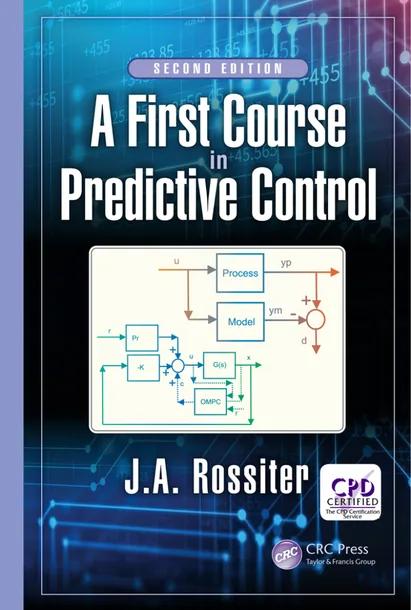
A First Course in Predictive Control
by J.A. Rossiter
2nd Edition
Publisher: CRC Press
Book Details
| Print ISBN | 9781032339160 |
| eText ISBN | 9781351597159 |
| Publisher | CRC Press |
| Publishing Year | 2018 |
| Edition | 2nd Edition |
| Language | English |
| Pages | 428 |
A First Course in Predictive Control, 2nd Edition, provides researchers with a foundation in model predictive control concepts and algorithms before they move into applications or advanced research topics. The textbook introduces essential theoretical principles and computational tools for designing control systems.
Coverage addresses prediction modeling, predictive functional control, generalized predictive control formulations, and dual mode control architectures. The text also examines horizon tuning strategies and constraint handling through optimization methods.
For the 2018 second edition, the text expanded its depth and breadth by adding substantially more numerical illustrations and editable MATLAB code. Embedded sample problems and in-text questions provide practice with numerical simulations.
Table of Contents
Chapter 1: Introduction and the industrial need for predictive control
- • 1.1 Guidance for the lecturer/reader
- • 1.2 Motivation and introduction
- • 1.3 Classical control assumptions
- • 1.4 Examples of systems hard to control effectively with classical methods
- • 1.5 The potential value of prediction
- • 1.6 The main components of MPC
- • 1.7 MPC philosophy in summary
- • 1.8 MATLAB files from this chapter
- • 1.9 Reminder of book organization
Chapter 2: Prediction in model predictive control
- • 2.1 Introduction
- • 2.2 Guidance for the lecturer/reader
- • 2.3 General format of prediction modelling
- • 2.4 Prediction with state space models
- • 2.5 Prediction with transfer function models – matrix methods
- • 2.6 Using recursion to find prediction matrices for CARIMA models
- • 2.7 Prediction with independent models
- • 2.8 Prediction with FIR models
- • 2.9 Closed-loop prediction
- • 2.10 Summary of Chapter
- • 2.11 Summary of MATLAB code supporting prediction
Chapter 3: Predictive functional control
- • 3.1 Introduction
- • 3.2 Guidance for the lecturer/reader
- • 3.3 Basic concepts in PFC
- • 3.4 PFC with first order models
- • 3.5 PFC with higher order models
- • 3.6 Stability results for PFC
- • 3.7 PFC with ramp targets
- • 3.8 Chapter summary
- • 3.9 MATLAB code available for readers
Chapter 4: Predictive control – the basic algorithm
- • 4.1 Introduction
- • 4.2 Guidance for the lecturer/reader
- • 4.3 Summary of main results
- • 4.4 The GPC performance index
- • 4.5 GPC algorithm formulation for transfer function models
- • 4.6 GPC formulation for finite impulse response models and Dynamic Matrix Control
- • 4.7 Formulation of GPC with an independent prediction model
- • 4.8 GPC with a state space model
- • 4.9 Chapter summary and general comments on stability and tuning of GPC
- • 4.10 Summary of MATLAB code supporting GPC simulation
Chapter 5: Tuning GPC: good and bad choices of the horizons
- • 5.1 Introduction
- • 5.2 Guidance for the lecturer/reader
- • 5.3 Poor choices lead to poor behavior
- • 5.4 Concepts of well posed and ill posed optimizations
- • 5.5 Illustrative simulations to show impact of different parameter choices on GPC behavior
- • 5.6 Systematic guidance for "tuning" GPC
- • 5.7 MIMO examples
- • 5.8 Dealing with open-loop unstable systems
- • 5.9 Chapter summary: guidelines for tuning GPC
- • 5.10 Useful MATLAB code
Chapter 6: Dual mode MPC (OMPC and SOMPC) and stability guarantees
- • 6.1 Introduction
- • 6.2 Guidance for the lecturer
- • 6.3 Foundation of a well posed MPC algorithm
- • 6.4 Dual mode MPC – an overview
- • 6.5 Algebraic derivations for dual mode MPC
- • 6.6 Closed-loop paradigm implementations of OMPC
- • 6.7 Numerical illustrations of OMPC and SOMPC
- • 6.8 Motivation for SOMPC: Different choices for mode 2 of dual mode control
- • 6.9 Chapter summary
- • 6.10 MATLAB files in support of this chapter
Chapter 7: Constraint handling in GPC/finite horizon predictive control
- • 7.1 Introduction
- • 7.2 Guidance for the lecturer
- • 7.3 Introduction
- • 7.4 Description of typical constraints and linking to GPC
- • 7.5 Constrained GPC
- • 7.6 Understanding a quadratic programming (QP) optimization
- • 7.7 Chapter summary
- • 7.8 MATLAB code supporting constrained MPC simulation
Chapter 8: Constraint handling in dual mode predictive control
- • 8.1 Introduction
- • 8.2 Guidance for the lecturer/reader and introduction
- • 8.3 Background and assumptions
- • 8.4 Description of simple or finite horizon constraint handling approach for dual mode algorithms
- • 8.5 Concepts of redundancy, recursive feasibility, admissible sets and autonomous models
- • 8.6 The OMPC/SOMPC algorithm using an MCAS to represent constraint handling
- • 8.7 Numerical examples of the SOMPC/OMPMC approach with constraint handling
- • 8.8 Discussion on the impact of cost function and algorithm selection on feasibility
- • 8.9 Chapter summary
- • 8.10 Summary of MATLAB code supporting constrained OMPC simulation
Chapter 9: Conclusions
- • 9.1 Introduction
- • 9.2 Design choices
- • 9.3 Summary
Chapter Appendix A: Tutorial and exam questions and case studies
- • A.1 Typical exam and tutorial questions with minimal computation
- • A.2 Generic questions
- • A.3 Case study based questions for use with assignments
Chapter Appendix B: Further reading
- • B.1 Introduction
- • B.2 Guidance for the lecturer/reader
- • B.3 Simple variations on the basic algorithm
- • B.4 Parametric approaches to solving quadratic programming
- • B.5 Prediction mismatch and the link to feedforward design in MPC
- • B.6 Robust MPC: ensuring feasibility in the presence of uncertainty
- • B.7 Invariant sets and predictive control
- • B.8 Conclusions
Chapter Appendix C: Notation, models and useful background
- • C.1 Guidance for the lecturer/reader
- • C.2 Notation for linear models
- • C.3 Minimization of functions of many variables
- • C.4 Common notation
Customer Reviews
0.0
0 reviews
No reviews yet. Be the first to review this book!
Write a Review
Reviewed by GradeFocus Editorial Team
▶Research Sources (1)
Related Books
Architecting Resilient Systems
Scott Jackson
Distributed Time-Sensitive Systems
Tanupriya Choudhury
Control Systems Engineering (CSE) Study Guide
International Society of Automation (ISA)

Digital Twins in Action
Greg Biegel
Systems Engineering Principles and Practice
Alexander Kossiakoff
Reliability Engineering
Mangey Ram