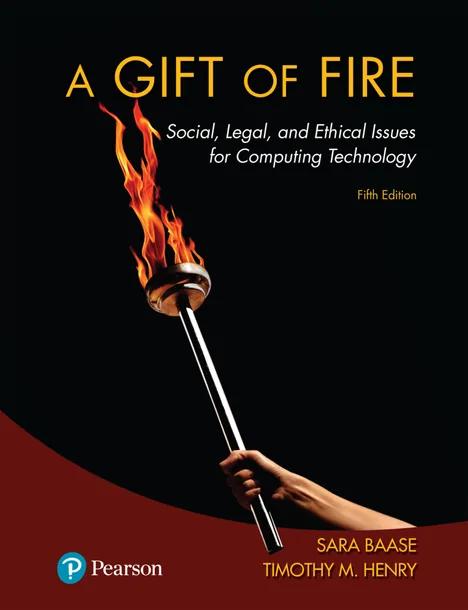
A Gift of Fire
Social, Legal, and Ethical Issues for Computing Technology
by Sara Baase, Timothy M. Henry
5th Edition
Publisher: Pearson
Book Details
| Print ISBN | 9780134615271 |
| eText ISBN | 9780134615394 |
| Publisher | Pearson |
| Publishing Year | 2018 |
| Edition | 5th Edition |
| Language | English |
A Gift of Fire: Social, Legal, and Ethical Issues for Computing Technology, 5th Edition, is a textbook that addresses the ethical, legal, and social issues surrounding computing systems. It explores the philosophical, political, constitutional, and economic implications of computer technology across contemporary society. The work provides a framework for analyzing how digital systems transform human institutions and individual rights.
The content offers structured analysis of how technical developments alter established legal principles and political governance. Readers evaluate complex questions surrounding software systems, public policies, and the evolving role of digital tools. Through systematic exploration, the material supports student practice in assessing technological advancements and their broader societal consequences.
To reflect ongoing technological change, this fifth edition includes updated material covering new topics and real-world examples, with specific attention given to drones and autonomous cars. The textbook is designed to support instruction in Computer Ethics and Computers and Society courses.
Table of Contents
Chapter 1: Unwrapping the Gift
- • 1.1 The Pace of Change
- • 1.2 Change and Unexpected Developments
- • 1.2.1 Self-Driving Vehicles
- • 1.2.2 Connections: Mobile Phones, Social Networking, and the Internet of Things
- • 1.2.3 E-commerce and Free Stuff
- • 1.2.4 Artificial Intelligence, Robotics, Sensors, and Motion
- • 1.2.5 Tools for Disabled People
- • 1.3 Themes
- • 1.4 Ethics
- • 1.4.1 What is Ethics, Anyway?
- • 1.4.2 A Variety of Ethical Views
- • 1.4.3 Some Important Distinctions
Chapter 2: Privacy
- • 2.1 Privacy Risks and Principles
- • 2.1.1 What Is Privacy?
- • 2.1.2 New Technology, New Risks
- • 2.1.3 Terminology and Principles for Managing Personal Data
- • 2.2 The Business and Social Sectors
- • 2.2.1 Marketing and Personalization
- • 2.2.2 Our Social and Personal Activity
- • 2.2.3 Location Tracking
- • 2.2.4 A Right to Be Forgotten
- • 2.3 The Fourth Amendment and Changing Technology
- • 2.3.1 The Fourth Amendment
- • 2.3.2 Background, Law, and Court Decisions
- • 2.3.3 Applying the Fourth Amendment in New Areas
- • 2.4 Government Systems
- • 2.4.1 Video Surveillance and Face Recognition
- • 2.4.2 Databases
- • 2.4.3 Public Records: Access versus Privacy
- • 2.4.4 National ID Systems
- • 2.4.5 The NSA and Secret Intelligence Gathering
- • 2.5 Protecting Privacy: Technology and Markets
- • 2.5.1 Developing Privacy Tools
- • 2.5.2 Encryption
- • 2.5.3 Blocking Ads
- • 2.5.4 Policies for Protecting Personal Data
- • 2.6 Protecting Privacy: Theory, Rights, and Laws
- • 2.6.1 A Right to Privacy
- • 2.6.2 Law and Regulation
- • 2.6.3 Contrasting Viewpoints
- • 2.7 Privacy Regulations in the European Union
Chapter 3: Freedom of Speech
- • 3.1 The First Amendment and Communications Paradigms
- • 3.1.1 Free Speech Principles
- • 3.1.2 Regulating Communications Media
- • 3.2 Controlling Speech in Cyberspace
- • 3.2.1 What Is O ensive Speech? What Is Illegal?
- • 3.2.2 Censorship Laws and Alternatives
- • 3.2.3 Child Pornography and Sexting
- • 3.2.4 Spam
- • 3.2.5 Challenging Old Regulatory Structures and Special Interests
- • 3.3 Decisions about Legal but Objectionable Content
- • 3.4 Leaking Sensitive Material
- • 3.5 Anonymity
- • 3.6 The Global Net: Censorship and Political Freedom
- • 3.6.1 Tools for Communication, Tools for Oppression
- • 3.6.2 Aiding Foreign Censors and Repressive Regimes
- • 3.6.3 Shutting Down Communications in Free Countries
- • 3.7 Net Neutrality: Regulations or the Market?
Chapter 4: Intellectual Property
- • 4.1 Principles and Laws
- • 4.1.1 What Is Intellectual Property?
- • 4.1.2 Challenges of New Technologies
- • 4.1.3 A Bit of History
- • 4.1.4 The Fair Use Doctrine
- • 4.1.5 Ethical Arguments About Copying
- • 4.2 Signi cant Fair Use Cases and Precedents
- • 4.2.1 Sony v. Universal City Studios (1984)
- • 4.2.2 Reverse Engineering: Game Machines
- • 4.2.3 Sharing Music: The Napster and Grokster Cases
- • 4.2.4 User and Programmer Interfaces
- • 4.3 Responses to Copyright Infringement
- • 4.3.1 Defensive and Aggressive Responses from the Content Industries
- • 4.3.2 The Digital Millennium Copyright Act: Anti Circumvention
- • 4.3.3 The Digital Millennium Copyright Act: Safe Harbor
- • 4.3.4 Evolving Business Models
- • 4.4 Search Engines and Online Libraries
- • 4.5 Free Software
- • 4.5.1 What Is Free Software?
- • 4.5.2 Should All Software Be Free?
- • 4.6 Patents for Software Inventions
- • 4.6.1 Patent Trends, Confusion, and Controversies
- • 4.6.2 To Patent or Not?
Chapter 5: Crime and Security
- • 5.1 Introduction
- • 5.2 What is Hacking?
- • 5.2.1 The Evolution of Hacking
- • 5.2.2 Hacker Tools
- • 5.2.3 Is “Harmless” Hacking Harmless?
- • 5.3 Some Speci c Applications of Hacking
- • 5.3.1 Identity Theft
- • 5.3.2 Case Study: The Target Breach
- • 5.3.3 Hacktivism, or Political Hacking
- • 5.3.4 Hacking by Governments
- • 5.4 Why Is the Digital World So Vulnerable?
- • 5.4.1 Vulnerability of Operating Systems and the Internet
- • 5.4.2 Human Nature, Markets, and Vulnerability of the Internet of Things
- • 5.5 Security
- • 5.5.1 Tools to Help Protect the Digital World
- • 5.5.2 People Who Can Help Protect the Digital World
- • 5.5.3 Hacking to Improve Security
- • 5.5.4 Backdoors for Law Enforcement
- • 5.6 The Law
- • 5.6.1 The Computer Fraud and Abuse Act
- • 5.6.2 Criminalize Virus Writing and Hacker Tools?
- • 5.6.3 Penalties for Young Hackers
- • 5.7 Whose Laws Rule the Web?
- • 5.7.1 A Crime in One Country but Not Another
- • 5.7.2 Libel and Freedom of Speech
- • 5.7.3 Culture, Law, and Ethics
- • 5.7.4 Potential Solutions
Chapter 6: Work
- • 6.1 Fears and Questions
- • 6.2 Impacts on Employment
- • 6.2.1 Job Destruction and Creation
- • 6.2.2 Changing Skills and Skill Levels
- • 6.2.3 Are We Earning Less and Working More?
- • 6.3 Changing Work Patterns: From Telecommuting to Gigs
- • 6.3.1 Telecommuting
- • 6.3.2 The Sharing Economy, On-Demand Services, and GIG Work
- • 6.4 A Global Workforce
- • 6.5 Employee Communication and Monitoring by Employers
- • 6.5.1 Social Media Content
- • 6.5.2 Separating–or Merging–Work and Personal Systems
- • 6.5.3 Monitoring Employer Systems and Tracking Employees
Chapter 7: Evaluating and Controlling Technology
- • 7.1 Evaluating Information
- • 7.1.1 The Need for Responsible Judgment
- • 7.1.2 Computer Models
- • 7.2 Neo-Luddite Views of Computers, Technology, and Quality of Life
- • 7.2.1 Criticisms of Computing Technologies
- • 7.2.2 Views of Economics, Nature, and Human Needs
- • 7.3 Digital Divides
- • 7.3.1 Trends in Access in the United States
- • 7.3.2 Reaching the Next Billion Users
- • 7.4 Control of Our Devices and Data
- • 7.4.1 Remote Deletion of Software and Data
- • 7.4.2 Automatic Software Upgrades
- • 7.5 Making Decisions About Technology
- • 7.5.1 Questions
- • 7.5.2 The Di culty of Prediction
- • 7.5.3 Intelligent Machines and Super-intelligent Humans–Or the End of the Human Race?
- • 7.5.4 A Few Observations
Chapter 8: Errors, Failures, and Risks
- • 8.1 Failures and Errors in Computer Systems
- • 8.1.1 An Overview
- • 8.1.2 Problems For Individuals
- • 8.1.3 System Failures
- • 8.1.4 Example: Stalled Airports at Denver, Hong Kong, and Malaysia
- • 8.1.5 Example: HealthCare.gov
- • 8.1.6 What Goes Wrong?
- • 8.1.7 Problems For Individuals
- • 8.2 Case Study:The Therac-25
- • 8.2.1 Therac-25 Radiation Overdoses
- • 8.2.2 Software and Design Problems
- • 8.2.3 Why So Many Incidents?
- • 8.2.4 Observations and Perspective
- • 8.3 Increasing Reliability and Safety
- • 8.3.1 Professional Techniques
- • 8.3.2 Trust the Human or the Computer System?
- • 8.3.3 Law, Regulation, and Markets
- • 8.4 Dependence, Risk, and Progress
- • 8.4.1 Are We Too Dependent on Computers?
- • 8.4.2 Risk and Progress
Chapter 9: Professional Ethics and Responsibilities
- • 9.1 What Is “Professional Ethics”?
- • 9.2 Ethical Guidelines for Computer Professionals
- • 9.2.1 Special Aspects of Professional Ethics
- • 9.2.2 Professional Codes of Ethics
- • 9.2.3 Guidelines and Professional Responsibilities
- • 9.3 Scenarios
- • 9.3.1 Introduction and Methodology
- • 9.3.2 Protecting Personal Data
- • 9.3.3 Designing an Application with Targeted Ads
- • 9.3.4 Webcams in School Laptops
- • 9.3.5 Publishing Security Vulnerabilities
- • 9.3.6 Specifications
- • 9.3.7 Schedule Pressures
- • 9.3.8 Software License Violation
- • 9.3.9 Going Public with Safety Concerns
- • 9.3.10 Release of Personal Information
- • 9.3.11 Conflict of Interest
- • 9.3.12 Kickbacks and Disclosure
- • 9.3.13 A Test Plan
- • 9.3.14 Artificial Intelligence and Sentencing Criminals
- • 9.3.15 A Gracious Host
Customer Reviews
0.0
0 reviews
No reviews yet. Be the first to review this book!
Write a Review
Reviewed by GradeFocus Editorial Team
▶Research Sources (12)
- Gift of Fire, A by: Sara Baase - 9780134615394
- ISBN 9780134615394 - A Gift of Fire 5th
- A Gift of Fire: Social, Legal, and Ethical Issues for Computing Technology
- A Gift of Fire: Social, Legal, and Ethical Issues for Computing Technology
- Gift of Fire, A: Social, Legal, and Ethical Issues for Computing Technology
- A Gift of Fire - Social, Legal, and Ethical Issues for Computing Technology
- Hello, I would love a link to a pdf for "Gift of Fire, A: Social, Legal, and Ethical ...
- A Gift of Fire - Social, Legal, and Ethical Issues for Computing Technology
- A Gift of Fire: Computing Ethics, Social & Legal Issues
- Gift of Fire, A: Social, Legal, and Ethical Issues for Computing Technology
- A Gift of Fire by Sara Baase Ch. 1-9 Final Flashcards - Ethics
- A Gift of Fire: Social, Legal, and Ethical Issues for Computing Technology