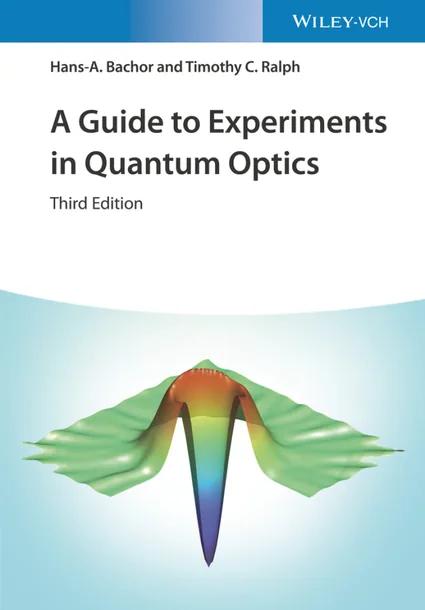
A Guide to Experiments in Quantum Optics
by Hans-A. Bachor, Timothy C. Ralph
3rd Edition
Publisher: Wiley-VCH
Book Details
| Print ISBN | 9783527411931 |
| eText ISBN | 9783527683932 |
| Publisher | Wiley-VCH |
| Publishing Year | 2019 |
| Edition | 3rd Edition |
| Language | English |
| Pages | 592 |
A Guide to Experiments in Quantum Optics, 3rd Edition, is an expanded textbook covering foundational concepts, procedures, and developments in optical experiments. It bridges theoretical principles with practical experimental methods across modern physics.
The text focuses on three primary goals: metrology, communications, and quantum logic. Core coverage addresses classical and quantum models of light, basic optical components, lasers, amplifiers, and quantum noise measurements, alongside investigations of squeezed light and fundamental tests of quantum mechanics.
Featuring end-of-chapter summaries and full problem sets, the book emphasizes single photon technology and hybrid detection methods. It is intended for upper-level and graduate students in physics and engineering science, as well as practicing professionals.
Table of Contents
Chapter 1: Introduction
- • 1.1 Optics in Modern Life
- • 1.2 The Origin and Progress of Quantum Optics
- • 1.3 Motivation Through Simple and Direct Teaching Experiments
- • 1.4 Consequences of Photon Correlations
- • 1.5 How to Use This Guide
- • References
Chapter 2: Classical Models of Light
- • 2.1 Classical Waves
- • 2.2 Optical Modes and Degrees of Freedom
- • 2.3 Statistical Properties of Classical Light
- • 2.4 An Example: Light from a Chaotic Source as the Idealized Classical Case
- • 2.5 Spatial Information and Imaging
- • 2.6 Summary
- • References
- • Further Reading
Chapter 3: Photons: The Motivation to Go Beyond Classical Optics
- • 3.1 Detecting Light
- • 3.2 The Concept of Photons
- • 3.3 Light from a Thermal Source
- • 3.4 Interference Experiments
- • 3.5 Modelling Single-Photon Experiments
- • 3.6 Intensity Correlation, Bunching, and Anti-bunching
- • 3.7 Observing Photons in Cavities
- • 3.8 Summary
- • References
- • Further Reading
Chapter 4: Quantum Models of Light
- • 4.1 Quantization of Light
- • 4.2 Quantum States of Light
- • 4.3 Quantum Optical Representations
- • 4.4 Propagation and Detection of Quantum Optical Fields
- • 4.5 Quantum Transfer Functions
- • 4.6 Quantum Correlations
- • 4.7 Summary
- • References
- • Further Reading
Chapter 5: Basic Optical Components
- • 5.1 Beamsplitters
- • 5.2 Interferometers
- • 5.3 Optical Cavities
- • 5.4 Other Optical Components
- • References
Chapter 6: Lasers and Amplifiers
- • 6.1 The Laser Concept
- • 6.2 Amplification of Optical Signals
- • 6.3 Parametric Amplifiers and Oscillators
- • 6.4 Measurement-Based Amplifiers
- • 6.5 Summary
- • References
Chapter 7: Photon Generation and Detection
- • 7.1 Photon Sources
- • 7.2 Photon Detection
- • 7.3 Generating, Detecting, and Analysing Photocurrents
- • 7.4 Imaging with Photons
- • References
- • Further Reading
Chapter 8: Quantum Noise: Basic Measurements and Techniques
- • 8.1 Detection and Calibration of Quantum Noise
- • 8.2 Intensity Noise
- • 8.3 The Intensity Noise Eater
- • 8.4 Frequency Stabilization and Locking of Cavities
- • 8.5 Injection Locking
- • References
Chapter 9: Squeezed Light
- • 9.1 The Concept of Squeezing
- • 9.2 Quantum Model of Squeezed States
- • 9.3 Detecting Squeezed Light
- • 9.4 Early Demonstrations of Squeezed Light
- • 9.5 Pulsed Squeezing
- • 9.6 Amplitude Squeezed Light from Diode Lasers
- • 9.7 Quantum State Tomography
- • 9.8 State of the Art of CW Squeezing
- • 9.9 Squeezing of Multiple Modes
- • 9.10 Summary: Quantum Limits and Enhancement
- • References
- • Further Reading
Chapter 10: Applications of Quantum Light
- • 10.1 Quantum Enhanced Sensors
- • 10.2 Optical Communication
- • 10.3 Gravitational Wave Detection
- • 10.4 Quantum Enhanced Imaging
- • 10.5 Multimode Squeezing Enhancing Sensors
- • 10.6 Summary and Outlook
- • References
Chapter 11: QND
- • 11.1 QND Measurements of Quadrature Amplitudes
- • 11.2 Classification of QND Measurements
- • 11.3 Experimental Results
- • 11.4 Single-Photon QND
- • References
Chapter 12: Fundamental Tests of Quantum Mechanics
- • 12.1 Wave–Particle Duality
- • 12.2 Indistinguishability
- • 12.3 Non-locality
- • 12.4 Summary
- • References
Chapter 13: Quantum Information
- • 13.1 Photons as Qubits
- • 13.2 Post-selection and Coincidence Counting
- • 13.3 True Single-Photon Sources
- • 13.4 Characterizing Photonic Qubits
- • 13.5 Quantum Key Distribution
- • 13.6 Teleportation
- • 13.7 Quantum Computation
- • 13.8 Summary
- • References
- • Further Reading
Chapter 14: The Future: From Q-demonstrations to Q-technologies
- • 14.1 Demonstrating Quantum Effects
- • 14.2 Matter Waves and Atoms
- • 14.3 Q-Technology Based on Optics
- • 14.4 Outlook
- • References
- • Further Reading
Chapter Appendices: Appendices
- • Appendix A: List of Quantum Operators, States, and Functions
- • Appendix B: Calculation of the Quantum Properties of a Feedback Loop
- • Appendix C: Detection of Signal and Noise with an ESA
- • Reference
- • Appendix D: An Example of Analogue Processing of Photocurrents
- • Appendix E: Symbols and Abbreviations
Customer Reviews
0.0
0 reviews
No reviews yet. Be the first to review this book!
Write a Review
Reviewed by GradeFocus Editorial Team