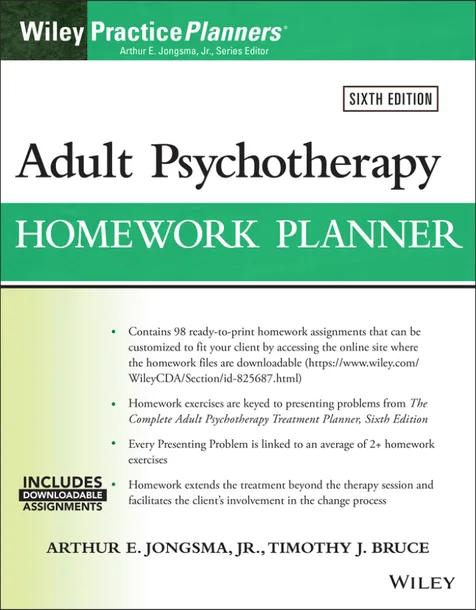
Adult Psychotherapy Homework Planner
by Arthur E. Jongsma Jr., Timothy J. Bruce
6th Edition
Publisher: John Wiley & Sons P&T
Book Details
| Print ISBN | 9781119840848 |
| eText ISBN | 9781119841050 |
| Publisher | John Wiley & Sons P&T |
| Publishing Year | 2021 |
| Edition | 6th Edition |
| Language | English |
| Pages | 400 |
The Adult Psychotherapy Homework Planner, 6th Edition functions as a dedicated clinical workbook delivering structured client activities for individual treatment plans. Published by John Wiley & Sons P&T, this resource enables clinicians to select tailored take-home exercises that support session goals across diverse therapeutic settings.
The content spans multiple psychological domains, organizing exercises by client presentation. Specific chapters deliver targeted tasks for mood and anxiety disorders, including anxiety, bipolar depression, bipolar mania, and anger control problems. Additional units supply practical assignments addressing behavioral and relational challenges, such as impulse control disorder, antisocial behavior, low self-esteem, family conflict, and intimate relationship conflicts.
Authored by Series Editor Arthur E. Jongsma, Jr. alongside Timothy J. Bruce, this workbook provides ready-to-use clinical tools across 400 pages. The structured layout fits the daily professional workflows of psychologists, counselors, social workers, psychiatrists, and therapists treating adult populations.
Table of Contents
Chapter 1: Anger Control Problems
- • Exercise 1.A Alternatives to Destructive Anger
- • Exercise 1.B Anger Journal
- • Exercise 1.C Assertive Communication of Anger
Chapter 2: Antisocial Behavior
- • Exercise 2.A How I Have Hurt Others
- • Exercise 2.B Letter of Apology
- • Exercise 2.C Three Acts of Kindness
Chapter 3: Anxiety
- • Exercise 3.A Analyze the Probability of a Feared Event
- • Exercise 3.B Past Successful Anxiety Coping
- • Exercise 3.C Worry Time
Chapter 4: Attention Deficit Disorder (Add)—Adult
- • Exercise 4.A Problem-Solving: An Alternative to Impulsive Action
- • Exercise 4.B Self-Monitoring/Self-Reward Program
- • Exercise 4.C Symptoms and Fixes for Add
Chapter 5: Bipolar—Depression
- • Exercise 5.A Early Warning Signs of Depression
- • Exercise 5.B Identifying and Handling Triggers
Chapter 6: Bipolar—Mania
- • Exercise 6.A Keeping a Daily Rhythm
- • Exercise 6.B Recognizing the Negative Consequences of Impulsive Behavior
- • Exercise 6.C What Are My Good Qualities?
- • Exercise 6.D Why I Dislike Taking My Medication
Chapter 7: Borderline Personality
- • Exercise 7.A Journal and Replace Self‑Defeating Thoughts
- • Exercise 7.B Plan Before Acting
Chapter 8: Childhood Trauma
- • Exercise 8.A Changing From Victim to Survivor
- • Exercise 8.B Deep Breathing Exercise
- • Exercise 8.C Feelings and Forgiveness Letter
Chapter 9: Chronic Pain
- • Exercise 9.A Pain and Stress Journal
Chapter 10: Cognitive Deficits
- • Exercise 10.A Memory Aid—Personal Information Organizer
- • Exercise 10.B Memory Enhancement Techniques
Chapter 11: Dependency
- • Exercise 11.A Making Your Own Decisions
- • Exercise 11.B Satisfying Unmet Emotional Needs
- • Exercise 11.C Taking Steps Toward Independence
Chapter 12: Dissociation
- • Exercise 12.A Describe the Trauma
- • Exercise 12.B Staying Focused on the Present Reality
Chapter 13: Eating Disorders and Obesity
- • Exercise 13.A A Reality Journal: Food, Weight, Thoughts, and Feelings
- • Exercise 13.B How Fears Control My Eating
Chapter 14: Educational Deficits
- • Exercise 14.A My Academic and Vocational Strengths
- • Exercise 14.B The Advantages of Education
Chapter 15: Family Conflict
- • Exercise 15.A Applying Problem Solving to Interpersonal Conflict
- • Exercise 15.B A Structured Parenting Plan
Chapter 16: Female Sexual Dysfunction
- • Exercise 16.A Factors Influencing Negative Sexual Attitudes
- • Exercise 16.B Study Your Body: Clothed and Unclothed
Chapter 17: Financial Stress
- • Exercise 17.A Plan a Budget
Chapter 18: Grief/Loss Unresolved
- • Exercise 18.A Creating a Memorial Collage
- • Exercise 18.B Dear _______________: A Letter to a Lost Loved One
Chapter 19: Impulse Control Disorder
- • Exercise 19.A Impulsive Behavior Journal
Chapter 20: Intimate Relationship Conflicts
- • Exercise 20.A How Can We Meet Each Other’s Needs and Desires?
- • Exercise 20.B Positive and Negative Contributions to the Relationship: Mine and Yours
Chapter 21: Legal Conflicts
- • Exercise 21.A Accept Responsibility for Illegal Behavior
- • Exercise 21.B Crooked Thinking Leads to Crooked Behavior
Chapter 22: Low Self-Esteem
- • Exercise 22.A Acknowledging My Strengths
- • Exercise 22.B Replacing Fears With Positive Messages
Chapter 23: Male Sexual Dysfunction
- • Exercise 23.A Journaling the Response to Nondemand, Sexual Pleasuring (Sensate Focus)
Chapter 24: Medical Issues
- • Exercise 24.A How I Feel About My Medical Treatment
- • Exercise 24.B The Impact of My Illness
Chapter 25: Obsessive-Compulsive Disorder (Ocd)
- • Exercise 25.A Interrupting Your Obsessions/Compulsions
- • Exercise 25.B Making Use of the Thought-Stopping Technique
- • Exercise 25.C Reducing the Strength of Compulsive Behaviors
Chapter 26: Panic/Agoraphobia
- • Exercise 26.A Coping Card
- • Exercise 26.B Monitoring My Panic Attack Experiences
Chapter 27: Paranoid Ideation
- • Exercise 27.A Check Suspicions Against Reality
Chapter 28: Parenting
- • Exercise 28.A Learning to Parent as a Team
- • Exercise 28.B The Two Sides of Parenting
- • Exercise 28.C Using Reinforcement Principles in Parenting
Chapter 29: Phase of Life Problems
- • Exercise 29.A What Needs to Be Changed in My Life?
- • Exercise 29.B What’s Good About Me and My Life?
Chapter 30: Phobia
- • Exercise 30.A Four Ways to Reduce Fear
- • Exercise 30.B Gradually Reducing Your Phobic Fear
Chapter 31: Posttraumatic Stress Disorder (Ptsd)
- • Exercise 31.A How the Trauma Affects Me
- • Exercise 31.B Share the Painful Memory
Chapter 32: Psychoticism
- • Exercise 32.A What Do You Hear and See?
Chapter 33: Sexual Abuse Victim
- • Exercise 33.A A Blaming Letter and a Forgiving Letter to Perpetrator
- • Exercise 33.B Picturing the Place of the Abuse
Chapter 34: Sexual Orientation[TB6]Confusion
- • Exercise 34.A Journal of Sexual Thoughts, Fantasies, Conflicts
- • Exercise 34.B To Whom and How to Reveal My Homosexuality
Chapter 35: Sleep Disturbance
- • Exercise 35.A Sleep Pattern Record
Chapter 36: Social Anxiety
- • Exercise 36.A Becoming Assertive
- • Exercise 36.B Restoring Socialization Comfort
Chapter 37: Somatization
- • Exercise 37.A Controlling the Focus on Physical Problems
Chapter 38: Spiritual Confusion
- • Exercise 38.A My History of Spirituality
- • Exercise 38.B Your Spiritual Inheritance Inventory
Chapter 39: Substance Use
- • Exercise 39.A Aftercare Plan Components
- • Exercise 39.B Identifying Relapse Triggers and Cues
- • Exercise 39.C Relapse Prevention Planning
- • Exercise 39.D Relapse Triggers
- • Exercise 39.E Substance Abuse’s Negative Impact Versus Sobriety’s Positive Impact
Chapter 40: Suicidal Ideation
- • Exercise 40.A Journal of Distorted, Negative Thoughts
- • Exercise 40.B No Self-Harm Contract
- • Exercise 40.C Strategies to Resist Suicidal Thoughts and Feelings
- • Exercise 40.D The Aftermath of Suicide
Chapter 41: Type A Behavior
- • Exercise 41.A Developing Noncompetitive Values
Chapter 42: Depression-Unipolar This Section needs to move up to be in alphabetical order
- • Exercise 42.A Identify and Schedule Pleasant Activities
- • Exercise 42.B Negative Thoughts Trigger Negative Feelings
- • Exercise 42.C Positive Self-Talk
Chapter 43: Vocational Stress
- • Exercise 43.A A Vocational Action Plan
Chapter Appendix A: Alternate Assignments for Presenting Problems
Chapter Appendix B: Alphabetical Index of Exercises
Customer Reviews
0.0
0 reviews
No reviews yet. Be the first to review this book!
Write a Review
Reviewed by GradeFocus Editorial Team
▶Research Sources (14)
- Adult Psychotherapy Homework Planner | Rent
- Social Work: Practice Planners - Adams Library
- Adult Psychotherapy Homework Planner (eBook)
- Please verify you are human - Captcha
- Adult Psychotherapy Homework Planner
- Literature & Thought
- Sourcebooks, LLC.
- Adult Psychotherapy Homework Planner, 6th Edition ...
- Adult Psychotherapy Homework Planner
- Adult Psychotherapy Homework Planner
- Resources!! : r/therapists
- The Complete Adult Psychotherapy Treatment Planner, 6th ...
- Adolescent Psychotherapy Homework Planner, 5th Edition
- Adult Psychotherapy Homework Planner