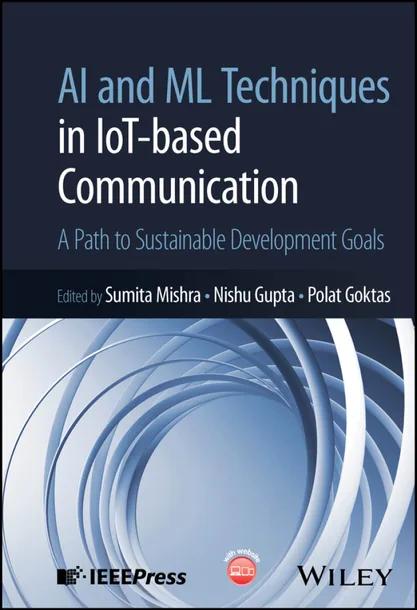
AI and ML Techniques in IoT-based Communication
A Path to Sustainable Development Goals
by Sumita Mishra, Nishu Gupta, Polat Goktas
1st Edition
Publisher: Wiley-IEEE Press
Book Details
| Print ISBN | 9781394337231 |
| eText ISBN | 9781394337248 |
| Publisher | Wiley-IEEE Press |
| Publishing Year | 2025 |
| Edition | 1st Edition |
| Language | English |
| Pages | 432 |
AI and ML Techniques in IoT-based Communication: A Path to Sustainable Development Goals, 1st Edition, presents engineering methods for combining artificial intelligence, machine learning, and Internet of Things networks to support the United Nations' Sustainable Development Goals. Edited by Sumita Mishra, Nishu Gupta, and Polat Goktas, this 432-page reference examines theoretical and applied frameworks designed to mitigate climate change and enhance environmental sustainability.
The text synthesizes domain-specific implementations across several essential sectors. Primary coverage includes water resource management, energy management, sustainable agriculture, and sustainable transportation and logistics. These sections detail how data-driven systems monitor environmental metrics, balance power usage, and optimize real-time resource allocation within modern municipal and industrial infrastructure.
Published by Wiley-IEEE Press in 2025, the work targets academics, researchers, industry practitioners, policymakers, and professionals at non-profit and non-governmental organizations. It provides these multidisciplinary specialists with technical context for implementing machine learning algorithms across regional and global communication networks.
Table of Contents
Chapter 1: Introduction to IoT, AI, and ML in Sustainable Communication
- • 1.1 Introduction
- • 1.2 Foundational Principles of IoT, AI, and ML
- • 1.3 Synergistic Integration of IoT, AI, and ML for Sustainable Communication Systems
- • 1.4 Challenges in Implementation
- • 1.5 Emerging Trends and Future Perspectives
- • 1.6 Conclusion
Chapter 2: AI/ML Techniques for Enhancing IoT-based Communication
- • 2.1 Introduction
- • 2.2 Background and Fundamentals
- • 2.3 AI/ML Techniques for Enhancing IoT Communication
- • 2.4 Architectures Integrating AI/ML in IoT Communication
- • 2.5 Challenges, Limitations, and Open Issues
- • 2.6 Conclusion
Chapter 3: IoT and AI in Sustainable Agriculture
- • 3.1 Introduction
- • 3.2 Fruit Quality Monitoring
- • 3.3 Crop Growth Monitoring Using IoT
- • 3.4 Case Study
- • 3.5 Drones in Agriculture
- • 3.6 Benefits of ICT in Agriculture
- • 3.7 Blockchain in Agriculture
- • 3.8 Summary
Chapter 4: AI and IoT-based Robust and Resilient Healthcare Services
- • 4.1 Introduction
- • 4.2 Role of IoT in Predictive Healthcare
- • 4.3 Improved Decision-making and Treatment Planning
- • 4.4 Personalized Healthcare
- • 4.5 Remote Diagnostics and Efficient Resource Allocation
- • 4.6 Benefits
- • 4.7 Applications in Specific Areas
- • 4.8 Challenges and Opportunities
- • 4.9 Conclusion
Chapter 5: Applications and Impact of Artificial Intelligence in the Field of Agriculture, Education, Healthcare, and Administration
- • 5.1 Introduction
- • 5.2 Application of AI in Several Fields of Agriculture
- • 5.3 AI in Education
- • 5.4 AI in the Field of Healthcare
- • 5.5 AI in the Field of Administration and Governance
- • 5.6 Results and Discussion
- • 5.7 Conclusion
Chapter 6: IoT-based Communication in Smart Cities for SDGs: Enhancing Urban Resilience Through Human-centric Hypernetwork Models
- • 6.1 Introduction
- • 6.2 Literature Review
- • 6.3 Methodology
- • 6.4 Results
- • 6.5 Discussion
- • 6.6 Conclusion
Chapter 7: Industrial IoT and Sustainable Development
- • 7.1 Foundations of Industrial Internet of Things in the Context of Sustainable Development
- • 7.2 Smart Manufacturing and Resource Efficiency
- • 7.3 Data-driven Decision-making and Environmental Monitoring
- • 7.4 Cybersecurity, Ethics, and Governance in Sustainable IIoT Systems
- • 7.5 Future Outlook: Scalable and Resilient IIoT Ecosystems for 2030 and Beyond
- • 7.6 Conclusion
Chapter 8: Energy Management and Smart Grid Communication
- • 8.1 Introduction to Smart Grids and Sustainable Energy Management
- • 8.2 Role of IoT in Smart Grid Communication
- • 8.3 ML for Predictive Energy Management
- • 8.4 AI-enabled Optimization in Grid Operations and Load Balancing
- • 8.5 Challenges, Opportunities, and Future Outlook
- • 8.6 Conclusion
Chapter 9: Urban Environmental Sensing for Sustainable Development: A Focus on Air Quality, Temperature, and Humidity
- • 9.1 Introduction
- • 9.2 Flowchart
- • 9.3 Methodology
- • 9.4 Pollution and Their Impacts
- • 9.5 Hardware Setup
- • 9.6 Different Types of Communication Interfaces
- • 9.7 Ways to Encounter the Problem
- • 9.8 Summary
Chapter 10: IoT Security and Privacy in Sustainable Communication
- • 10.1 Introduction: The Intersection of Security, Privacy, and Sustainable IoT Communication
- • 10.2 Artificial Intelligence and Machine Learning-enabled Security Mechanisms in IoT Networks
- • 10.3 Privacy-preserving Frameworks and Data Governance in Sustainable IoT
- • 10.4 Energy-aware and Resource-efficient Security Protocols
- • 10.5 Future Directions and Ethical Considerations in IoT Security for Sustainability
- • 10.6 Conclusion
Chapter 11: Machine Learning-empowered Physical Layer Security Techniques Toward 6G Wireless Communication
- • 11.1 Introduction
- • 11.2 6G Technologies: Security and Privacy Issues
- • 11.3 The Role of ML in PLS for 6G
- • 11.4 AI-driven Extensions for PLS in 6G
- • 11.5 Applications of ML-powered PLS in 6G
- • 11.6 Open Challenges and Future Directions in ML-empowered PLS for 6G
- • 11.7 Conclusion
Chapter 12: Justice in IoT and AI for Sustainable Development
- • 12.1 Introduction
- • 12.2 Foundations and Ethical Frameworks
- • 12.3 Ethical Governance and Implementation
- • 12.4 Security Architecture and Privacy
- • 12.5 Resource Justice and Equitable Access
- • 12.6 Regulatory Frameworks and Compliance
- • 12.7 Implementation Roadmap
Chapter 13: Advances, Challenges, and Future Directions in IoT Architectures for Smart Environments: A Comprehensive Review
- • 13.1 Introduction
- • 13.2 Scalability and Interoperability
- • 13.3 Energy Efficiency
- • 13.4 Data Privacy and Security
- • 13.5 Real-time Data Processing and Analytics
- • 13.6 Edge Computing and Fog Computing Integration
- • 13.7 Context Awareness and Adaptability
- • 13.8 Standardization
- • 13.9 Network Management and Optimization
- • 13.10 Conclusion
Chapter 14: Future Trends and Innovations in IoT-based Communication Through AI/ML for SDG
- • 14.1 Introduction
- • 14.2 Role of AI/ML in IoT-based Communication
- • 14.3 Emerging Trends in IoT-based Communication Through AI/ML
- • 14.4 Challenges and Ethical Considerations
- • 14.5 Future Directions and Innovations
- • 4.6 Conclusion
Customer Reviews
0.0
0 reviews
No reviews yet. Be the first to review this book!
Write a Review
Reviewed by GradeFocus Editorial Team
▶Research Sources (14)
- AI and ML techniques in IoT-based communication: a path to ...
- [PDF] AI and ML Techniques in IoT-based Communication by ...
- AI and ML Techniques in IoT-based Communication - heise shop
- AI and ML Techniques in IoT-based Communication - ISBN ...
- AI and ML Techniques in IoT-based Communication A Path to ...
- AI and ML Techniques in IoT-based Communication - Porrúa
- Captcha
- AI and ML Techniques in IoT-based Communication eBook by
- AI and ML Techniques in IoT-based Communication
- AI and ML Techniques in IoT-based Communication ( ...
- AI and ML Techniques in IoT-based Communication
- Artificial Intelligence-based Internet of Things Systems - eBooks
- AI and ML Techniques in IoT-based Communication
- The Role of Machine Learning Techniques in Internet ...