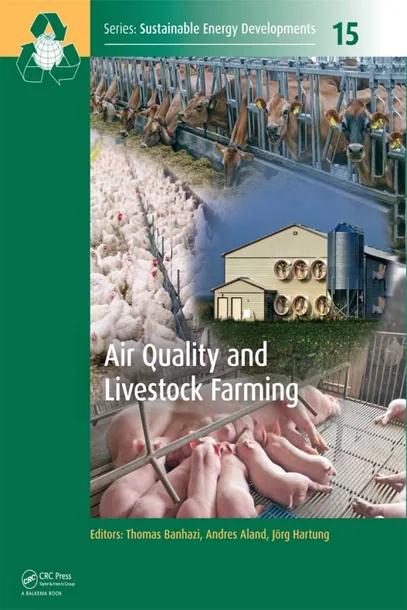
Air Quality and Livestock Farming
by Thomas Banhazi, Andres Aland, Jörg Hartung
1st Edition
Publisher: CRC Press
Book Details
| Print ISBN | 9781138027039 |
| eText ISBN | 9781317573401 |
| Publisher | CRC Press |
| Publishing Year | 2018 |
| Edition | 1st Edition |
| Language | English |
| Pages | 412 |
Air Quality and Livestock Farming, 1st Edition, examines agricultural air quality, focusing on methods used to monitor, manage, and reduce airborne contaminants in and around animal facilities.
The volume addresses how airborne dust, noxious gases, and microorganisms affect animal welfare and herd production efficiency while presenting occupational respiratory hazards for farm personnel. It reviews pollutant levels across diverse housing systems, such as swine units and loose-housing cowsheds, and details the impact of atmospheric ammonia during the live export of animals.
With contributions from international researchers, this book serves agricultural consultants, farming professionals, students, researchers, business leaders, and regulatory policymakers.
Table of Contents
Chapter 1: Airborne dust in livestock buildings
- • 1.1 Introduction
- • 1.2 Particulate sources and fractional characteristics
- • 1.3 Indoor particulate matter concentrations
- • 1.4 Summary of comprehensive animal and poultry housing PM studies
- • 1.5 Conclusion
Chapter 2: Lagoon characteristics and ambient hydrogen sulfide concentrations at a swine feeding facility
- • 2.1 Introduction
- • 2.2 Literature review
- • 2.3 Methodology
- • 2.4 Results and discussion
- • 2.5 Summary and conclusions
Chapter 3: Ammonia and hydrogen sulfide in swine production
- • 3.1 Introduction
- • 3.2 Ammonia in swine production
- • 3.3 Hydrogen sulfide in swine production
- • 3.4 Discussion and conclusions
Chapter 4: Pollutants in livestock buildings: Ammonia and dust interplay with the respiratory tract
- • 4.1 Ammonia in piggeries: concentrations and effects on animal’s health and performance
- • 4.2 Particulate matter: origin, classification, deposition in the respiratory system and effects on animal health and production
- • 4.3 Concept of secondary particulate matter: from gases to PM formation
Chapter 5: Gaseous emissions of bedded pack barns with wood chips and compost as bedding material
- • 5.1 Introduction
- • 5.2 Materials and methods
- • 5.3 Results
- • 5.4 Discussion
- • 5.5 Conclusions
Chapter 6: Seasonal variability of the PM and ammonia concentrations in uninsulated loose-housing cowshed
- • 6.1 Introduction
- • 6.2 Materials and methods
- • 6.3 Results and discussion
- • 6.4 Conclusions
Chapter 7: Air quality and factors related to sub-optimal pig housing conditions in nursery and finishing rooms: A field study in 143 French herds
- • 7.1 Introduction
- • 7.2 Material and methods
- • 7.3 Results
- • 7.4 Discussion
- • 7.5 Conclusions
Chapter 8: Temperature, relative humidity, noise, dust and odor levels recorded on free-range piggery sites in three states of Australia
- • 8.1 Introduction
- • 8.2 Materials and methods
- • 8.3 Results and discussion
- • 8.4 Conclusions 136
Chapter 9: Airborne pollutant concentrations within and emission rates from Australian piggery buildings
- • 9.1 Introduction
- • 9.2 Material and methods
- • 9.3 Results
- • 9.4 Discussion
- • 9.5 Conclusions
Chapter 10: Microclimate and air quality in uninsulated loose-housing cowsheds in temperate climate conditions
- • 10.1 Introduction
- • 10.2 Materials and methods
- • 10.3 Results and discussion
- • 10.4 Conclusions
Chapter 11: Intensive livestock housing: a review: Preventing occupational respiratory hazards for workers
- • 11.1 Introduction
- • 11.2 Which hazardous dusts and gases are found in ILHs?
- • 11.3 Who is exposed to these dusts and gases, and when?
- • 11.4 How commonly does excessive exposure occur?
- • 11.5 Respiratory effects of inhaling ILH dusts and gases
- • 11.6 Diagnosis
- • 11.7 Treatment
Chapter 12: The effect of air quality in livestock buildings on the occupational health of farm workers
- • 12.1 Introduction
- • 12.2 Materials and methods
- • 12.3 Results
- • 12.4 Discussion
- • 12.5 Recommendations 180
Chapter 13: Dust dispersion modeling of fugitive emissions from piggeries
- • 13.1 Introduction
- • 13.2 Methodology
- • 13.3 Results and discussion
- • 13.4 Conclusions
Chapter 14: The effects of atmospheric ammonia during export of livestock
- • 14.1 Introduction
- • 14.2 Source of atmospheric ammonia during live export
- • 14.3 Atmospheric ammonia levels during live export
- • 14.4 Effects of ammonia on livestock during live export
- • 14.5 Threshold levels of atmospheric ammonia for humans
- • 14.6 Threshold levels of atmospheric ammonia for animals
- • 14.7 Conclusions
Chapter 15: Hygiene and cleanliness in pig buildings as preventive medicine to ensure healthier animals
- • 15.1 Introduction
- • 15.2 Influence of hygiene and cleanliness on pig health
- • 15.3 Hygiene to ensure food safety and quality
- • 15.4 Hygiene, health and air quality in buildings
- • 15.5 Current means to attain hygiene in pig production and the need to implement better hygiene
- • 15.6 Cleaning and disinfection procedures in pig buildings
- • 15.7 Conclusions
Chapter 16: Controlling the internal concentrations of gases and odor within and emissions from animal buildings
- • 16.1 A general view on airborne pollutants – an introduction
- • 16.2 A brief description of relevant gases and odor
- • 16.3 Control and reduction measures
- • 16.4 Final remarks
Chapter 17: Controlling the internal concentrations of particulate matter within and emissions from animal buildings
- • 17.1 The characteristics of airborne particles at a glance
- • 17.2 Control and reduction measures
- • 17.3 Final remarks
Chapter 18: Emission reduction from livestock buildings using a filtration device
- • 18.1 Introduction
- • 18.2 Materials and methods
- • 18.3 Results and discussion
- • 18.4 Conclusions
Chapter 19: Effect of electrostatic precipitation on particulate matter emissions from a high-rise layer house
- • 19.1 Introduction and objective
- • 19.2 Methods and procedures
- • 19.3 Experimental design
- • 19.4 Results and discussion
- • 19.5 Conclusions
Chapter 20: Oil-spraying technologies to be used for dust reduction in livestock buildings
- • 20.1 Introduction
- • 20.2 Fundamentals for designing oil-spraying for dust control
- • 20.3 Strategy of the oil-spraying operation
- • 20.4 Different types of oil-spraying systems
- • 20.5 Review of studies reported previously
- • 20.6 Recommendations for future studies
Chapter 21: Housing index development for a holistic air quality evaluation: A preliminary framework
- • 21.1 Introduction
- • 21.2 The concepts of air quality indices
- • 21.3 Conclusions
Chapter 22: Computer-based management of air quality data: Development of a software system
- • 22.1 Introduction
- • 22.2 General description of the software
- • 22.3 Description of the main functionalities of the BASE-Q software
- • 22.4 Description of the main functionalities of the Pocket BASE-Q program
- • 22.5 Conclusion
Customer Reviews
0.0
0 reviews
No reviews yet. Be the first to review this book!
Write a Review
Reviewed by GradeFocus Editorial Team
▶Research Sources (1)
Related Books
Innovative Biotic Stress Management Strategies in Crops
Dinesh Singh
AI Technologies for Crop Breeding
Jen-Tsung Chen
Nanotechnology in Modern Aquaculture
Jyothis Mathew
Computational Intelligence and Image Processing in Agriculture
Jay Kumar Pandey
Melatonin in Horticultural Plants
Muhammad Ahsan Altaf
Nanomaterials in the Soil-Plant Continuum
Manoj Shrivastava