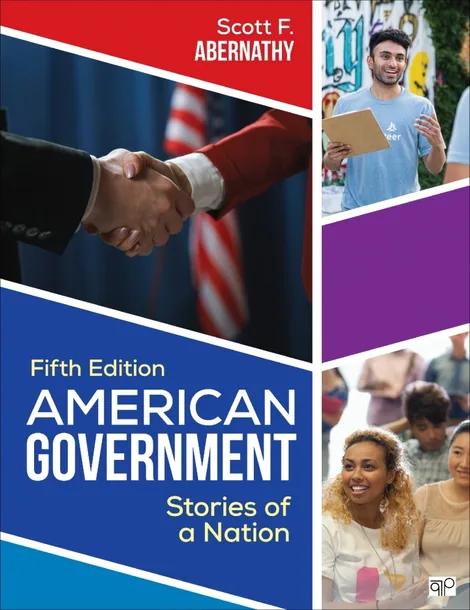
American Government
Stories of a Nation
by Scott F. Abernathy
5th Edition
Publisher: CQ Press
Book Details
| Print ISBN | 9781071929711 |
| eText ISBN | 9781071929919 |
| Publisher | CQ Press |
| Publishing Year | 2024 |
| Edition | 5th Edition |
| Language | English |
In American Government: Stories of a Nation, 5th Edition, author Scott F. Abernathy presents a foundational study of United States governance and political institutions. Published by CQ Press, this textbook provides students and instructors with a detailed analysis of how constitutional principles, government structures, and citizen action shape public policy and national identity.
The content synthesizes major thematic areas across political science. Core sections examine American political culture, the U.S. Constitution, and federalism, detailing how power is distributed between state and national authorities. Later chapters focus on civil liberties, the Bill of Rights, civil rights, public opinion, and the patterns defining voting behavior and political participation.
Delivered through the Sage Vantage online learning platform, the textbook aligns directly with the curriculum of Introduction to American Government courses. It provides academic programs with a structured approach for guiding undergraduate students through complex political concepts, civic processes, and institutional dynamics.
Table of Contents
Chapter 1: American Political Stories: Claiming Rights, Demanding to Be Heard
- • Standing Rock: Water Protectors Claim Their Rights and Freedoms in North Dakota
- • American Political Culture Is Built on a Set of Shared Ideas
- • The American Revolutionaries Employ Strategic Political Action
- • The Structure of Institutions Affects How Citizens Participate
- • Dr. Martin Luther King Jr.’s “Letter from Birmingham Jail” Links the Challenge against Racial Segregation to Core American Ideals
- • Conclusion: The American Experiment Continues, and You Are Part of It
Chapter 2: The Constitution of the United States: A New Vision of Representative Government
- • James Madison Plans for a Republic That Will Last
- • The Confederal System Made Coordination between the States Difficult
- • Delegates Reach a Compromise at the Constitutional Convention
- • Delegates Work Out Details of the New Government
- • Federalists and Anti-Federalists Argue over Ratification
- • Conclusion: The Motives of the Framers and the Effects of the Constitution Are Still Being Debated
Chapter 3: Federalism: The Changing Boundaries between the Nation and the States
- • Marijuana Policy Today Reveals Tensions between State and Federal Law
- • The Constitution Divides Power between the Nation and the States
- • For Much of American History, the Boundaries between the Nation and the States Were Sharper Than They Are Today
- • President Franklin Roosevelt’s Response to the Great Depression Reshapes American Federalism
- • Modern American Federalism Remains Cooperative but Faces Challenges
- • Conclusion: The Evolution of Federalism Continues
Chapter 4: Civil Liberties: Building and Defending Fences
- • Claims on Rights to Privacy Highlight the Shifting and Contentious Debates Surrounding Americans’ Civil Liberties
- • The Bill of Rights Establishes Protections for Americans’ Civil Liberties
- • The First Amendment’s First Two Protections Both Involve Religion
- • The First Amendment Also Protects Expression: Speech, Press, Assembly, and Petitioning the Government
- • The Constitution Also Protects Individuals Involved with the Criminal Justice System
- • The Ninth and Tenth Amendments Help Shape Freedoms in the Nation and across the States
- • Conclusion: Civil Liberties Involve Fences Still under Construction
Chapter 5: Civil Rights: How Equal Is Equal?
- • Protesters Act to Secure Rights for Americans with Disabilities
- • Civil Rights Amendments Emerge from the Civil War—but Provide Limited Protection in Practice
- • Challenges to Legal Segregation Achieve Successes but Face Resistance
- • American Women Work to Secure Their Civil Rights
- • Americans Confront Overlapping Forms of Discrimination
- • Conclusion: Have Americans’ Civil Rights Been Secured?
Chapter 6: Political Participation: Carry That Weight
- • Acting against Campus Sexual Violence Involves Many Forms of Political Participation
- • Political Participation Can Take Many Forms
- • The Decision to Vote or Not Vote Involves Many Factors
- • #MeToo Highlights the Possibilities and Challenges of Digital Political Participation
- • Are Young Adult Americans Really Disconnected from the Political Process?
- • Conclusion: Americans Are Continually Tasked with Carrying the Weight of Self-Governance
Chapter 7: Public Opinion: How Are Americans’ Voices Measured, and Do They Matter?
- • Public Opinion May Be Moved by Important Events
- • Public Opinion Is the Sum Total of Individual Beliefs and Attitudes
- • Public Opinion Is Transmitted and Measured in Several Ways
- • Political Socialization and Political Ideology Shape Public Opinion
- • From Changing the Conversation to Changing Public Policy: Americans Remain Divided over the Protests’ Legacy
- • Conclusion: How Meaningful Is Public Opinion?
Chapter 8: The Media: Truth, Trust, and Power
- • Can Americans Trust Their News Media?
- • Though the American Media Have Changed, Questions of Trust and Power Endure
- • Questions of Bias Challenge Americans’ Trust in the Media’s Objectivity
- • Media Ownership and Content Are Subject to Regulation
- • Did the Media Convince Americans That They Were Being Invaded by Martians?
- • Conclusion: Debates about the Power of the Media Continue
Chapter 9: Political Parties: The Insurgents versus the Establishment
- • Bernie Sanders Challenges the Democratic Party to Become More Progressive, Twice
- • Parties Act to Identify, Support, and Nominate Candidates for Elected Office
- • Parties Strive to Get Voters to Identify with Them
- • Donald Trump Takes on the Establishment
- • Political Polarization, Gridlock, and Two-Party Dominance Are the Defining Features of Parties in Government Today
- • Conclusion: In a Tumultuous 2024 Election Season, the Parties Respond
Chapter 10: Campaigns and Elections: Candidates and Voters in a Time of Uncertainty and Change
- • Elections from the Candidate’s Point of View: Campaigning in Uncertain Times
- • The Rules Governing National Elections Shape the Transmission of Americans’ Preferences into Laws and Policies
- • The Details of Congressional Elections Differ by State, but Many of the Rules Are the Same
- • Presidential Elections Have Many Stages and Moving Parts
- • Conclusion: The 2024 Elections: The National Becomes Local, and the Local Has National Implications
Chapter 11: Interest Groups and Social Movements: Collective Action, Power, and Representation
- • A Housing Bubble Bursts, and Interest Groups Pop Up
- • Americans Face Challenges in Acting Collectively in a Representative Democracy
- • Interest Groups Vary by Type and Tactic, but They All Face Similar Challenges
- • Occupy Wall Street Illustrates the Struggles, Successes, and Failures of Social Movements
- • Social Movements Employ Different Tactics from Interest Groups to Make Change and Educate
- • Conclusion: The Challenges of Organizing in American Political Life Continue
Chapter 12: Congress: Representation, Organization, and Legislation
- • Two “Years of the Woman” Highlight the Promise and Challenge of More Inclusive Representation in Congress
- • The Constitution Defines Congress’s Shape and Powers
- • Congress Is Organized around Formal and Informal Rules
- • The Legislative Process Is Complex by Design
- • Members Represent Constituents in How They Act and Who They Are
- • Conclusion: Representation Remains Complex, but the Landscape Continues to Change
Chapter 13: The American Presidency: Individuals, Institutions, and Power
- • As Individuals, American Presidents Must Confront the Often Contradictory Demands of Their Office
- • The Constitution Outlines the Powers of the American Presidency and Places Limits on Those Powers
- • Institutions and Other Informal Sources of Power Shape the Modern Executive Branch
- • Presidents Have Pushed the Limits of Their Power to Preserve National Security
- • The President Has Several Tools for Unilateral Action
- • Conclusion: The Paradoxes of the Presidency Continue
Chapter 14: The Federal Bureaucracy: Putting the Nation’s Laws into Effect
- • Federal Bureaucratic Action Consists of Many Actors and Evolves over Time
- • Theories of Bureaucratic Organization Focus on Rules, People, and Tasks
- • The Bureaucracy Has Developed in Response to Demands and Crises
- • A Functioning Bureaucracy Depends on Effective Organization
- • The Bureaucracy Is Constrained by Oversight and Reform
- • Conclusion: New Challenges Arise, and the Federal Bureaucracy Is Asked to Respond
Chapter 15: The Federal Judiciary: Politics, Power, and the “Least Dangerous” Branch
- • The Politics of Supreme Court Confirmations Pl
Customer Reviews
0.0
0 reviews
No reviews yet. Be the first to review this book!
Write a Review
Reviewed by GradeFocus Editorial Team
▶Research Sources (9)
- American Government - Sage College Publishing
- eBook - American Government, 5e-9781071929919
- American Government: Stories of a Nation - Scott F. Abernathy
- American Government | Rent | 9781071929711 - eCampus.com
- American Government: Stories of a Nation - ritograk.fo
- American Government: Stories of a Nation - ISBN 9781071929711
- American Government: Stories of a Nation - BooksRun
- American Government | Rent | 9781071929711 - Valore
- 9781071929711 | American Government - Knetbooks