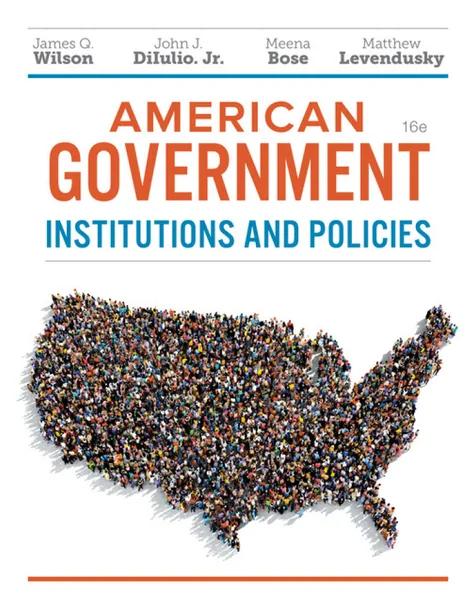
American Government: Institutions and Policies
by James Q. Wilson, John J. DiIulio, Jr.
16th Edition
Publisher: Cengage Learning
Book Details
| Print ISBN | 9781337568395 |
| eText ISBN | 9798214337326 |
| Publisher | Cengage Learning |
| Publishing Year | 2019 |
| Edition | 16th Edition |
| Language | English |
| Pages | 627 |
American Government: Institutions and Policies, 16th Edition, is a political science textbook by James Q. Wilson, John J. DiIulio, Jr., Meena Bose, and Matthew Levendusky that outlines the structural principles of the United States government. Published by Cengage Learning, this resource supports students analyzing governance structures and political behavior across the American political system.
The main narrative organizes topics into clear thematic sections, beginning with an introduction to the study of American government. Initial chapters examine the legal framework of the republic, focusing on the U.S. Constitution, federalism, and American political culture, before evaluating legal protections under civil liberties and civil rights. The material then explores political engagement, detailing public opinion, political participation, political parties, elections and campaigns, interest groups, and the media.
To support active reading, the textbook incorporates highlighted key concepts throughout each chapter. This organizational structure provides intended practice for learners examining how public sentiment and organized interest groups interact with democratic processes.
Table of Contents
Chapter 1: The Study of American Government
- • 1-1 Politics and Democracy
- • Power, Authority, and Legitimacy
- • Defining Democracy
- • 1-2 Political Power in America: Five Views
- • 1-3 Who Governs? To What Ends?
- • Expanding the Political Agenda
- • 1-4 The Politics of Different Issues
- • Four Types of Politics
Chapter 2: The Constitution
- • 2-1 The Problem of Liberty
- • The Colonial Mind
- • The Real Revolution
- • Weaknesses of the Confederation
- • 2-2 The Constitutional Convention
- • The Lessons of Experience
- • The Framers
- • The Challenge
- • 2-3 Ratification Debates
- • Key Principles
- • Government and Human Nature
- • The Constitution and Liberty
- • The Antifederalist View
- • Need for a Bill of Rights
- • The Constitution and Slavery
- • 2-4 Democracy and the Constitution: Post-Ratification Debates
- • Economic Interests
- • The Constitution and Equality
- • Constitutional Reform: Modern Views
- • Reducing the Separation of Powers
Chapter 3: Federalism
- • 3-1 Why Federalism Matters
- • The Founding
- • The Debate on the Meaning of Federalism
- • Dual to Cooperative Federalism
- • 3-2 Governmental Structure
- • Increased Political Activity
- • Different States, Different Policies
- • 3-3 Federal Money, State Programs
- • Grants-In-Aid
- • Meeting National Needs
- • The Intergovernmental Lobby
- • Categorical Grants
- • Rivalry Among the States
- • Federal Aid and Federal Control
- • 3-4 A Devolution Revolution?
- • Congress and Federalism
Chapter 4: American Political Culture
- • 4-1 Political Culture
- • The Political System
- • The Economic System
- • 4-2 How We Compare: Comparing America with Other Nations
- • The Civic Role of Religion
- • 4-3 Sources of Political Culture
- • 4-4 The Culture War
- • Mistrust of Government
- • Civil Society
- • Political Tolerance
Chapter 5: Civil Liberties
- • 5-1 The Courts and Conflicts over Civil Liberties
- • Rights in Conflict
- • Cultural Conflicts
- • Applying the Bill of Rights to the States
- • 5-2 The First Amendment and Freedom of Expression
- • Speech and National Security
- • What Is Speech?
- • Commercial and Youthful Speech
- • 5-3 The First Amendment and Freedom of Religion
- • The Free-Exercise Clause
- • The Establishment Clause
- • 5-4 Crime and Due Process
- • The Exclusionary Rule
- • Search and Seizure
- • Confessions and Self-Incrimination
- • Relaxing the Exclusionary Rule
- • Terrorism and Civil Liberties
- • Information Gathering and Surveillance
- • Prosecuting Suspected Terrorists
- • 5-5 Civil Liberties and American Democracy
Chapter 6: Civil Rights
- • 6-1 Race and Civil Rights
- • The Campaign in the Courts
- • The Campaign in Congress
- • 6-2 Women and Equal Rights
- • Women’s Rights and the Supreme Court
- • Sexual Harassment
- • Privacy and Sex
- • 6-3 Affirmative Action
- • Equality of Results
- • Equality of Opportunity
- • 6-4 Gay Rights
- • 6-5 Looking Back—and Ahead
Chapter 7: Public Opinion
- • 7-1 What Is Public Opinion?
- • How Do We Measure Public Opinion?
- • 7-2 What Drives Opinion?
- • Political Socialization and the Family
- • Demographic Factors
- • Political Partisanship and Ideology
- • 7-3 Political Information and Public Opinion
- • 7-4 Public Opinion and Public Policy
Chapter 8: Political Participation
- • 8-1 A Close Look at Nonvoting
- • 8-2 The Rise of the American Electorate
- • From State to Federal Control
- • Voter Turnout
- • 8-3 Who Participates in Politics?
- • Forms of Participation
- • What Drives Participation?
- • Political Participation Among Young People
Chapter 9: Political Parties
- • 9-1 What Is a Party?
- • Political Parties at Home and Abroad
- • 9-2 The Rise and Decline of the Political Party
- • The Founding
- • The Jacksonians
- • The Civil War and Sectionalism
- • The Era of Reform
- • Polarization and Resurgence
- • Party Realignments
- • 9-3 The Functions of Political Parties
- • Recruiting Candidates
- • Nominating Candidates
- • Helping Candidates Win Elections
- • 9-4 Parties as Organizations
- • The National Parties
- • State and Local Parties
- • 9-5 Parties in the Electorate: Partisanship
- • 9-6 The Two-Party System
- • Minor Parties
Chapter 10: Elections and Campaigns
- • Here and Abroad
- • 10-1 Presidential Elections: Winning the Nomination
- • 10-2 How Does the Campaign Matter?
- • Assigning Credit or Blame for the State of the Nation
- • Activating Latent Partisanship
- • Judging the Candidates’ Character
- • 10-3 How Do Voters Learn About the Candidates?
- • Campaign Communications
- • Campaign Events
- • 10-4 Building a Winning Coalition
- • 10-5 Congressional Elections
- • The Incumbency Advantage
- • Redistricting and Gerrymandering
- • On-Year and Off-Year Elections
- • 10-6 Campaign Finance: Regulating the Flow of Political Money
- • Sources of Campaign Money
- • Campaign Finance Rules
- • 10-7 Effects of Elections on Policy
Chapter 11: Interest Groups
- • 11-1 The Rise of Interest Groups
- • 11-2 Kinds of Organizations
Chapter 12: The Media
Chapter 13: Congress
Chapter 14: The Presidency
Chapter 15: The Bureaucracy
Chapter 16: The Judiciary
Chapter 17: Domestic Policy
Chapter 18: Economic Policy
Chapter 19: Foreign and Military Policy
Chapter 20: American Democracy, Then and Now
Customer Reviews
0.0
0 reviews
No reviews yet. Be the first to review this book!
Write a Review
Reviewed by GradeFocus Editorial Team
▶Research Sources (10)
- American Government: Institutions and Policies | Rent
- Search Results : Wilson
- American Government: Institutions and Policies
- American Government: Institutions and Policies - Rent
- Moving Pictures
- American government : institutions and policies [Sixteenth edition] ...
- American Government Institutions and Policies, 16th Updated Edition, AP ...
- American Government Institutions and Policies Study Guide 16th Ed
- American Government: Institutions and Policies Paperback - 2018
- American Government - 4e - Open Textbook Library