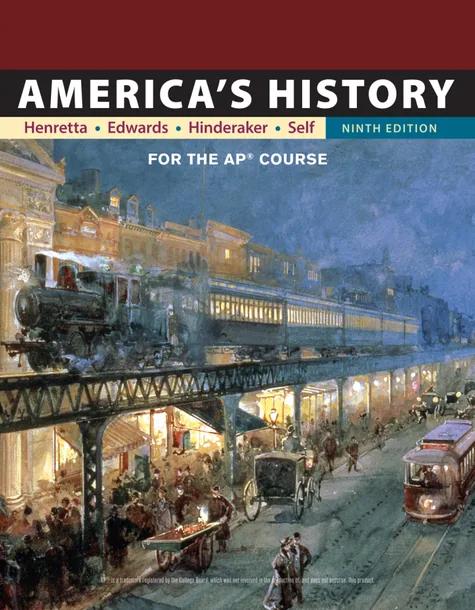
America's History: for the AP® Course
by James A. Henretta, Eric Hinderaker, Rebecca Edwards
9th Edition
Publisher: Bedford/St. Martin's
Book Details
| Print ISBN | 9781319065072 |
| eText ISBN | 9781319121594 |
| Publisher | Bedford/St. Martin's |
| Publishing Year | 2018 |
| Edition | 9th Edition |
| Language | English |
America's History: for the AP® Course, 9th Edition, by James A. Henretta, Eric Hinderaker, Rebecca Edwards, and Robert Self, is a high school textbook created to support student success in AP U.S. History. Published in 2018 by Bedford/St. Martin's, this edition offers structured historical material tailored for secondary educators and enrolled students.
The thematic scope covers early historical eras and transformations across North America. Core subjects include the Native American experience, European exploration and conquest, colonial America, and plantation colonies. The text also analyzes the dynamics of the British Atlantic World and the imperial slave economy.
To assist with course progression, the volume includes a nine-part organizational framework that aligns with the AP U.S. History course chronology. Additionally, each chapter and part concludes with AP-style practice questions, offering high school students ongoing opportunities to practice AP-level historical analysis.
Table of Contents
Chapter 1: Colliding Worlds, 1491–1600
- • The Native American Experience
- • The First Americans
- • American Empires
- • Chiefdoms and Confederacies
- • Patterns of Trade
- • Sacred Power
- • Western Europe: The Edge of the Old World
- • Hierarchy and Authority
- • Peasant Society
- • Expanding Trade Networks
- • Myths, Religions, and Holy Warriors
- • West and Central Africa: Origins of the Atlantic Slave Trade
- • Empires, Kingdoms, and Ministates
- • Trans-Saharan and Coastal Trade
- • The Spirit World
- • Exploration and Conquest
- • Portuguese Expansion
- • The African Slave Trade
- • Sixteenth-Century Incursions
- • AP® AMERICA IN THE WORLD Altered Landscapes
- • AP® INTERPRETING THE PAST How Connected Were Native American Communities Before 1492?
- • AP® THINKING LIKE A HISTORIAN Colliding Cultures
- • AP® ANALYZING VOICES A Spanish Priest Criticizes His Fellow Colonists
- • CHAPTER 1 REVIEW
- • CHAPTER 1 AP® PRACTICE QUESTIONS
Chapter 2: American Experiments, 1521–1700
- • Spain’s Tribute Colonies
- • A New American World
- • The Columbian Exchange
- • The Protestant Challenge to Spain
- • Plantation Colonies
- • Brazil’s Sugar Plantations
- • England’s Tobacco Colonies
- • The Caribbean Islands
- • Plantation Life
- • Neo-European Colonies
- • New France
- • New Netherland
- • The Rise of the Iroquois
- • New England
- • Instability, War, and Rebellion
- • Native American Resistance
- • Bacon’s Rebellion
- • AP® THINKING LIKE A HISTORIAN Who Was Pocahontas?
- • AP® INTERPRETING THE PAST What Role Did Climate Play in American Colonization?
- • AP® AMERICA IN GLOBAL CONTEXT Plantation Colonies Versus Neo-Europes
- • AP® ANALYZING VOICES Susanna Martin, Accused Witch
- • CHAPTER 2 REVIEW
- • CHAPTER 2 AP® PRACTICE QUESTIONS
Chapter 3: The British Atlantic World, 1607–1750
- • Colonies to Empire, 1607–1713
- • Self-Governing Colonies and New Elites, 1607–1660
- • The Restoration Colonies and Imperial Expansion
- • From Mercantilism to Imperial Dominion
- • The Glorious Revolution in England and America
- • Imperial Wars and Native Peoples
- • Tribalization
- • Indian Goals
- • The Imperial Slave Economy
- • The South Atlantic System
- • Africa, Africans, and the Slave Trade
- • Slavery in the Chesapeake and South Carolina
- • An African American Community Emerges
- • The Rise of the Southern Gentry
- • The Northern Maritime Economy
- • The Urban Economy
- • Urban Society
- • The New Politics of Empire, 1713–1750
- • The Rise of Colonial Assemblies
- • Salutary Neglect
- • Protecting the Mercantile System
- • Mercantilism and the American Colonies
- • AP® ANALYZING VOICES Native Americans and European Empires
- • AP® AMERICA IN THE WORLD Olaudah Equiano: The Brutal "Middle Passage"
- • AP® INTERPRETING THE PAST Why Did Americans Adopt Slavery?
- • AP® THINKING LIKE A HISTORIAN Servitude and Slavery
- • CHAPTER 3 REVIEW
- • CHAPTER 3 AP® PRACTICE QUESTIONS
Chapter 4: Growth, Diversity, and Conflict, 1720–1763
- • New England’s Freehold Society
- • Farm Families: Women in the Household Economy
- • Farm Property: Inheritance
- • Freehold Society in Crisis
- • Diversity in the Middle Colonies
- • Economic Growth, Opportunity, and Conflict
- • Cultural Diversity
- • Religion and Politics
- • Commerce, Culture, and Identity
- • Transportation and the Print Revolution
- • The Enlightenment in America
- • American Pietism and the Great Awakening
- • Religious Upheaval in the North
- • Social and Religious Conflict in the South
- • The Midcentury Challenge: War, Trade, and Social Conflict, 1750–1763
- • The French and Indian War
- • The Great War for Empire
- • British Industrial Growth and the Consumer Revolution
- • The Struggle for Land in the East
- • Western Rebels and Regulators
- • AP® THINKING LIKE A HISTORIAN Women’s Labor
- • AP® AMERICA IN THE WORLD Transatlantic Migration, 1500–1760
- • AP® INTERPRETING THE PAST Did Diversity Lead to Toleration?
- • AP® ANALYZING VOICES Evangelical Religion and Enlightenment Rationalism
- • CHAPTER 4 REVIEW
- • CHAPTER 4 AP® PRACTICE QUESTIONS
Chapter 5: The Problem of Empire, 1754–1776
- • An Empire Transformed
- • The Costs of Empire
- • George Grenville and the Reform Impulse
- • An Open Challenge: The Stamp Act
- • The Dynamics of Rebellion, 1765–1770
- • Formal Protests and the Politics of the Crowd
- • The Ideological Roots of Resistance
- • Another Kind of Freedom
- • Parliament and Patriots Square Off Again
- • The Problem of the West
- • Parliament Wavers
- • The Road to Independence, 1771–1776
- • A Compromise Repudiated
- • The Continental Congress Responds
- • The Rising of the Countryside
- • Loyalists and Neutrals
- • Violence East and West
- • Lord Dunmore’s War
- • Armed Resistance in Massachusetts
- • The Second Continental Congress Organizes for War
- • Thomas Paine’s Common Sense
- • Independence Declared
- • AP® AMERICA IN THE WORLD Britain’s Atlantic and Asian Empires
- • AP® INTERPRETING THE PAST Beyond the Proclamation Line
- • AP® INTERPRETATIONS Did British Administrators Try to Protect or Exploit Native Americans?
- • AP® ANALYZING VOICES The Debate over Representation and Sovereignty
- • CHAPTER 5 REVIEW
- • CHAPTER 5 AP® PRACTICE QUESTIONS
Chapter 6: Making War and Republican Governments, 1776–1789
- • The Trials of War, 1776–1778
- • War in the North
- • Armies and Strategies
- • Victory at Saratoga
- • The Perils of War
- • Financial Crisis
- • Valley Forge
- • The Path to Victory, 1778–1783
- • The French Alliance
- • War in the South
- • The Patriot Advantage
- • Diplomatic Triumph
- • Creating Republican Institutions, 1776–1787
- • The State Constitutions: How Much Democracy?
- • Women Seek a Public Voice
- • The War’s Losers: Loyalists, Native Americans, and Slaves
- • The Articles of Confederation
- • Shays’s Rebellion
- • The Constitution of 1787
- • The Rise of a Nationalist Faction
- • The Philadelphia Convention
- • The People Debate Ratification
- • AP® THINKING LIKE A HISTORIAN The Black Soldier’s Dilemma
- • AP® AMERICA IN THE WORLD China’s Growing Empire
- • AP® INTERPRETING THE PAST Was the Constitution Necessary?
- • AP® ANALYZING VOICES The First National Debate over Slavery
- • CHAPTER 6 REVIEW
- • CHAPTER 6 AP® PRACTICE QUESTIONS
Chapter 7: Hammering Out a Federal Republic, 1787–1820
- • The Political Crisis of the 1790s
- • The Federalists Implement the Constitution
- • Hamilton’s Financial Program
- • Jefferson’s Agrarian Vision
- • The French Revolution Divides Americans
- • The Rise of Political Parties
- • A Republican Empire Is Born
- • Sham Treaties and Indian Lands
- • Migration and the Changing Farm Economy
- • The Jefferson Presidency
- • Jefferson and the West
- • The War of 1812 and the Transformation of Politics
- • Conflict in the Atlantic and the West
- • The War of 1812
- • The Federalist Legacy
- • AP® INTERPRETING THE PAST Did Hamilton’s Economic System Endanger the Legacy of the Revolution?
- • AP® THINKING LIKE A HISTORIAN The Social Life of Alcohol
- • AP® AMERICA IN THE WORLD The Haitian Revolution and the Problem of Race
- • AP® ANALYZING VOICES Factional Politics and the War of 1812
- • CHAPTER 7 REVIEW
- • CHAPTER 7 AP® PRACTICE QUESTIONS
Chapter 8: Economic Transformations, 1800–1848
- • Foundations of a New Economic Order
- • Credit and Banking
- • Transportation and the Market Revolution
- • The Cotton Complex: Northern Industry and Southern Agriculture
- • The American Industrial Revolution
- • Origins of the Cotton South
- • The Cotton Boom and Slavery
- • Technological Innovation and Labor
- • The Spread of Innovation
- • Wageworkers and the Labor Movement
- • The Growth of Cities and Towns
- • New Social Classes and Cultures
- • Planters, Yeomen, and Slaves
- • The Northern Business Elite
- • The Middle Class
- • Urban Workers and the Poor
- • AP® THINKING LIKE A HISTORIAN The Entrepreneur and the Community
- • AP® AMERICA IN THE WORLD The Fate of the American and Indian Textile Industries
- • AP® ANALYZING VOICES The Debate over Free and Slave Labor
- • AP® INTERPRETING THE PAST Did the Market Revolution Expand Opportunities for Women?
- • CHAPTER 8 REVIEW
- • CHAPTER 8 AP® PRACTICE QUESTIONS
Chapter 9: A Democratic Revolution, 1800–1848
- • The Rise of Popular Politics
- • The Decline of the Notables and the Rise of Parties
- • Racial Exclusion and Republican Motherhood
- • The Missouri Crisis, 1819–1821
- • The Election of 1824
- • The Last Notable President: John Quincy Adams
- • "The Democracy" and the Election of 1828
- • Jackson in Power, 1829–1837
- • Jackson’s Agenda: Rotation and Decentralization
- • The Tariff and Nullification
- • The Bank War
- • Indian Removal
- • Jackson’s Impact
- • Class, Culture, and the Second Party System
- • The Whig Worldview
- • Labor Politics and the Depression of 1837–1843
- • "Tippecanoe and Tyler Too!"
- • AP® AMERICA IN THE WORLD Alexis de Tocqueville: Letter to Louis de Kergorlay, June 29, 1831
- • AP® ANALYZING VOICES The Character and Goals of Andrew Jackson
- • AP® INTERPRETING THE PAST Was Indian Removal Humanitarian or Racist?
- • AP® THINKING LIKE A HISTORIAN Becoming Literate: Public Education and Democracy
- • CHAPTER 9 REVIEW
- • CHAPTER 9 AP® PRACTICE QUESTIONS
Chapter 10: Religion, Reform, and Culture, 1820–1848
- • Spiritual Awakenings
- • The Second Great Awakening
- • Ralph Waldo Emerson and Transcendentalism
- • Utopian Experiments
- • Urban Cultures and Conflicts
- • Sex in the City
- • Popular Fiction and the Penny Press
- • Urban Entertainments
- • African Americans and the Struggle for Freedom
- • Free Black Communities, North and South
- • The Rise of Abolitionism
- • The Women’s Rights Movement
- • Origins of the Women’s Rights Movement
- • From Antislavery to Women’s Rights
- • AP® INTERPRETING THE PAST What Motivated Antebellum Reformers?
- • AP® ANALYZING VOICES Saving the Nation from Drink
- • AP® THINKING LIKE A HISTORIAN Dance and Social Identity in Antebellum America
- • AP® AMERICA IN THE WORLD Women’s Rights in France and the United States, 1848
- • CHAPTER 10 REVIEW
- • CHAPTER 10 AP® PRACTICE QUESTIONS
Chapter 11: Imperial Ambitions, 1820–1848
- • The Expanding South
- • Planters, Small Freeholders, and Poor Freemen
- • The Settlement of Texas
- • The Politics of Democracy
- • The African American World
- • Evangelical Black Protestantism
- • Forging Families and Communities
- • Negotiating Rights
- • Manifest Destiny, North and South
- • The Push to the Pacific
- • The Plains Indians
- • The Fateful Election of 1844
- • The U.S.-Mexico War, 1846–1848
- • The "War of a Thousand Deserts"
- • Polk’s Expansionist Program
- • American Military Successes
- • AP® THINKING LIKE A HISTORIAN Childhood in Black and White
- • AP® INTERPRETING THE PAST What Explains American Enthusiasm for Manifest Destiny?
- • AP® ANALYZING VOICES The U.S.-Mexico War: Expansion and Slavery
- • AP® AMERICA IN THE WORLD Financing War
- • CHAPTER 11 REVIEW
- • CHAPTER 11 AP® PRACTICE QUESTIONS
Chapter 12: Sectional Conflict and Crisis, 1844–1861
- • A Divisive War, 1844–1850
- • "Free Soil" in Politics
- • California Gold and Racial Warfare
- • 1850: Crisis and Compromise
- • The End of the Second Party System, 1850–1858
- • The Abolitionist Movement Grows
- • The Whig Party’s Demise
- • Immigrants and Know-Nothings
- • The West and the Fate of the Union
- • Abraham Lincoln and the Republican Triumph, 1858–1860
- • Lincoln’s Political Career
- • The Union Under Siege
- • The Election of 1860
- • Secession Winter, 1860–1861
- • AP® INTERPRETING THE PAST Did Slavery Have a Future in the West?
- • AP® AMERICA IN THE WORLD The Gold Rush: California and Australia
- • AP® THINKING LIKE A HISTORIAN The Irish in America
- • AP® ANALYZING VOICES To Secede or Not to Secede?
- • CHAPTER 12 REVIEW
- • CHAPTER 12 AP® PRACTICE QUESTIONS
Chapter 13: Bloody Ground: The Civil War, 1861–1865
- • War Begins, 1861–1862
- • Early Expectations
- • Campaigns East and West
- • Antietam and Its Consequences
- • Toward "Hard War," 1863
- • Politics North and South
- • The Impact of Emancipation
- • Citizens and the Work of War
- • Vicksburg and Gettysburg
- • The Road to Union Victory, 1864–1865
- • Grant and Sherman Take Command
- • The Election of 1864 and Sherman’s March
- • The Confederacy Collapses
- • The World the War Made
- • AP® INTERPRETING THE PAST How Divided Was the Confederate Public?
- • AP® THINKING LIKE A HISTORIAN Military Deaths — and Lives Saved — During the Civil War
- • AP® ANALYZING VOICES These Honored Dead
- • AP® AMERICA IN THE WORLD War Debt: Britain and the United States, 1830–1900
- • CHAPTER 13 REVIEW
- • CHAPTER 13 AP® PRACTICE QUESTIONS
Chapter 14: Reconstruction, 1865–1877
- • The Struggle for National Reconstruction
- • Presidential Approaches: From Lincoln to Johnson
- • Congress Versus the President
- • Radical Reconstruction
- • Women’s Rights Denied
- • The Meaning of Freedom
- • The Quest for Land
- • Republican Governments in the South
- • Building Black Communities
- • The Undoing of Reconstruction
- • The Republicans Unravel
- • Counterrevolution in the South
- • Reconstruction Rolled Back
- • The Political Crisis of 1877
- • Lasting Legacies
- • AP® AMERICA IN THE WORLD Labor Laws After Emancipation: Haiti and the United States
- • AP® INTERPRETING THE PAST How Free Were Freedwomen in Reconstruction?
- • AP® ANALYZING VOICES The Impact of Terror
- • AP® THINKING LIKE A HISTORIAN The South’s "Lost Cause"
- • CHAPTER 14 REVIEW
- • CHAPTER 14 AP® PRACTICE QUESTIONS
Chapter 15: Conquering a Continent, 1860–1890
- • The Republican Vision
- • The New Union and the World
- • Integrating the National Economy
- • Incorporating the West
- • Mining Empires
- • Cattlemen on the Plains
- • Homesteaders
- • The First National Park
- • A Harvest of Blood: Native Peoples Dispossessed
- • The Civil War and Indians on the Plains
- • Grant’s Peace Policy
- • The End of Armed Resistance
- • Strategies of Survival
- • Western Myths and Realities
- • AP® AMERICA IN THE WORLD The Santa Fe Railroad in Mexico and the United States
- • AP® ANALYZING VOICES Women’s Rights in the West
- • AP® INTERPRETING THE PAST What Factors Motivated America’s Indian Policies?
- • AP® THINKING LIKE A HISTORIAN Representing Indians
- • CHAPTER 15 REVIEW
- • CHAPTER 15 AP® PRACTICE QUESTIONS
Chapter 16: Industrial America: Corporations and Conflicts, 1877–1911
- • The Rise of Big Business
- • Innovators in Enterprise
- • The Corporate Workplace
- • On the Shop Floor
- • Immigrants, East and West
- • Newcomers from Europe
- • Asian Americans and Exclusion
- • Labor Gets Organized
- • The Emergence of a Labor Movement
- • The Knights of Labor
- • Farmers and Workers: The Cooperative Alliance
- • Another Path: The American Federation of Labor
- • AP® INTERPRETING THE PAST How Modern Were Late-Nineteenth-Century Corporations?
- • AP® THINKING LIKE A HISTORIAN Poverty and Food
- • AP® AMERICA IN THE WORLD Emigrants and Destinations, 1881–1915
- • AP® ANALYZING VOICES Jewish Immigrants in the Industrial E
Customer Reviews
0.0
0 reviews
No reviews yet. Be the first to review this book!
Write a Review
Reviewed by GradeFocus Editorial Team
▶Research Sources (11)
- America's History: for the AP® Course, 9th Edition
- America's History by James Henretta: 9781319121594
- America's History: for the AP® Course notes
- America's History by James A. Henretta, Eric Hinderaker ...
- America's History: for the AP® Course
- America\'s History: for the AP® Course Notes
- America's History: For the Ap* Course
- AMERICA'S HISTORY FOR THE AP® COURSE
- America's History for the AP Course - 9th Edition - Solutions and Answers
- Americas-History-For-the-Ap-Course
- Does anyone have a pdf for America's History 9th edition by Henretta?