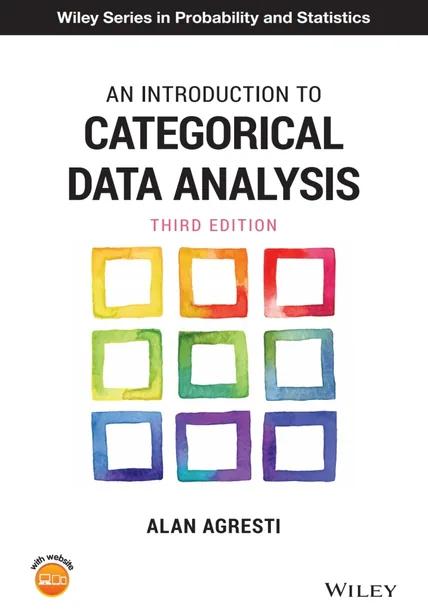
An Introduction to Categorical Data Analysis
by Alan Agresti
3rd Edition
Publisher: Wiley-Blackwell
Book Details
| Print ISBN | 9781119405269 |
| eText ISBN | 9781119405276 |
| Publisher | Wiley-Blackwell |
| Publishing Year | 2019 |
| Edition | 3rd Edition |
| Language | English |
| Pages | 400 |
An Introduction to Categorical Data Analysis, 3rd Edition, is a reference volume that provides an applied presentation of statistical methods for discrete response data.
The text focuses on a generalized linear models framework that unifies categorical methods, connecting logistic regression and loglinear models for discrete outcomes with normal regression for continuous data. Coverage addresses contingency table analysis, multicategory logit models, methods for matched pairs, and random effects using generalized linear mixed models.
Written in an applied, nontechnical style, the volume demonstrates how to carry out all included analyses using R software, illustrating concepts through empirical studies such as medical clinical trials and environmental questions.
Table of Contents
Chapter 1: Introduction
- • 1.1 Categorical Response Data
- • 1.2 Probability Distributions for Categorical Data
- • 1.3 Statistical Inference for a Proportion
- • 1.4 Statistical Inference for Discrete Data
- • 1.5 Bayesian Inference for Proportions *
- • 1.6 Using R Software for Statistical Inference about Proportions *
- • Exercises
Chapter 2: Analyzing Contingency Tables
- • 2.1 Probability Structure for Contingency Tables
- • 2.2 Comparing Proportions in 2 × 2 Contingency Tables
- • 2.3 The Odds Ratio
- • 2.4 Chi-Squared Tests of Independence
- • 2.5 Testing Independence for Ordinal Variables
- • 2.6 Exact Frequentist and Bayesian Inference *
- • 2.7 Association in Three-Way Tables
- • Exercises
Chapter 3: Generalized Linear Models
- • 3.1 Components of a Generalized Linear Model
- • 3.2 Generalized Linear Models for Binary Data
- • 3.3 Generalized Linear Models for Counts and Rates
- • 3.4 Statistical Inference and Model Checking
- • 3.5 Fitting Generalized Linear Models
- • Exercises
Chapter 4: Logistic Regression
- • 4.1 The Logistic Regression Model
- • 4.2 Statistical Inference for Logistic Regression
- • 4.3 Logistic Regression with Categorical Predictors
- • 4.4 Multiple Logistic Regression
- • 4.5 Summarizing Effects in Logistic Regression
- • 4.6 Summarizing Predictive Power: Classification Tables, ROC Curves, and Multiple Correlation
- • Exercises
Chapter 5: Building and Applying Logistic Regression Models
- • 5.1 Strategies in Model Selection
- • 5.2 Model Checking
- • 5.3 Infinite Estimates in Logistic Regression
- • 5.4 Bayesian Inference, Penalized Likelihood, and Conditional Likelihood for Logistic Regression *
- • 5.5 Alternative Link Functions: Linear Probability and Probit Models *
- • 5.6 Sample Size and Power for Logistic Regression *
- • Exercises
Chapter 6: Multicategory Logit Models
- • 6.1 Baseline-Category Logit Models for Nominal Responses
- • 6.2 Cumulative Logit Models for Ordinal Responses
- • 6.3 Cumulative Link Models: Model Checking and Extensions *
- • 6.4 Paired-Category Logit Modeling of Ordinal Responses *
- • Exercises
Chapter 7: Loglinear Models for Contingency Tables and Counts
- • 7.1 Loglinear Models for Counts in Contingency Tables
- • 7.2 Statistical Inference for Loglinear Models
- • 7.3 The Loglinear – Logistic Model Connection
- • 7.4 Independence Graphs and Collapsibility
- • 7.5 Modeling Ordinal Associations in Contingency Tables
- • 7.6 Loglinear Modeling of Count Response Variables *
- • Exercises
Chapter 8: Models for Matched Pairs
- • 8.1 Comparing Dependent Proportions for Binary Matched Pairs
- • 8.2 Marginal Models and Subject-Specific Models for Matched Pairs
- • 8.3 Comparing Proportions for Nominal Matched-Pairs Responses
- • 8.4 Comparing Proportions for Ordinal Matched-Pairs Responses
- • 8.5 Analyzing Rater Agreement *
- • 8.6 Bradley–Terry Model for Paired Preferences *
- • Exercises
Chapter 9: Marginal Modeling of Correlated, Clustered Responses
- • 9.1 Marginal Models Versus Subject-Specific Models
- • 9.2 Marginal Modeling: The Generalized Estimating Equations (GEE) Approach
- • 9.3 Marginal Modeling for Clustered Multinomial Responses
- • 9.4 Transitional Modeling, Given the Past
- • 9.5 Dealing with Missing Data *
- • Exercises
Chapter 10: Random Effects: Generalized Linear Mixed Models
- • 10.1 Random Effects Modeling of Clustered Categorical Data
- • 10.2 Examples: Random Effects Models for Binary Data
- • 10.3 Extensions to Multinomial Responses and Multiple Random Effect Terms
- • 10.4 Multilevel (Hierarchical) Models
- • 10.5 Latent Class Models *
- • Exercises
Chapter 11: Classification and Smoothing *
- • 11.1 Classification: Linear Discriminant Analysis
- • 11.2 Classification: Tree-Based Prediction
- • 11.3 Cluster Analysis for Categorical Responses
- • 11.4 Smoothing: Generalized Additive Models
- • 11.5 Regularization for High-Dimensional Categorical Data (Large p)
- • Exercises
Chapter 12: A Historical Tour of Categorical Data Analysis *
Chapter Appendix: Software for Categorical Data Analysis
- • A.1 R for Categorical Data Analysis
- • A.2 SAS for Categorical Data Analysis
- • A.3 Stata for Categorical Data Analysis
- • A.4 SPSS for Categorical Data Analysis
Customer Reviews
0.0
0 reviews
No reviews yet. Be the first to review this book!
Write a Review
Reviewed by GradeFocus Editorial Team
Related Books
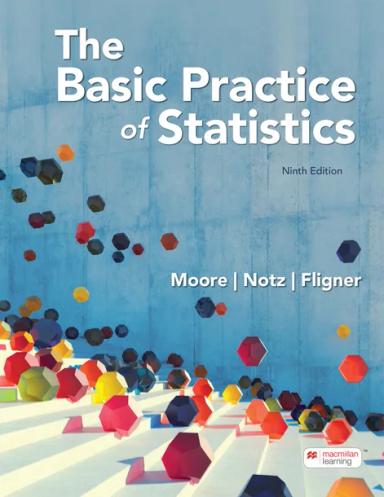
The Basic Practice of Statistics
David S. Moore
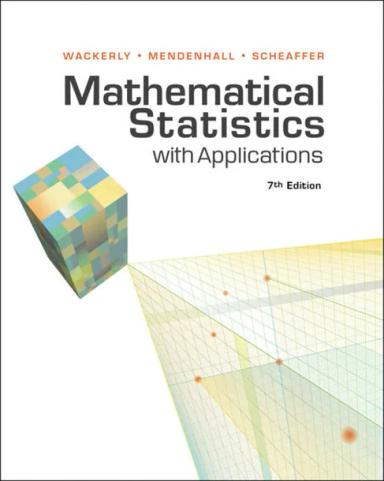
Mathematical Statistics with Applications
Dennis Wackerly
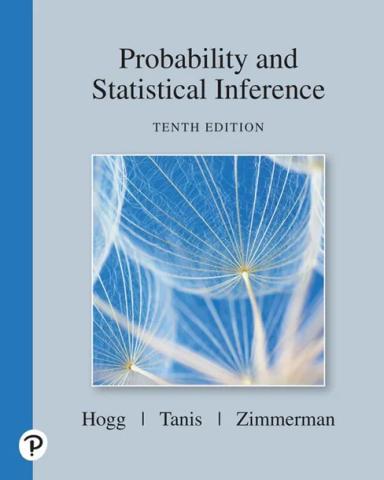
Probability and Statistical Inference
Robert V. Hogg
Essentials of Statistics for the Behavioral Sciences
Frederick J Gravetter

The Practice of Statistics for the AP® Course
Daren Starnes
The Practice of Statistics for the AP® Course
Daren Starnes