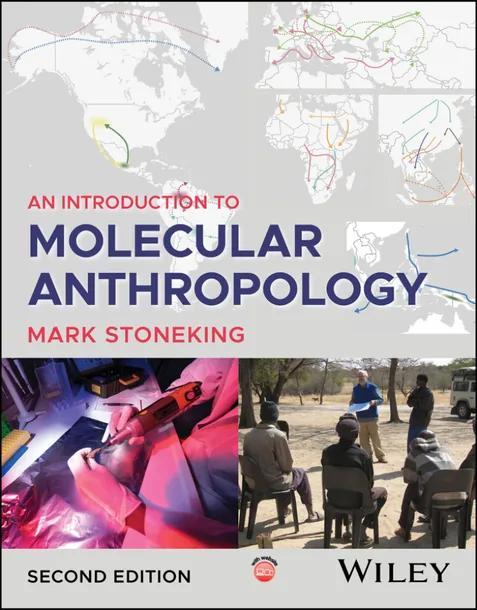
An Introduction to Molecular Anthropology
by Mark Stoneking
2nd Edition
Publisher: Wiley-Blackwell
Book Details
| Print ISBN | 9781394262595 |
| eText ISBN | 9781394262601 |
| Publisher | Wiley-Blackwell |
| Publishing Year | 2025 |
| Edition | 2nd Edition |
| Language | English |
| Pages | 464 |
An Introduction to Molecular Anthropology, 2nd Edition is a textbook that explains how basic genetic principles are applied to infer human population history and evolution in the genomics era.
The narrative connects several core thematic areas, beginning with the technical production and analysis of genome-wide data and recent ancient DNA findings. It moves through broad topics in human origins, global population spread, and existing structures of human genetic variation. The content further details the mechanics of selection and adaptation throughout human evolutionary history while explaining how cultural behaviors influence underlying genetic variation across populations.
A key focus of this revision involves the ethical issues surrounding modern human population sampling. The volume provides clear instructional support for students taking courses in anthropology or introductory human evolution, while offering direct reference value for practicing anthropologists and academic researchers in related fields.
Table of Contents
Chapter 1: Genes: How They Are Inherited
- • Blood and ABO Blood Groups
- • Inheritance of ABO Blood Groups
- • Inheritance of More than One Gene: ABO and Rhesus Blood Groups
- • Sex Chromosomes
- • Determining How Traits Are Inherited: Pedigree Analysis
- • What Is – and Isn’t – Inherited
- • Concluding Remarks
- • References
Chapter 2: What Genes Are, What They Do, and How They Do It
- • Chromosomes, Proteins, and Nucleic Acids: Figuring Out What Genes Are
- • The Structure of Genes and What They Do: The Central Dogma and the Flow of Information
- • How Genes Do What They Do: Transcription and Translation
- • The Genetic Code
- • DNA Replication
- • The Consequences of Mutations
- • What Causes Mutations?
- • A Final Cautionary Note
- • References
Chapter 3: Genes in Populations
- • What Is a Population?
- • The Concept of “Effective Population Size”
- • The Sex Ratio and N e
- • Inbreeding and N e
- • Variation in Population Size over Time and N e
- • Differential Fertility and N e
- • N e for Humans
- • The Gene Pool with No Evolution: The Hardy–Weinberg Principle
- • Exceptions
- • A Real-life Example
- • Some Practical Uses for Hardy–Weinberg
- • References
Chapter 4: Evolutionary Forces
- • Nonrandom Mating
- • Small Population Size
- • Mutation
- • Migration
- • Selection
- • Evolutionary Forces: Summary
- • References
Chapter 5: Molecular Evolution
- • Functionally Less Important Molecules (or Parts of Molecules) Evolve Faster than More Important Ones
- • Conservative Substitutions Occur More Frequently than Disruptive Ones
- • The Rate of Molecular Evolution Is Approximately Constant
- • Contrasting Phenotypic and Molecular Evolution
- • How Do New Gene Functions Arise?
- • Gene Regulation and Phenotypic Evolution
- • References
Chapter 6: Genetic Markers
- • The First DNA Markers: Restriction Fragment Length Polymorphisms
- • Polymerase Chain Reaction
- • DNA Sequencing: The Sanger Method
- • Next-generation Sequencing
- • Targeting Single DNA Bases: SNPS
- • Variation in Length
- • Other Structural Variation
- • Concluding Remarks
- • References
Chapter 7: Ancient DNA
- • Properties of Ancient DNA: Degradation
- • Properties of Ancient DNA: Damage
- • Properties of Ancient DNA: Contamination
- • History of Ancient DNA Studies
- • References
Chapter 8: Sampling Issues
- • Sampling Populations: General Issues
- • Sampling Populations: Ethical Issues
- • Archival Samples
- • Ancient Remains
- • Sampling DNA Regions
- • Mitochondrial DNA
- • Y Chromosomal DNA
- • Autosomal DNA
- • X Chromosome
- • Public Databases
- • References
Chapter 9: Analysis of Genetic Data from Populations
- • Genetic Diversity Within Populations
- • Genetic Distances Between Populations
- • Analysis of Molecular Variance (AMOVA) and Mantel Tests
- • Displaying Genetic Distance Data: Trees
- • Displaying Genetic Data: Multidimensional Scaling, Principal Components, and Correspondence Analysis
- • References
Chapter 10: Analysis of Genetic Data from Individuals
- • Genetic Distances for DNA Sequences
- • Trees for DNA Sequences
- • Rooting Trees
- • Assessing the Confidence of a Tree
- • Network Analyses
- • Genome-wide Data: Unsupervised Analyses
- • References
Chapter 11: Inferences About Demographic History (Part 1)
- • Dating Events
- • Population Size and Population Size Change
- • References
Chapter 12: Inferences About Demographic History (Part 2)
- • Migration and Admixture
- • Putting It All Together: Simulations
- • References
Chapter 13: Human Origins
- • Our Closest Living Relatives
- • Resolving the Trichotomy
- • Complications
- • Ape Genetics and Genomics
- • The Origins of Our Species: Insights from Modern Populations
- • The Genetic Evidence: mtDNA
- • The Genetic Evidence: Y Chromosome
- • The Genetic Evidence: Autosomes
- • References
Chapter 14: The Origins of Our Species: Insights from Archaic Genomes
- • Enter the Denisovans
- • The Plot Thickens: Multiple Contributions of Ancestry from Archaic to Modern Humans…
- • … And Multiple Contributions of Ancestry from Modern to Archaic Humans!
- • Some Concluding Remarks
- • References
Chapter 15: Migration and Dispersal: The Colonization of the Americas
- • Into Remote Lands: The Colonization of the Americas
- • References
Chapter 16: Into Even More Remote Lands: The Colonization of Polynesia
- • What About Micronesia?
- • Contact Between Polynesia and the Americas?
- • Some Concluding Remarks
- • References
Chapter 17: Species-wide Selection
- • Species-wide Selection
- • Nonsynonymous Substitutions and the dN/dS Ratio
- • Tests Based on the Allele Frequency Distribution
- • Selection Tests Based on Comparing Divergence to Polymorphism
- • Archaic Genomes
- • References
Chapter 18: Local Selection
- • Example: Lactase Persistence
- • Example: EDAR
- • Using Admixture to Detect Selection
- • Concluding Remarks
- • References
Chapter 19: The Genetic Basis of Phenotypic Variation
- • Skin Pigmentation Variation
- • Hair and Eye Color Variation
- • Other Traits
- • Predicting Ancient Phenotypes
- • References
Chapter 20: Genes and Culture
- • Are Humans Still Evolving?
- • Genetic Variation Can Be Directly Influenced by Cultural Practices
- • Genetic Variation Can Be Indirectly Influenced by Cultural Practices
- • Using Genetic Analyses to Learn More About Cultural Practices: Farming/Language Family Expansions
- • Using Genetic Analyses to Learn More About Cultural Practices: Dating the Origin of Clothing
- • Concluding Remarks
- • References
Chapter 21: Ongoing and Future Developments in Molecular Anthropology
- • More Modern and Ancient DNA Genomic Studies
- • The Other “OMICS”
- • Beyond “YOU”: The Microbiome
- • More Analyses
- • Figuring Out What Mutations Do: Functional Genomics
- • Personal Ancestry Testing and Genomics
- • References
Customer Reviews
0.0
0 reviews
No reviews yet. Be the first to review this book!
Write a Review
Reviewed by GradeFocus Editorial Team
▶Research Sources (13)
- An Introduction to Molecular Anthropology (Paperback) by Mark ...
- An Introduction to Molecular... | Rent | 9781394262595 - eCampus.com
- An Introduction to Molecular Anthropology - Booktopia
- Rakuten Kobo - An Introduction to Molecular Anthropology
- eBook: An Introduction to Molecular Anthropology von Mark Stoneking
- An Introduction to Molecular Anthropology - Stoneking, Mark
- An Introduction to Molecular Anthropology von Mark Stoneking (E ...
- 楽天Kobo電子書籍ストア: An Introduction to Molecular Anthropology ...
- An Introduction to Molecular Anthropology, 2nd Edition ...
- An Introduction to Molecular Anthropology (2nd ed.)
- An Introduction to Molecular Anthropology - Mark Stoneking
- An Introduction to Molecular Anthropology by Mark Stoneking
- An Introduction to Molecular Anthropology - Stoneking, Mark