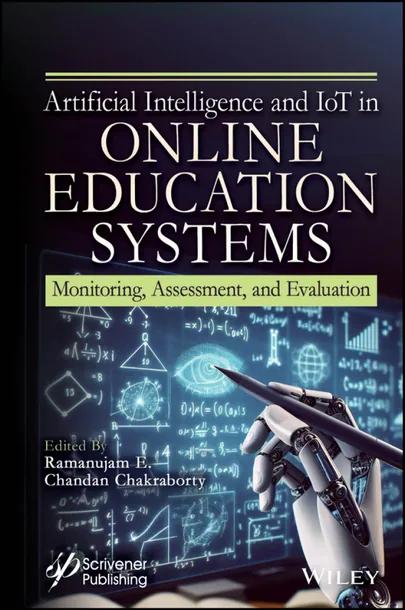
Artificial Intelligence and IoT in Online Education Systems
Monitoring, Assessment, and Evaluation
by Ramanujam E., Chandan Chakraborty
1st Edition
Publisher: Wiley-Scrivener
Book Details
| Print ISBN | 9781394302635 |
| eText ISBN | 9781394302642 |
| Publisher | Wiley-Scrivener |
| Publishing Year | 2025 |
| Edition | 1st Edition |
| Language | English |
| Pages | 560 |
The 1st Edition of Artificial Intelligence and IoT in Online Education Systems examines technical architectures for monitoring, assessment, and evaluation across digital learning environments. Edited by Ramanujam E. and Chandan Chakraborty, this volume details automated tools designed for online proctoring examination systems. Computer scientists, educational researchers, and policymakers gain structural perspectives on deploying data-driven models within modern remote learning contexts.
Technical chapters concentrate on multi-modal systems and IoT-based architecture that incorporate computer vision, machine learning, and deep learning algorithms. The text details methods for audio-to-text processing, handwritten stroke analysis, text similarity detection, and handling class imbalance data in evaluation datasets. These technical contributions establish methodological approaches for tracking examinee behavior and maintaining testing integrity across networked environments.
Additionally, the volume addresses quality assurance protocols and psychological aspects necessary to preserve ethics during high-stakes examinations. The publication offers computer scientists and administrative leaders documented strategies for implementing automated evaluation software. This text provides academic institutions with analytical frameworks for designing secure, scalable digital assessment platforms.
Table of Contents
Chapter 1: AI Literacy and Online Proctoring: Educational Perspectives and Strategies
- • 1.1 Introduction
- • 1.2 AI in Education — Theoretical Framework
- • 1.3 AI-Assisted Educational Practices
- • 1.3.1 Hyper Sentient Syllabus
- • 1.3.2 Role of AI in Redesigning Assessment Strategies
- • 1.3.3 Framework for Adopting and Implementing AI-Assisted Online Proctoring Systems
- • 1.3.4 Ethical Implications of AI in Online Proctoring
- • 1.4 Strengthening Teacher Preparation for AI Literacy in Higher Education Curricula
- • 1.4.1 Updating Educator’s Knowledge of AI Concepts
- • 1.4.2 Utilizing AI-Enhanced Technologies for Personalized Learning
- • 1.4.3 Integrating AI Literacy Education with the TPACK Framework
- • 1.5 Conclusion and Implications
- • References
Chapter 2: Next-Generation Online Education Integrating AI and IoT for Superior Management and Evaluation
- • 2.1 Introduction
- • 2.2 AI and IoT in Online Education Systems
- • 2.2.1 Overview
- • 2.2.2 Smart Online Education Model
- • 2.2.3 Smart Online Classroom
- • 2.2.4 Smart Online Labs
- • 2.2.5 Smart Online Tutoring
- • 2.2.6 Smart Simulation
- • 2.2.7 Smart Online Evaluation
- • 2.2.8 Smart Online Security and Content Adaptation
- • 2.2.9 Application and Infrastructure Levels
- • 2.3 Functional Structure of IoT System
- • 2.3.1 Online Exam Management
- • 2.3.2 Automated Correction of Exam Papers
- • 2.3.3 Student’s Performance Calculation
- • 2.4 Emerging Technologies in the Online Education System
- • 2.4.1 AI Technologies
- • 2.4.2 AR, VR
- • 2.4.3 Big Data Technology
- • 2.4.4 Robotics and IoT Labs
- • 2.4.5 Cloud Computing Technology
- • 2.4.6 Machine Learning Technology
- • 2.4.7 Deep Learning Technology
- • 2.4.8 IoT Technology
- • 2.4.9 5G Technology
- • 2.4.10 Learning Management System (LMS)
- • 2.5 Challenges of AI and IoT in Online Education System
- • 2.6 The Future Vision of AI and IoT in Online Education Systems
- • 2.6.1 Emerging Trends and Future Applications
- • 2.7 Conclusion
- • References
Chapter 3: Ethical Integrity in Educational Contexts
- • 3.1 Introduction
- • 3.2 Types and Methods of Fake Credentials
- • 3.2.1 Counterfeit Diploma and Degrees
- • 3.2.2 Fake Transcripts
- • 3.2.3 Misrepresentation of Professional Licenses and Certifications
- • 3.2.4 Online Credential Verification Scams
- • 3.2.5 Impersonation of Genuine Graduates
- • 3.2.6 Use of Photoshop and Graphic Design Software
- • 3.3 Consequences of Fake Credentials
- • 3.3.1 Legal Consequences
- • 3.3.2 Educational and Professional Consequences
- • 3.3.3 Financial Consequences
- • 3.3.4 Loss of Trust
- • 3.3.5 Long-Term Implications
- • 3.3.6 Ethical and Psychological Consequences
- • 3.3.7 Public Shame
- • 3.4 Challenges in Detecting and Verifying Fake Credentials
- • 3.5 Role of Technology in Facilitating and Combating Fake Credentials
- • 3.6 Impact on Organizational Reputation and Public Trust
- • 3.7 Multi-Layered Approach to Tackling the Problem
- • 3.8 Innovative Solutions and Technologies
- • 3.9 Promoting Awareness and Education
- • 3.10 Future Trends and Strategies
- • 3.11 Conclusion
- • References
Chapter 4: Psychological and Ethical Aspects of Using Intelligent Systems in Online Proctoring
- • 4.1 Introduction
- • 4.1.1 Importance of Proctoring in Online Examination
- • 4.1.2 Briefing on Intelligent Systems (AI, BD, IoT)
- • 4.1.3 Relevance of Intelligent Systems to Online Proctoring
- • 4.2 The Advent of AI in Online Proctoring
- • 4.2.1 The Need for AI in Online Proctoring
- • 4.2.2 Evolution and Current State of AI Applications in Online Proctoring
- • 4.3 The Prevailing Situation
- • 4.4 Psychological Aspects
- • 4.4.1 User Perceptions of AI-Driven Proctoring
- • 4.4.2 Impact on Test Taker Stress and Performance
- • 4.4.3 Privacy Concerns and their Psychological Implications
- • 4.5 Ethical Aspects
- • 4.5.1 Ethical Implications of Using AI for Surveillance
- • 4.5.2 Potential for Bias and Discrimination in AI Proctoring
- • 4.6 Discussion and Recommendations
- • 4.6.1 Strategies for Ethically Implementing AI in Online Proctoring
- • 4.6.2 Recommendations for Addressing Psychological Concerns
- • 4.7 Conclusion
- • Acknowledgments
- • References
Chapter 5: A Comprehensive Review of Deep Learning Models on Detecting Student Emotions in Online Education
- • 5.1 Introduction
- • 5.1.1 Research Overview
- • 5.1.2 Importance of Detecting Student Emotions in Online Education
- • 5.1.3 Purpose of the Literature Review
- • 5.2 Understanding Student Emotions
- • 5.2.1 Definition of Emotions
- • 5.2.2 The Role of Emotions in Learning
- • 5.2.3 Significance of Detecting Student Emotions in Online Education
- • 5.3 Overview of Deep Learning
- • 5.3.1 Definition of Deep Learning
- • 5.3.2 Benefits of Deep Learning in Educational Research
- • 5.3.3 Applications of Deep Learning in Detecting Emotions
- • 5.4 Literature Review
- • 5.4.1 Studies on Detecting Student Emotions in Online Education
- • 5.4.1.1 Methods Used for Emotion Detection
- • 5.4.1.2 Effectiveness of Different Approaches
- • 5.4.2 Applications of Deep Learning in Emotion Detection
- • 5.4.2.1 Algorithms Used in Deep Learning for Emotion Recognition
- • 5.4.2.2 Success Stories and Challenges Faced in Using Deep Learning
- • 5.4.2.3 Proposed Model for Student Behavior Analysis in Classroom
- • 5.4.2.4 Literature Summary and Analysis
- • 5.5 Challenges in Detecting Student Emotions
- • 5.5.1 Technical Challenges
- • 5.5.1.1 Data Collection and Processing
- • 5.5.1.2 Model Accuracy and Reliability
- • 5.5.2 Ethical Considerations
- • 5.5.2.1 Privacy Concerns
- • 5.5.2.2 Bias in Emotion Detection Algorithms
- • 5.6 Future Directions and Recommendations
- • 5.7 Conclusion
- • References
Chapter 6: Deep Learning Models for Monitoring Student’s Emotion During the Class: A Comprehensive Survey
- • 6.1 Introduction
- • 6.2 Literature Survey
- • 6.2.1 Deep Learning Approach
- • 6.2.2 Transfer Learning
- • 6.3 Research Background
- • 6.3.1 Computer Vision
- • 6.3.2 Internet of Things (IoT)
- • 6.3.3 Deep Learning Architectures
- • 6.3.3.1 ConvNet
- • 6.3.3.2 Recurrent Neural Network
- • 6.3.4 Pre-Trained Models
- • 6.4 Prediction Models for Tracking and Monitoring Students
- • 6.4.1 Emotion Recognition Models
- • 6.4.2 Learning Engagement Models
- • 6.5 Conclusion
- • References
Chapter 7: Comparative Analysis of Head Pose Estimation and Eye Gaze Tracking with Machine Learning Classifiers for Proctored Online Examination
- • 7.1 Introduction
- • 7.1.1 Head Pose Estimation
- • 7.1.2 Eye Gaze Tracking
- • 7.1.3 Relevance of Head Pose Estimation and Eye Gaze Tracking in Online Proctored Exams
- • 7.2 Benchmark Datasets for Head Pose and Eye Gaze Tracking
- • 7.3 Apparatus for Estimating Head Pose and Tracking Eye Gaze
- • 7.4 Models for Head Pose Estimation and Eye Gaze Tracking
- • 7.4.1 Geometrical Method Based on Interest Points
- • 7.4.2 Gradient Boosting Regression
- • 7.4.3 Genetic Algorithm
- • 7.4.4 Linear Discriminant Analysis (LDA) and Discrete Wavelet Transform (DWT)
- • 7.4.5 Aff Net
- • 7.4.6 FSA-Net
- • 7.4.7 Multi-Modal Convolutional Neural Network
- • 7.5 Comparison of Models for Head Pose Estimation and Eye Gaze Tracking
- • 7.6 Conclusion
- • References
Chapter 8: Uni- and Multi-Modal Aspects in the Online Proctoring System: Survey
- • 8.1 Introduction
- • 8.1.1 Online Proctoring Techniques
- • 8.1.2 Concerns in Online Proctoring Systems
- • 8.2 AI-Based Online Proctoring System
- • 8.2.1 Online Proctoring Process
- • 8.2.1.1 Proctoring Prior to Examination
- • 8.2.1.2 Proctoring During Examination
- • 8.2.1.2(a) Examinee Behavior Screening
- • 8.2.1.2(b) Examinee System Screening
- • 8.2.1.2(c) Examinee Environment Screening
- • 8.3 Existing AI-Based Online Proctoring Frameworks
- • 8.4 Challenges in AI-Based Online Proctoring Frameworks
- • 8.5 Future Scope of AI-Based Proctoring Frameworks
- • 8.6 Conclusion
- • References
Chapter 9: Advancing Academic Integrity: AI and IoT in Enhancing Monitoring for Online Examination Systems
- • 9.1 Introduction
- • 9.2 Predictive Analysis of Student Performance
- • 9.2.1 Data Collection
- • 9.2.2 Data Preprocessing
- • 9.2.3 Feature Engineering
- • 9.2.4 Model Selection and Training
- • 9.2.5 Model Evaluation
- • 9.2.6 Model Deployment
- • 9.3 Authentication of Students
- • 9.4 Supervision of Examination
- • 9.4.1 Plagiarism Detection
- • 9.4.2 Fraud Detection and Malpractice Prevention
- • 9.4.3 Multiple Account Detection
- • 9.4.4 E-Cheating Intelligence Agents
- • 9.4.5 Detection of Liveliness Spoofs
- • 9.4.6 Anomaly Detection
- • 9.5 Challenges in Monitoring
- • 9.5.1 Privacy Concerns
- • 9.5.2 Security Challenges
- • 9.5.3 Fairness Consideration
- • 9.6 Conclusion
- • References
Chapter 10: Optimizing Academic Excellence: Leveraging Advanced AI Tools for Assessment and Evaluation in Modern Online Examination Systems
- • 10.1 Introduction
- • 10.2 Role of AI in Online Examination Systems
- • 10.2.1 Benefits of AI in Assessments
- • 10.2.2 Personalization of Assessments
- • 10.2.3 Efficiency and Time-Saving
- • 10.2.4 Fairness and Objectivity
- • 10.2.5 Scalability and Accessibility
- • 10.2.6 Enhanced Security and Integrity
- • 10.2.7 Data-Driven Insights
- • 10.2.8 Continuous Learning and Improvement
- • 10.3 Advanced AI Tools for Assessment
- • 10.3.1 Knewton
- • 10.3.2 DreamBox
- • 10.3.3 Edpuzzle
- • 10.3.4 Squirrel AI
- • 10.3.5 ProctorU
- • 10.3.6 Smart Sparrow
- • 10.3.7 MoodleNet
- • 10.3.8 Canvas by Instructure
- • 10.4 Implementing AI Tools in Online Examination Systems
- • 10.4.1 Needs for AI in Online Examination Systems
- • 10.4.2 Steps for Implementing AI Tools
- • 10.4.3 Advantages of AI in Online Examinations
- • 10.4.4 Challenges of Implementing AI
- • 10.5 Future Trends
- • 10.6 Conclusion
- • References
Chapter 11: Evaluation of Web Design Deficiency and Anxiety Constructs, with Computer‑Based Test: Use Case in India
- • 11.1 Introduction
- • 11.2 Review of Literature
- • 11.3 Methodology
- • 11.4 Results
- • 11.4.1 Structural Model
- • 11.5 Discussions
- • 11.6 Conclusion
- • Acknowledgment
- • References
Chapter 12: AI for Learners’ Emotions — A Perspective Approach of Analysis During Online Assessments
- • 12.1 Introduction
- • 12.2 Literature Survey
- • 12.3 Role of Emotions in Learning
- • 12.4 Challenges in Online Assessments
- • 12.5 The Rise of AI in Education
- • 12.6 AI Tools for Monitoring Learner Emotions
- • 12.6.1 Facial Expression Analysis Tools
- • 12.6.2 Voice Analysis Tools
- • 12.6.3 Sentiment Analysis and NLP Tools
- • 12.6.4 Physiological Monitoring Tools
- • 12.7 Methodology
- • 12.7.1 Selection of Appropriate Tools
- • 12.7.2 Data Collection and Consent
- • 12.7.3 Integration with Assessment Platforms
- • 12.7.4 Training for Educators and Administrators
- • 12.7.5 Pilot Testing and Evaluation
- • 12.7.6 Full Implementation and Ongoing Monitoring
- • 12.7.7 Addressing Ethical and Privacy Concerns
- • 12.7.8 Feedback and Continuous Improvement
- • 12.8 Advantages of Using AI Tools
- • 12.9 Possible Implementational Risks
- • 12.10 Demerits and Future Scope
- • 12.11 Conclusion
- • References
Chapter 13: Implementing Personalized Adaptive Online Assessments through Deep Learning
- • 13.1 Introduction
- • 13.1.1 The Need for Adaptive Assessment Systems
- • 13.1.2 The Role of DL in Education
- • 13.1.3 Research Context and Case Studies
- • 13.2 Literature Review
- • 13.3 Methodology
- • 13.3.1 Description of the DL Algorithms and Models
- • 13.3.1.1 Convolutional Neural Networks (CNNs)
- • 13.3.1.2 Recurrent Neural Networks (RNNs)
- • 13.3.1.3 Long Short-Term Memory (LSTM) Networks
- • 13.3.2 Data Collection and Pre-Processing Methods
- • 13.3.2.1 Data Collection
- • 13.3.2.2 Data Pre-Processing
- • 13.3.3 Steps Involved in Developing and Implementing the Adaptive Assessment System
- • 13.3.3.1 Model Design and Training
- • 13.3.3.2 Adaptive Assessment Generation
- • 13.3.3.3 Real-Time Feedback System
- • 13.3.3.4 Implementation and Testing
- • 13.4 Case Studies
- • 13.4.1 Case Study 1: Beaconhouse International College (BIC)
- • 13.4.1.1 Background and Context
- • 13.4.1.2 Implementation Process
- • 13.4.1.3 Key Findings
- • 13.4.1.4 Challenges and Solutions
- • 13.4.2 Case Study 2: Government College University Faisalabad (GCUF)
- • 13.4.2.1 Background and Context
- • 13.4.2.2 Implementation Process
- • 13.4.2.3 Key Findings
- • 13.4.2.4 Challenges and Solutions
- • 13.5 Results and Discussion
- • 13.5.1 Improvement in Learning Outcomes
- • 13.5.2 Increase in Engagement Rates
- • 13.5.3 Reduction in Exam-Related Anxiety
- • 13.5.4 Enhanced Overall Performance
- • 13.5.5 Comparative Analysis of the Case Studies
- • 13.5.5.1 Similarities
- • 13.5.5.2 Differences
- • 13.5.6 Future Research Directions
- • 13.5.7 Limitations of the Study
- • 13.6 Conclusion
- • References
Chapter 14: Generative Artificial Intelligence for Online Education Systems
- • 14.1 Introduction
- • 14.2 The Types of GAI Models
- • 14.3 Working of GAI
- • 14.3.1 Generative Modeling
- • 14.3.2 GANs
- • 14.3.3 Transformer-Based Models
- • 14.4 Use Cases of GAI
- • 14.5 The Limitations of GAI
- • 14.6 Adaptive Learning Platforms
- • 14.7 GAI and Adaptive Learning Intersection
- • 14.7.1 Potential Benefits of Integrating GAI and Adaptive Learning
- • 14.7.2 Some Examples of Successful Integration
- • 14.7.3 Future Trends of GAI and Adaptive Learning
- • 14.7.4 Prospective Developments in GAI for the Education Sector
- • 14.8 Implications for Educators and Learners
- • 14.9 GAI Effect on Workforce
- • 14.10 GAI Has Already Transformed Education
- • 14.11 Effect on the Participation and Performance of Learners
- • 14.11.1 Develop Their Expressiveness and Creativity
- • 14.11.2 Develop Their Information Literacy and Research Abilities
- • 14.11.3 Improve Their Capacity for Self-Control and Metacognition
- • 14.12 The Education Sector’s Challenges with GAI
- • 14.12.1 Challenge Cause Due to Plagiarism
- • 14.12.2 Equity
- • 14.12.3 Privacy
- • 14.12.4 Efficacy
- • 14.12.5 Detection
- • 14.12.6 Appropriate Use
- • 14.12.7 Authorship
- • 14.13 Policymakers and Educators Need to Reconsider the Current Educational Paradigm
- • 14.14 Access and Equity Comes First
- • 14.15 United Nations Educational, Scientific and Cultural Organization’s (UNESCO’s) Policy for Reshaping Education by Using GAI
- • 14.16 Conclusion
- • References
Chapter 15: Level of Academic Misconduct During Online Unproctored Examination with Perception of Engineering Students in India
- • 15.1 Introduction
- • 15.2 Literature Rev
Customer Reviews
0.0
0 reviews
No reviews yet. Be the first to review this book!
Write a Review
Reviewed by GradeFocus Editorial Team
▶Research Sources (16)
- Artificial Intelligence and IoT in Online Education Systems ...
- Artificial Intelligence and IoT in Online Education Systems : start ...
- Artificial Intelligence and IoT in Online Education Systems | E-kirja ...
- https://lernerbooks.com/products/search_results?se...
- Please verify you are human - Captcha
- New in Paperback - Macmillan Publishers
- Artificial Intelligence and IoT in Online Education Systems ... - Torrossa
- Sourcebooks, LLC.
- AI and IoT in education: Training for Industry 5.0 and skills development ...
- Artificial Intelligence and IoT in Online Education Systems
- Artificial Intelligence and IoT in Online Education Systems - BookPal
- Artificial Intelligence and IoT in Online Education Systems [Book] - O'Reilly
- Internet of Things and Artificial Intelligence Journal
- [PDF] Artificial Intelligence-based Internet of Things Systems - eBooks
- [PDF] ai, iot, and aiot: definitions and impacts on the artificial intelligence ...
- Artificial Intelligence and IoT in Online Education Systems - Perlego
Related Books

The Digital Student
Andy Phippen
Degrees of Change
Juan M. Lavista Ferres

Human Factors in Simulation and Training
Dennis Vincenzi

An Introduction to Distance Education
Martha F. Cleveland-Innes
Trends and Issues in Instructional Design and Technology
Robert A. Reiser
Trends and Issues in Instructional Design and Technology
Robert A. Reiser