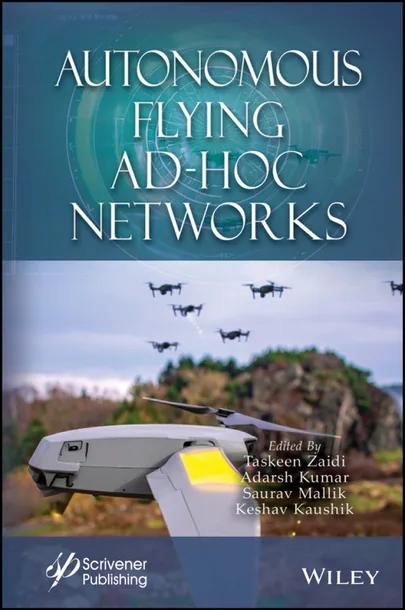
Autonomous Flying Ad-Hoc Networks
by Taskeen Zaidi, Adarsh Kumar, Saurav Mallik
1st Edition
Publisher: Wiley-Scrivener
Book Details
| Print ISBN | 9781394231058 |
| eText ISBN | 9781394231065 |
| Publisher | Wiley-Scrivener |
| Publishing Year | 2025 |
| Edition | 1st Edition |
| Language | English |
| Pages | 288 |
The 1st Edition of Autonomous Flying Ad-Hoc Networks provides researchers with a rigorous examination of autonomous aerial node architectures built for information gathering. This work demonstrates how swarms of locally connected Unmanned Aerial Vehicles interact to collect data across expansive geographic regions where conventional terrestrial infrastructure is absent or compromised.
To establish technical context, the text evaluates the fundamental characteristics, features, and design models of Flying Ad-Hoc Networks alongside Mobile Ad-hoc Networks and Vehicle Ad-Hoc Networks. It highlights how airborne node swarms cover larger distances than ground networks, supporting essential field operations such as urban surveillance, disaster management, and coordinated emergency rescue missions.
The book also examines active research efforts that utilize aerial ad-hoc systems to improve artificial intelligence algorithms and quantum computing frameworks. Available as a 288-page volume, this publication provides specialized guidance for researchers working to advance self-organizing airborne network topology and multi-UAV data collection.
Table of Contents
Chapter 1: Research Perspectives of Various Routing Protocols for Flying Ad Hoc Networks (FANETs)
- • 1.1 Introduction
- • 1.2 Unmanned Aerial Vehicles
- • 1.3 FANET Characteristics
- • 1.4 Routing Protocols for FANETs
- • 1.5 Communication Pedagogy for FANETs
- • 1.6 Challenges and Applications of FANET Configuration
- • 1.6.1 Issues and Challenges in FANETs
- • 1.6.2 Applications for FANETs
- • 1.6.2.1 Multilevel-UAV Collaboration
- • 1.6.2.2 UAV-to-Ground Cooperation
- • 1.6.2.3 UAVs in VANETs
- • 1.7 Conclusion
Chapter 2: Exploring Quantum Cryptography, Blockchain, and Flying Ad Hoc Networks: A Comprehensive Survey with Mathematical Analysis
- • 2.1 Introduction to Quantum Cryptography
- • 2.1.1 Quantum Mechanics Primer
- • 2.1.2 Genesis of Quantum Cryptography
- • 2.2 Quantum Key Distribution
- • 2.2.1 Components of Quantum Key Distribution
- • 2.2.2 Key Aspects and Security
- • 2.2.3 Challenges and Practical Considerations
- • 2.2.4 Applications
- • 2.3 Literature Review
- • 2.4 Blockchain Technology: Enhancing Security and Transparency
- • 2.4.1 Decentralization and Consensus Mechanisms
- • 2.4.2 Enhancing Security
- • 2.4.3 Transparency and Auditability
- • 2.4.4 Use Cases
- • 2.4.5 Challenges and Prospects
- • 2.4.6 Synergy Between Quantum Cryptography and Blockchain
- • 2.5 Flying Ad Hoc Networks: A Dynamic Communication Infrastructure
- • 2.5.1 Key Characteristics and Components
- • 2.5.2 Challenges and Considerations
- • 2.5.3 Applications
- • 2.5.4 Convergence of Quantum Cryptography, Blockchain, and FANETs
- • 2.6 Future Directions and Challenges
- • 2.6.1 Future Directions
- • 2.6.2 Challenges
- • 2.7 Conclusion
Chapter 3: A Survey on Security Issues, Challenges, and Future Perspectives on FANETs
- • 3.1 Introduction
- • 3.2 Architecture of FANET
- • 3.3 Unmanned Aerial Vehicle Classification
- • 3.3.1 Classification of UAVs According to the Size
- • 3.3.1.1 Very Small UAVs
- • 3.3.1.2 Small UAVs
- • 3.3.1.3 Medium UAV
- • 3.3.1.4 Large UAVs
- • 3.3.2 Classification of UAVs Based on Wing Type
- • 3.3.2.1 Multi-Rotor Drones
- • 3.3.2.2 Fixed-Wing Drones
- • 3.3.2.3 Single-Rotor Helicopter Drones
- • 3.3.2.4 Fixed-Wing Hybrid VTOL Drones
- • 3.3.3 Classifications of Drones Based on Payload
- • 3.3.3.1 Featherweight Drones
- • 3.3.3.2 Lightweight Drones
- • 3.3.3.3 Middleweight Drones
- • 3.3.3.4 Heavy Lift Drones
- • 3.4 Security Requirements
- • 3.4.1 Confidentiality
- • 3.4.2 Integrity
- • 3.4.3 Availability
- • 3.4.4 Authentication
- • 3.4.5 Non-Repudiation
- • 3.4.6 Authorization
- • 3.4.7 Non-Disclosure
- • 3.5 Routing Protocols
- • 3.5.1 Static Routing Protocol
- • 3.5.1.1 Load Carry and Deliver Routing
- • 3.5.1.2 Multi-Level Hierarchical Routing Protocol
- • 3.5.1.3 Data-Centric Routing
- • 3.5.2 Proactive Routing Protocol
- • 3.5.2.1 Destination Sequenced Distance Vector (DSDV) Routing Protocol
- • 3.5.2.2 Optimized Link State Routing
- • 3.5.3 Reactive Routing Protocol
- • 3.5.3.1 Dynamic Source Routing Protocol
- • 3.5.3.2 Ad Hoc On-Demand Distance Vector Routing Protocol
- • 3.5.3.3 Time-Slotted On-Demand Routing Protocol
- • 3.5.4 Hybrid Routing Protocols
- • 3.5.4.1 Zone Routing Protocol
- • 3.5.4.2 Temporarily Ordered Routing Algorithm
- • 3.5.5 Geographic-Based Routing Protocols
- • 3.5.5.1 Greedy Perimeter Stateless Routing
- • 3.5.5.2 Mobility-Oriented Geographical Routing
- • 3.5.6 Hierarchical Routing Protocols
- • 3.5.7 Mobility Prediction Clustering Algorithm
- • 3.5.8 Clustering Algorithm
- • 3.6 Security Issues and Countermeasures in FANET
- • 3.6.1 Sensor Level Security Issues
- • 3.6.1.1 Vulnerabilities and Treats
- • 3.6.1.2 Sensor-Based Attacks
- • 3.6.1.3 Defense Mechanisms Against Sensor-Based Attacks
- • 3.6.2 Hardware Level Issues
- • 3.6.2.1 Vulnerabilities and Threats
- • 3.6.2.2 Hardware-Based Attacks
- • 3.6.2.3 Defense Mechanisms Against Hardware- Based Attack
- • 3.6.3 Software Level Issues
- • 3.6.3.1 Vulnerabilities and Threats
- • 3.6.3.2 Software-Level Attacks
- • 3.6.3.3 Defense Mechanism Against Software- Based Attack
- • 3.7 Conclusion
Chapter 4: Quantum Cryptography for Secure FANET
- • Abbreviations
- • 4.1 Introduction
- • 4.2 Network Security Requirements
- • 4.3 Security Threats
- • 4.3.1 Taxonomy of Security Threats/Attacks
- • 4.3.1.1 Denial of Service Attack
- • 4.3.1.2 Modification and Fabrication Attacks
- • 4.3.1.3 Routing Attacks
- • 4.3.1.4 Other Attacks
- • 4.3.2 Summary
- • 4.4 Quantum Cryptography
- • 4.4.1 Quantum Cryptography Introduction
- • 4.4.2 QPKE Based FANET Model (Based on the Encryption Model Introduced by Yuqi Wang)
- • 4.5 Conclusion
Chapter 5: A Review of Various Routing Protocols for FANET
- • 5.1 Introduction
- • 5.2 Flying Ad Hoc Network Routing Protocol
- • 5.2.1 Static Routing
- • 5.2.2 Hierarchical Routing
- • 5.2.2.1 Data-Centric Routing
- • 5.2.2.2 Load, Carry, and Delivery Routing
- • 5.2.3 Proactive Routing
- • 5.2.3.1 Optimized Link State Routing
- • 5.2.3.2 Destination-Sequenced Distance Vector (dsdv)
- • 5.2.4 Reactive Routing
- • 5.2.4.1 Dynamic Source Routing
- • 5.2.4.2 Ad Hoc On-Demand Distance Vector
- • 5.2.5 Hybrid Routing
- • 5.2.5.1 Zone Routing Protocol
- • 5.2.5.2 Temporarily Ordered Routing Algorithm (tora)
- • 5.2.6 Geographic (or Position)-Based Routing
- • 5.2.6.1 DREAM (Temporarily Ordered Routing Algorithm)
- • 5.2.6.2 Location-Aided Routing
- • 5.2.6.3 Greedy Perimeter Stateless Routing
- • 5.2.6.4 AeroRP
- • 5.2.7 Cross-Layer Routing
- • 5.3 Conclusion
Chapter 6: The Integration of the Internet of Things in FANET
- • 6.1 Introduction
- • 6.1.1 Integration of IoT Technology with a FANET
- • 6.1.2 Overview of FANET and Its Applications
- • 6.1.3 Introduction of IoT and Its Relevance in FANET
- • 6.1.4 Importance of Integrating IoT with FANET for Enhanced Capabilities
- • 6.2 Fundamentals of FANETs
- • 6.2.1 Explanation of FANET Architecture and Operation
- • 6.2.1.1 Challenges in FANET Activity
- • 6.2.1.2 Activity of FANETs
- • 6.2.2 Explanation of FANET Architecture and Operation
- • 6.2.2.1 Key Characteristics and Difficulties of FANETs
- • 6.2.3 Use Cases and Advantages of a FANET in Various Industries
- • 6.2.3.1 Applications of a FANET
- • 6.2.3.2 Benefits of a FANET
- • 6.3 Introduction to the IoT
- • 6.3.1 Advantages of the IoT
- • 6.3.2 Difficulties of the IoT
- • 6.3.2.1 Definition and Core Principles of the IoT
- • 6.3.2.2 Components and Layers of the IoT Ecosystem
- • 6.4 Internet-of-Things-Enabled Communication in a FANET
- • 6.5 Internet-of-Things Communication Protocol
- • 6.5.1 Message Queuing Telemetry Transport
- • 6.5.2 Constrained Application Protocol
- • 6.5.3 Data Aggregation and Routing Strategies in IoT-Enabled FANET
- • 6.5.3.1 Methodologies of IoT-Enabled FANETs
- • 6.5.3.2 Methodologies of IoT-Empowered FANETs
- • 6.6 Conclusion
- • 6.6.1 Recap of the Key Points
- • 6.6.2 Potential Impact of IoT Integration on the Future of FANET
Chapter 7: Enhancing Precision Agriculture Through Bio-Inspired Routing Protocols for Flying Ad Hoc Networks
- • 7.1 Introduction
- • 7.2 Precision Agriculture
- • 7.3 Bio-Inspired Routing Protocols for FANET
- • 7.3.1 Gray Wolf Optimization
- • 7.3.2 BAT Algorithm
- • 7.3.3 Sand Cat Swarm Optimization Algorithm
- • 7.3.4 Ant Colony Optimization Algorithm
- • 7.3.5 Bee Colony Optimization
- • 7.3.6 Firefly Optimization Algorithm
- • 7.3.7 Case Studies and Real-World Examples of FANET in Precision Agriculture
- • 7.3.7.1 Case Study 1
- • 7.3.7.2 Case Study 2
- • 7.3.7.3 Case Study 3
- • 7.3.7.4 Case Study 4
- • 7.3.7.5 Case Study 5
- • 7.4 Real-World Applications
- • 7.5 Conclusion
Chapter 8: Disaster Recovery Management in FANETs
- • 8.1 Introduction
- • 8.2 Related Work/Literature Survey
- • 8.3 Disaster Recovery Method of FANETs
- • 8.4 Proposed New Solutions for Improved Disaster Management in FANETs
- • 8.5 Conclusion
- • 8.6 Future Techniques for Disaster Recovery in FANETs
Chapter 9: AI-Based Cybersecurity Opportunities and Issues on the IIoT
- • 9.1 Introduction
- • 9.2 Application of AI in IIoT Cybersecurity
- • 9.2.1 Anomaly Detection
- • 9.2.2 Threat Intelligence
- • 9.2.3 Network Security
- • 9.2.4 User Behavioral Analysis
- • 9.2.5 Predictive Maintenance
- • 9.2.6 Fraud Detection
- • 9.2.7 Cybersecurity Automation
- • 9.3 Potential Benefits and Issues
- • 9.4 AI-Cybersecurity Use Cases
- • 9.4.1 Siemens
- • 9.4.2 Honeywell
- • 9.4.3 Darktrace
- • 9.4.4 Symantec
- • 9.4.5 Ibm
- • 9.5 Conclusion
Chapter 10: Exploring the Synergy of Fog Computing and FANETs for Next-Generation Networking
- • 10.1 Introduction
- • 10.2 Fog Computing
Customer Reviews
0.0
0 reviews
No reviews yet. Be the first to review this book!
Write a Review
Reviewed by GradeFocus Editorial Team
▶Research Sources (14)
- Autonomous Flying Ad-Hoc Networks : John Wiley & Sons - Book2look
- [PDF] Autonomous Flying Ad-Hoc Networks by Taskeen Zaidi - Perlego
- Start reading Autonomous Flying Ad-Hoc Networks for free
- Autonomous Flying Ad-Hoc Networks eBook door - EPUB | Rakuten ...
- keshav kaushik | Adlibris
- Autonomous Flying Ad-Hoc Networks 電子書,作者- EPUB ... - Kobo
- Keshav, Kaushik - Search - Snapplify Kenya
- Wiley-Scrivener - Librairie Le Passage Alençon ALENCON
- Autonomous Flying Ad-Hoc Networks
- (PDF) Flying Ad-Hoc Networks (FANETs): A Review
- Flying Ad Hoc Networks: A New Domain for ...
- A Systematic Approach of a Flying Ad-hoc Network for ...
- Autonomous Flying Ad-Hoc Networks (ebook) | 9781394231065 ...
- Flying Ad-Hoc Networks (FANETs)