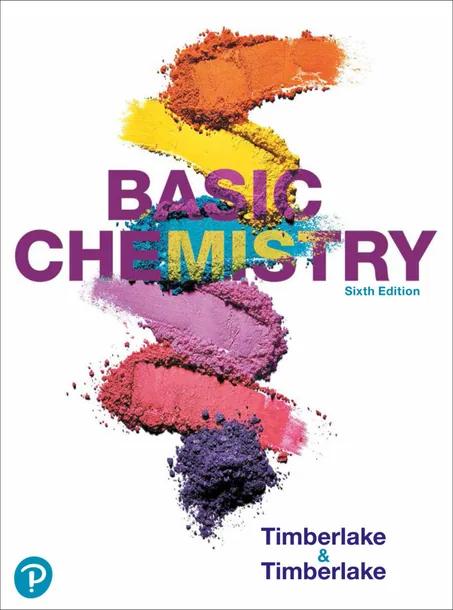
Basic Chemistry
by Karen C. Timberlake, William Timberlake
6th Edition
Publisher: Pearson
Book Details
| Print ISBN | 9780134878119 |
| eText ISBN | 9780134987088 |
| Publisher | Pearson |
| Publishing Year | 2020 |
| Edition | 6th Edition |
| Language | English |
| Pages | 704 |
The introductory textbook Basic Chemistry, 6th Edition, presents fundamental scientific concepts alongside essential quantitative problem-solving techniques. The text guides students through the scientific method, key mathematical skills, and scientific notation to build conceptual understanding and practical problem-solving confidence.
The curriculum focuses on three broad subject areas: the classification and energetic properties of matter, atomic structure and periodic trends, and the quantitative relationships that govern chemical reactions. The volume also introduces chemical bonding, the physical properties of gases, and the behavior of aqueous solutions.
To support coursework, the Pearson eTextbook provides interactive practice exercises designed to help students review numerical calculations and foundational chemical concepts.
Table of Contents
Chapter 1: Chemistry in Our Lives
- • 1.1 Chemistry and Chemicals
- • 1.2 Scientific Method: Thinking Like a Scientist
- • 1.3 Studying and Learning Chemistry
- • 1.4 Key Math Skills for Chemistry
- • 1.5 Writing Numbers in Scientific Notation
Chapter 2: Chemistry and Measurements
- • 2.1 Units of Measurement
- • 2.2 Measured Numbers and Significant Figures
- • 2.3 Significant Figures in Calculations
- • 2.4 Prefixes and Equalities
- • 2.5 Writing Conversion Factors
- • 2.6 Problem Solving Using Unit Conversion
- • 2.7 Density
Chapter 3: Matter and Energy
- • 3.1 Classification of Matter
- • 3.2 States and Properties of Matter
- • 3.3 Temperature
- • 3.4 Energy
- • 3.5 Specific Heat
- • 3.6 Energy and Nutrition
Chapter 4: Atoms and Elements
- • 4.1 Elements and Symbols
- • 4.2 The Periodic Table
- • 4.3 The Atom
- • 4.4 Atomic Number and Mass Number
- • 4.5 Isotopes and Atomic Mass
Chapter 5: Electronic Structure of Atoms and Periodic Trends
- • 5.1 Electromagnetic Radiation
- • 5.2 Atomic Spectra and Energy Levels
- • 5.3 Sublevels and Orbitals
- • 5.4 Orbital Diagrams and Electron Configurations
- • 5.5 Electron Configurations and the Periodic Table
- • 5.6 Trends in Periodic Properties
Chapter 6: Ionic and Molecular Compounds
- • 6.1 Ions: Transfer of Electrons
- • 6.2 Ionic Compounds
- • 6.3 Naming and Writing Ionic Formulas
- • 6.4 Polyatomic Ions
- • 6.5 Molecular Compounds: Sharing Electrons
Chapter 7: Chemical Quantities
- • 7.1 The Mole
- • 7.2 Molar Mass
- • 7.3 Calculations Using Molar Mass
- • 7.4 Mass Percent Composition
- • 7.5 Empirical Formulas
- • 7.6 Molecular Formulas
Chapter 8: Chemical Reactions
- • 8.1 Equations for Chemical Reactions
- • 8.2 Balancing a Chemical Equation
- • 8.3 Types of Chemical Reactions
- • 8.4 Oxidation—Reduction Reactions
Chapter 9: Chemical Quantities in Reactions
- • 9.1 Conservation of Mass
- • 9.2 Mole Relationships in Chemical Equations
- • 9.3 Mass Calculations for Chemical Reactions
- • 9.4 Limiting Reactants
- • 9.5 Percent Yield
- • 9.6 Energy in Chemical Reactions
Chapter 10: Bonding and Properties of Solids and Liquids
- • 10.1 Lewis Structures for Molecules and Polyatomic Ions
- • 10.2 Resonance Structures
- • 10.3 Shapes of Molecules and Polyatomic Ions (VSEPR Theory)
- • 10.4 Electronegativity and Bond Polarity
- • 10.5 Polarity of Molecules
- • 10.6 Intermolecular Forces Between Atoms or Molecules
- • 10.7 Changes of State
Chapter 11: Gases
- • 11.1 Properties of Gases
- • 11.2 Pressure and Volume (Boyle's Law)
- • 11.3 Temperature and Volume (Charles's Law)
- • 11.4 Temperature and Pressure (Gay-Lussac's Law)
- • 11.5 The Combined Gas Law
- • 11.6 Volume and Moles (Avogadro's Law)
- • 11.7 The Ideal Gas Law
- • 11.8 Gas Laws and Chemical Reactions
- • 11.9 Partial Pressures (Dalton's Law)
Chapter 12: Solutions
- • 12.1 Solutions
- • 12.2 Electrolytes and Nonelectrolytes
- • 12.3 Solubility
- • 12.4 Solution Concentrations
- • 12.5 Dilution of Solutions
- • 12.6 Chemical Reactions in Solution
- • 12.7 Molality and Freezing Point Lowering/Boiling Point Elevation
- • 12.8 Properties of Solutions: Osmosis
Chapter 13: Reaction Rates and Chemical Equilibrium
- • 13.1 Rates of Reactions
- • 13.2 Chemical Equilibrium
- • 13.3 Equilibrium Constants
- • 13.4 Using Equilibrium Constants
- • 13.5 Changing Equilibrium Conditions: Le Châtelier's Principle
Chapter 14: Acids and Bases
- • 14.1 Acids and Bases
- • 14.2 Brønsted—Lowry Acids and Bases
- • 14.3 Strengths of Acids and Bases
- • 14.4 Dissociation Constants of Weak Acids and Bases
- • 14.5 Dissociation of Water
- • 14.6 The pH Scale
- • 14.7 Reactions of Acids and Bases
- • 14.8 Acid—Base Titration
- • 14.9 Buffers
Chapter 15: Oxidation and Reduction
- • 15.1 Oxidation and Reduction
- • 15.2 Balancing Oxidation—Reduction Equations Using Half-Reactions
- • 15.3 Electrical Energy from Oxidation—Reduction Reactions
- • 15.4 Oxidation—Reduction Reactions That Require Electrical Energy
Chapter 16: Nuclear Chemistry
- • 16.1 Natural Radioactivity
- • 16.2 Nuclear Reactions
- • 16.3 Radiation Measurement
- • 16.4 Half-Life of a Radioisotope
- • 16.5 Medical Applications Using Radioactivity
- • 16.6 Nuclear Fission and Fusion
Chapter 17: Organic Chemistry
- • 17.1 Alkanes
- • 17.2 Alkenes, Alkynes, and Polymers
- • 17.3 Aromatic Compounds
- • 17.4 Alcohols and Ethers
- • 17.5 Aldehydes and Ketones
- • 17.6 Carboxylic Acids and Esters
- • 17.7 Amines and Amides
Chapter 18: Biochemistry
- • 18.1 Carbohydrates
- • 18.2 Disaccharides and Polysaccharides
- • 18.3 Lipids
- • 18.4 Amino Acids and Proteins
- • 18.5 Protein Structure
- • 18.6 Proteins as Enzymes
- • 18.7 Nucleic Acids
- • 18.8 Protein Synthesis
Customer Reviews
0.0
0 reviews
No reviews yet. Be the first to review this book!
Write a Review
Reviewed by GradeFocus Editorial Team