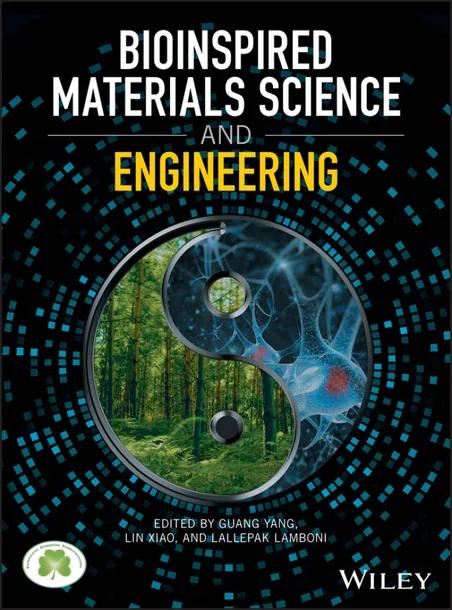
Bioinspired Materials Science and Engineering
by Guang Yang, Lin Xiao, Lallepak Lamboni
1st Edition
Publisher: John Wiley & Sons P&T
Book Details
| Print ISBN | 9781119390329 |
| eText ISBN | 9781119390343 |
| Publisher | John Wiley & Sons P&T |
| Publishing Year | 2018 |
| Edition | 1st Edition |
| Language | English |
| Pages | 400 |
Bioinspired Materials Science and Engineering, 1st Edition, provides a comprehensive introduction to the science and engineering principles governing the development of bioinspired materials.
The volume examines biological compounds and demonstrates their utility in creating functional materials. It follows the bioinspiration process from materials design and conception to practical implementation, illustrating how principles acquired from nature contribute to biofabrication and biomaterial technologies.
Featuring expert contributions, the textbook emphasizes the multidisciplinary nature of the field with a focus on biomedical applications. The work is written for chemists, biologists, physicists, and engineers.
Table of Contents
Chapter 1: Biotemplating Principles
- • 1.1 Introduction
- • 1.2 Mineralization in Nature
- • 1.3 Petrified Wood in Construction and Technology
- • 1.4 Structural Description and Emulation
- • 1.5 Characteristic Parameters
- • 1.6 Applications
- • 1.7 Limitations and Challenges
- • 1.8 Conclusion and Future Topics
- • Acknowledgments
- • Notes
- • References
Chapter 2: Tubular Tissue Engineering Based on Microfluidics
- • 2.1 Introduction
- • 2.2 Natural Tubular Structures
- • 2.3 Microfluidics
- • 2.4 Fabrication of Tubular Structures by Microfluidics
- • 2.5 Conclusion
- • Acknowledgments
- • References
Chapter 3: Construction of Three‐Dimensional Tissues with Capillary Networks by Coating of Nanometer‐ or Micrometer‐Sized Film on Cell Surfaces
- • 3.1 Introduction
- • 3.2 Fabrication of Nanometer‐ and Micrometer‐Sized ECM Layers on Cell Surfaces
- • 3.3 3D‐ Tissue with Various Thicknesses and Cell Densities
- • 3.4 Fabrication of Vascularized 3D‐Tissues and Their Applications
- • 3.5 Conclusion
- • Acknowledgments
- • References
Chapter 4: Three‐dimensional Biofabrication on Nematic Ordered Cellulose Templates
- • 4.1 Introduction
- • 4.2 What Is Nematic Ordered Cellulose (NOC)?
- • 4.3 Exclusive Surface Properties of NOC and Its Unique Applications
- • 4.4 Conclusion
- • References
Chapter 5: Preparation and Application of Biomimetic Materials Inspired by Mussel Adhesive Proteins
- • 5.1 Introduction
- • 5.2 Various Research Studies
- • 5.3 Conclusion
- • References
Chapter 6: Self‐assembly of Polylactic Acid‐based Amphiphilic Block Copolymers and Their Application in the Biomedical Field
- • 6.1 Introduction
- • 6.2 Micellar Structures from PLA‐based Amphiphilic Block Copolymers
- • 6.3 Hydrogels from PLA‐based Amphiphilic Block Copolymers
- • 6.4 Conclusion
- • Acknowledgments
- • References
Chapter 7: Electroconductive Bioscaffolds for 2D and 3D Cell Culture
- • 7.1 Introduction
- • 7.2 Electrical Stimulation
- • 7.3 Electroconductive Bioscaffolds
- • 7.4 Conclusion
- • Acknowledgments
- • References
Chapter 8: Starch and Plant Storage Polysaccharides
- • 8.1 Starch and Other Seed Polysaccharides: Availability, Molecular Structure, and Heterogeneity
- • 8.2 Effect of the Molecular Structure of Starch and Seed Polysaccharides on the Macroscopic Properties of Derived Carbohydrate‐based Materials
- • 8.3 Chemo‐ enzymatic Modification Routes for Starch and Seed Polysaccharides
- • 8.4 Conclusion
- • References
Chapter 9: Conformational Properties of Polysaccharide Derivatives
- • 9.1 Introduction
- • 9.2 Theoretical Backbone to Determine the Chain Conformation of Linear and Cyclic Polymers from Dilute Solution Properties
- • 9.3 Chain Conformation of Linear Polysaccharides Carbamate Derivatives in Dilute Solution
- • 9.4 Lyotropic Liquid Crystallinity of Polysaccharide Carbamate Derivatives
- • 9.5 Cyclic Amylose Carbamate Derivatives: An Application to Rigid Cyclic Polymers
- • 9.6 Conclusion
- • Appendix: Wormlike Chain Parameters for Polysaccharide Carbamate Derivatives
- • References
Chapter 10: Silk Proteins: A Natural Resource for Biomaterials
- • 10.1 Introduction
- • 10.2 Bio‐ synthesis of Silk Proteins
- • 10.3 Extraction of Silk Proteins
- • 10.4 Structure and Physical Properties of Silk Proteins
- • 10.5 Properties of Silk Proteins in Biomedical Applications
- • 10.6 Processing Silk Fibroin for the Preparation of Biomaterials
- • 10.7 Processing Silk Sericin for Biomaterials Applications
- • 10.8 Conclusion
- • Acknowledgments
- • Abbreviations
- • References
Chapter 11: Polypeptides Synthesized by Ring‐opening Polymerization of N‐Carboxyanhydrides: Preparation, Assembly, and Applications
- • 11.1 Introduction
- • 11.2 Living Polymerization of NCAs
- • 11.3 Synthesis of Traditional Copolypeptides and Hybrids
- • 11.4 New Monomers and Side‐Chain Functionalized Polypeptides
- • 11.5 The Self‐assembly of Polypeptides
- • 11.6 Novel Bio‐related Applications of Polypeptides
- • 11.7 Conclusion
- • References
Chapter 12: Preparation of Gradient Polymeric Structures and Their Biological Applications
- • 12.1 Introduction
- • 12.2 Gradient Polymeric Structures
- • 12.3 Gradient Polymeric Structures Regulated Cell Behavior
- • 12.4 Conclusion
- • References
Chapter 13: Bioinspired Materials and Structures: A Case Study Based on Selected Examples
- • 13.1 Introduction
- • 13.2 Fiber‐ reinforced Structures Inspired by Unbranched and Branched Plant Stems
- • 13.3 Pomelo Peel as Inspiration for Biomimetic Impact Protectors
- • 13.4 Self‐ repair in Technical Materials Inspired by Plants’ Solutions
- • 13.5 Elastic Architecture: Lessons Learnt from Plant Movements
- • 13.6 Conclusions
- • Acknowledgments
- • References
Chapter 14: Thermal‐ and Photo‐deformable Liquid Crystal Polymers and Bioinspired Movements
- • 14.1 Introduction
- • 14.2 Thermal‐ responsive CLCPs
- • 14.3 Photothermal‐ responsive CLCPs
- • 14.4 Light‐ responsive CLCPs
- • 14.4 Conclusion
- • References
Chapter 15: Tuning Mechanical Properties of Protein Hydrogels: Inspirations from Nature and Lessons from Synthetic Polymers
- • 15.1 Introduction
- • 15.2 What Are Different about Proteins?
- • 15.3 Protein Cross‐linking
- • 15.4 Strategies for Mechanical Reinforcement
- • 15.5 Conclusion
- • References
Chapter 16: Dendritic Polymer Micelles for Drug Delivery
- • 16.1 Introduction
- • 16.2 Dendrimers
- • 16.3 Hyperbranched Polymers
- • 16.4 Dendrigraft Polymers
- • 16.5 Conclusion
- • References
Chapter 17: Bone‐inspired Biomaterials
- • 17.1 Introduction
- • 17.2 Bone
- • 17.3 Bone‐ like Materials
- • 17.4 Bone‐ like Scaffolds
- • 17.5 Conclusion
- • References
Chapter 18: Research Progress in Biomimetic Materials for Human Dental Caries Restoration
- • 18.1 Introduction
- • 18.2 Tooth Structure
- • 18.3 The Formation Mechanism of Dental Caries
- • 18.4 HA‐ filled Biomimetic Resin Composites
- • 18.5 Biomimetic Synthesis of Enamel Microstructure
- • Acknowledgments
- • References
Customer Reviews
0.0
0 reviews
No reviews yet. Be the first to review this book!
Write a Review
Reviewed by GradeFocus Editorial Team
▶Research Sources (1)
Related Books
Biomechanics of the Human Spine
Fabio Galbusera

Emerging Diagnostic Glucose Sensing Approaches
Abhishek Kandwal

Engineering Nanoparticles for Biomedical Applications
Sulalit Bandyopadhyay

Soft Electronics for Diagnosis, Therapy, and Integrated Systems
Xinge Yu
Green Carbon Dots for Theranostic Applications
Hamed Barabadi
Human-Machine interfaces in Medical Robotics
Yanpei Huang