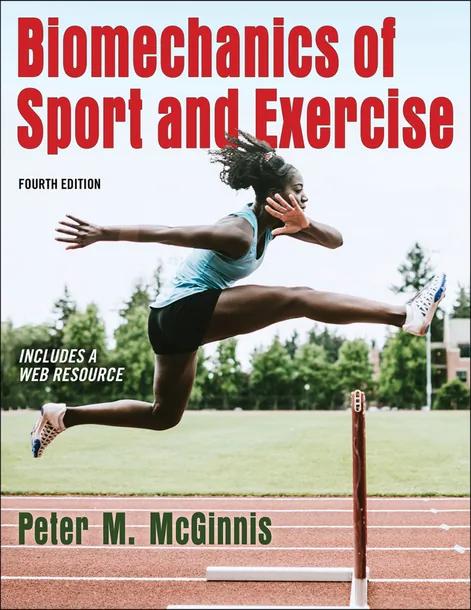
Biomechanics of Sport and Exercise
by Peter M. McGinnis
4th Edition
Publisher: Human Kinetics, Inc.
Book Details
| Print ISBN | 9781492592334 |
| eText ISBN | 9781492592297 |
| Publisher | Human Kinetics, Inc. |
| Publishing Year | 2021 |
| Edition | 4th Edition |
| Language | English |
| Pages | 400 |
Biomechanics of Sport and Exercise, 4th Edition, presents an introductory textbook designed for undergraduate students, coaches, and athletes learning to evaluate human performance. Author Peter M. McGinnis structures the content to introduce physical mechanics prior to functional anatomy, helping readers analyze external forces and their impact on motion prior to examining internal biological systems.
The text explains how the musculoskeletal system responds to external loads and generates internal forces required to maintain body position. Targeted concept application boxes illustrate physical principles in active sports, examining the Magnus effect during baseball pitching, wetsuit performance advantages in triathlon swimming, and mechanical power output measurements during cycling.
Full-color art and detailed diagrams help students visualize mechanical principles within real-world athletic scenarios. Structured classroom and self-directed experiments provide direct opportunities for students to observe physical forces in motion, making the text a practical selection for introductory coursework across kinesiology and sport science programs.
Table of Contents
Chapter Introduction: Why Study Biomechanics?
- • What Is Biomechanics?
- • What Are the Goals of Sport and Exercise Biomechanics?
- • The History of Sport Biomechanics
- • The Organization of Mechanics
- • Basic Dimensions and Units of Measurement Used in Mechanics
- • Summary
Chapter 1: Forces: Maintaining Equilibrium or Changing Motion
- • What Are Forces?
- • Classifying Forces
- • Friction
- • Addition of Forces: Force Composition
- • Resolution of Forces
- • Static Equilibrium
- • Summary
Chapter 2: Linear Kinematics: Describing Objects in Linear Motion
- • Motion
- • Linear Kinematics
- • Uniform Acceleration and Projectile Motion
- • Summary
Chapter 3: Linear Kinetics: Explaining the Causes of Linear Motion
- • Newton’s First Law of Motion: Law of Inertia
- • Conservation of Momentum
- • Newton’s Second Law of Motion: Law of Acceleration
- • Impulse and Momentum
- • Newton’s Third Law of Motion: Law of Action-Reaction
- • Newton’s Law of Universal Gravitation
- • Summary
Chapter 4: Work, Power, and Energy: Explaining the Causes of Motion Without Newton
- • Work
- • Energy
- • The Work–Energy Principle
- • Power
- • Summary
Chapter 5: Torques and Moments of Force: Maintaining Equilibrium or Changing Angular Motion
- • What Are Torques?
- • Forces and Torques in Equilibrium
- • What Is Center of Gravity?
- • Summary
Chapter 6: Angular Kinematics: Describing Objects in Angular Motion
- • Angular Position and Displacement
- • Angular and Linear Displacement
- • Angular Velocity
- • Angular and Linear Velocity
- • Angular Acceleration
- • Angular and Linear Acceleration
- • Anatomical System for Describing Limb Movements
- • Summary
Chapter 7: Angular Kinetics: Explaining the Causes of Angular Motion
- • Angular Inertia
- • Angular Momentum
- • Angular Interpretation of Newton’s First Law of Motion
- • Angular Interpretation of Newton’s Second Law of Motion
- • Angular Impulse and Angular Momentum
- • Angular Interpretation of Newton’s Third Law of Motion
- • Summary
Chapter 8: Fluid Mechanics: The Effects of Water and Air
- • Buoyant Force: Force Due to Immersion
- • Dynamic Fluid Force: Force Due to Relative Motion
- • Summary
Chapter 9: Mechanics of Biological Materials: Stresses and Strains on the Body
- • Stress
- • Strain
- • Mechanical Properties of Materials: The Stress–Strain Relationship
- • Mechanical Properties of the Musculoskeletal System
- • Summary
Chapter 10: The Skeletal System: The Rigid Framework of the Body
- • Bones
- • Joints
- • Summary
Chapter 11: The Muscular System: The Motors of the Body
- • The Structure of Skeletal Muscle
- • Muscle Action
- • Muscle Contraction Force
- • Summary
Chapter 12: The Nervous System: Control of the Musculoskeletal System
- • The Nervous System and the Neuron
- • The Motor Unit
- • Receptors and Reflexes
- • Summary
Chapter 13: Qualitative Biomechanical Analysis to Improve Technique
- • Types of Biomechanical Analysis
- • Steps of a Qualitative Biomechanical Analysis
- • Sample Analyses
- • Summary
Chapter 14: Qualitative Biomechanical Analysis to Improve Training
- • Biomechanics and Training
- • Qualitative Anatomical Analysis Method
- • Sample Analyses
- • Summary
Chapter 15: Qualitative Biomechanical Analysis to Understand Injury Development
- • Mechanical Stress and Injury
- • Tissue Response to Stress
- • Mechanism of Overuse Injury
- • Individual Differences in Tissue Threshold
- • Intrinsic and Extrinsic Factors Affecting Injury
- • Sample Analysis: Overuse Injuries in Running
- • Summary
Chapter 16: Technology in Biomechanics
- • Quantitative Biomechanical Analysis
- • Measurement Issues
- • Tools for Measuring Biomechanical Variables
- • Summary
Customer Reviews
0.0
0 reviews
No reviews yet. Be the first to review this book!
Write a Review
Reviewed by GradeFocus Editorial Team
▶Research Sources (11)
- Biomechanics of Sport and Exercise 4th Edition epub
- Biomechanics of Sport and Exercise by: Peter M. McGinnis
- Biomechanics of Sport and Exercise: Seton Hall University
- Biomechanics of Sport and Exercise: University Of The Incarnate Word
- Biomechanics of Sport and Exercise (4e): Essential eBook Resources
- Biomechanics of Sport and Exercise, eBook by Peter M. McGinnis
- Biomechanics of Sport and Exercise (4th Edition)
- Biomechanics of Sport and Exercise Textbook
- Biomechanics of Sport and Exercise 4th Edition Mcginnis Full Chapters
- Biomechanics of Sport and Exercise - Peter Merton McGinnis
- Biomechanics of sport and exercise : McGinnis, Peter Merton, 1954