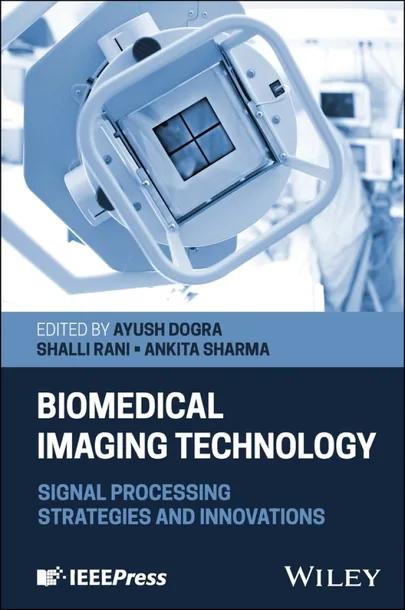
Biomedical Imaging Technology
Signal Processing Strategies and Innovations
by Ayush Dogra, Shalli Rani, Ankita Sharma
1st Edition
Publisher: Wiley-IEEE Press
Book Details
| Print ISBN | 9781394348053 |
| eText ISBN | 9781394348060 |
| Publisher | Wiley-IEEE Press |
| Publishing Year | 2025 |
| Edition | 1st Edition |
| Language | English |
| Pages | 272 |
The 1st Edition of Biomedical Imaging Technology: Signal Processing Strategies and Innovations provides a structured technical introduction to signal processing strategies used across modern medical diagnostic systems. The text outlines core computational principles to help readers analyze complex physiological data and evaluate signal acquisition frameworks.
The core thematic coverage concentrates on specialized optical imaging technologies. It provides dedicated analysis of fluorescence imaging, photoacoustic imaging, and Optical Coherence Tomography (OCT). Expanding into operational practice, the text details how signal processing strategies are applied within image-guided interventions, modern surgical navigation, and theranostics in cancer treatment.
By linking optical diagnostic methods directly to interventional applications, the text provides functional clarity for specialized academic study. The content is tailored to support researchers in biomedical engineering alongside researchers in imaging and signal processing.
Table of Contents
Chapter 1: Historical Evolution and Technological Advancements in Biomedical Imaging
- • 1.1 Introduction
- • 1.2 Early Milestones in Biomedical Imaging
- • 1.2.1 Pre-Imaging Era: Anatomy and Physical Diagnosis
- • 1.2.2 Discovery of X-Rays and Birth of Radiography
- • 1.2.3 Development of Radioisotope Imaging (Nuclear Medicine)
- • 1.3 Signal Processing Strategies in Biomedical Imaging
- • 1.3.1 Data Acquisition and Preprocessing
- • 1.3.2 Image Reconstruction Algorithms
- • 1.3.3 Feature Extraction and Enhancement
- • 1.3.4 Real-Time Processing Strategies
- • 1.4 Innovations in Signal Processing for Biomedical Imaging
- • 1.4.1 Machine Learning and AI-Driven Techniques
- • 1.4.2 Quantum Signal Processing in Imaging
- • 1.4.3 Multimodal Imaging and Data Fusion
- • 1.4.4 Emerging Trends in Signal Processing Hardware
- • 1.5 Case Studies
- • 1.5.1 Innovations in Signal Processing for MRI
- • 1.5.2 Deep Learning in Ultrasound Imaging
- • 1.5.3 Hybrid Imaging Modalities
- • 1.6 Challenges and Future Directions
- • 1.6.1 Ethical and Regulatory Concerns
- • 1.6.2 Scalability and Cost Effectiveness of Signal Processing Techniques
- • 1.6.3 Future Trends in Biomedical Signal Processing
- • 1.6.3.1 Image Systems at the Crossroads of Edge AI and IoT
- • 1.6.3.2 Signal Processing for Personalized Imaging
- • 1.7 Advancements in Signal Processing Techniques and Innovations
- • 1.7.1 Future Perspectives on Biomedical Imaging
- • 1.8 Conclusion
Chapter 2: Deep Learning Techniques for Biomedical Imaging
- • 2.1 Introduction
- • 2.2 Overview of DL Architecture in Biomedical Imaging
- • 2.3 CNN Architecture
- • 2.4 Basic Concepts in Biomedical Imaging
- • 2.4.1 Data Representation in Imaging
- • 2.4.2 Image Reconstruction with dl
- • 2.4.2.1 Concept of Image Reconstruction
- • 2.4.3 Image Segmentation
- • 2.4.3.1 Traditional Image Segmentation Techniques
- • 2.4.3.2 dl Image Segmentation Models
- • 2.4.4 Image Registration
- • 2.4.5 Diagnosis and Classification
- • 2.4.5.1 Types of Image Classification
- • 2.4.5.2 Working of Image Classification
- • 2.4.6 Functional and Molecular Imaging
- • 2.4.7 Explainability and Interpretability
- • 2.4.7.1 Significance of Interpretability and Explainability
- • 2.5 Future Study and Application of Image Processing in Biomedical
- • 2.6 Conclusion
Chapter 3: Advanced Methods and Approaches in Image Reconstruction
- • 3.1 Introduction
- • 3.1.1 Fundamental Principles of Image Reconstruction
- • 3.1.2 Forward and Inverse Problems in Image Reconstruction
- • 3.1.2.1 Forward Problems
- • 3.1.2.2 Inverse Problems
- • 3.2 Classical Analytical Methods
- • 3.2.1 Filtered Back Projection (FBP)
- • 3.2.2 Fourier-Based Methods
- • 3.2.3 Algebraic and Iterative Techniques
- • 3.2.3.1 Algebraic Reconstruction Techniques (ARTs)
- • 3.2.3.2 Simultaneous Algebraic Reconstruction Technique (SART)
- • 3.3 Convergence and Computational Challenges
- • 3.4 Signal Processing for Noise and Artifact Management
- • 3.4.1 Sources of Noise and Artifacts
- • 3.4.2 Sources of Noise
- • 3.4.3 Sources of Artifacts
- • 3.5 Denoising Techniques
- • 3.5.1 Spatial Domain Filtering
- • 3.5.2 Transform Domain Approaches
- • 3.6 Artifact Correction Methods
- • 3.6.1 Model-Based Correction Techniques
- • 3.6.2 Deep Learning Approaches for Artifact Reduction
- • 3.6.3 Advanced Signal Processing Strategies
- • 3.7 Compressed Sensing in Imaging
- • 3.7.1 Sparse Representation and Sampling
- • 3.7.2 Applications in MRI and CT
- • 3.7.3 Model-Based Reconstruction Techniques
- • 3.7.4 Bayesian Inference Models
- • 3.8 Statistical Methods for Noise Modeling
- • 3.8.1 Machine Learning and Neural Networks
- • 3.8.2 Supervised vs Unsupervised Approaches
- • 3.8.3 Deep Learning for Artifact Removal and Reconstruction
- • 3.8.4 Emerging Innovations in Image Reconstruction
- • 3.9 Hybrid Computational Methods
- • 3.9.1 Optimization-Based Deep Networks
- • 3.9.2 Multimodal and Multiresolution Techniques
- • 3.9.3 Super-Resolution Approaches for Enhanced Detail
- • 3.10 Quantum Signal Processing
- • 3.10.1 Quantum Imaging and Sensing
- • 3.11 AI-Assisted Real-Time Reconstruction
- • 3.12 Conclusion
Chapter 4: Integrative Approaches in Image Analysis and Signal Interpretation
- • 4.1 Introduction
- • 4.2 Related Work
- • 4.3 Materials and Methodology
- • 4.3.1 Description of Dataset
- • 4.3.2 Proposed Methodology
- • 4.3.2.1 Input Dataset and Pre-Processing
- • 4.3.2.2 Designing of Deep Learning Models
- • 4.4 Results and Discussion
- • 4.4.1 Analysis Based on Confusion Matrix
- • 4.4.2 Analysis Based on Accuracy
- • 4.4.3 Analysis Based on Loss
- • 4.5 Conclusion and Future Scope
Chapter 5: Multimodal Imaging: Combining Molecular and Optical Approaches
- • 5.1 Introduction
- • 5.2 Network Model
- • 5.2.1 Dataset Selection
- • 5.2.2 Image Patches for Classification and Regression Localization
- • 5.2.3 Candidate Block Screening Network
- • 5.2.4 Verification Module—Task-Guided Radial Basis Network
- • 5.2.5 Loss Function
- • 5.3 Evaluation and Results from Experiments
- • 5.3.1 Experimental Setting
- • 5.3.2 Performance Evaluation Metrics
- • 5.3.3 The Impact of Picture Block Size on the Efficiency of the Model
- • 5.3.4 The Impact of Deep Supervision and Attention Mechanism on Model Performance
- • 5.3.5 The Impact of the Number of Cluster Centers on Model Performance
- • 5.3.6 Experiments on ICPR 2014 Dataset
- • 5.3.7 Experiments on the AMIDA 2013 Dataset
- • 5.4 Conclusion
Chapter 6: Advancements in Biomedical Imaging Using Fluorescence and Bioluminescence
- • 6.1 Introduction
- • 6.2 Advancements in Imaging Bioluminescence
- • 6.2.1 Advances in Bioluminescence Imaging
- • 6.2.2 Fluorescence Imaging Challenges
- • 6.2.3 Recent Innovations in Imaging Technologies
- • 6.3 Key Innovations in Bioluminescence Imaging (BLI)
- • 6.3.1 Recent Advances
- • 6.3.1.1 Luciferase-Loaded Nanoparticles
- • 6.3.1.2 Synthetic Bioluminescent Reactions
- • 6.3.1.3 Bioluminescent Reporters
- • 6.3.1.4 Bacterial Bioluminescence
- • 6.3.1.5 Applications and Future Directions
- • 6.4 Limitations of Bioluminescence Imaging (BLI)
- • 6.4.1 Depth Limitations
- • 6.4.2 Variation in Outputs
- • 6.4.3 Limitations to Quantitative Precision
- • 6.4.4 Other Major Limitations
- • 6.5 Evolution of BLI Technology
- • 6.5.1 Enhanced Luminescent Units
- • 6.5.2 Advanced Imaging Methods
- • 6.5.3 Improvements in Photon Detection
- • 6.5.3.1 High-Sensitivity Photon Detectors
- • 6.6 Applications of Bioluminescence Imaging
- • 6.6.1 Gene Expressions and Protein Localizations
- • 6.6.1.1 Multicolor Auto-Bioluminescence Systems
- • 6.6.2 Tumor Imaging
- • 6.6.2.1 Long-Term Imaging with Nanoparticles
- • 6.6.3 Optogenetic Biosensing
- • 6.6.3.1 Bioluminescence-Induced Optogenetic Biosensors
- • 6.6.4 Biomedical Research and Diagnostics
- • 6.6.4.1 Studies of Infectious Disease and Compounds for Treatment
- • 6.6.4.2 Challenges and Direction for the Future
- • 6.7 Innovations in Fluorescence Imaging
- • 6.7.1 Miniaturized Fluorescent Probes
- • 6.7.2 Computational Photography in Surgery
- • 6.7.3 Advanced Imaging Methods
- • 6.7.3.1 Challenges and Future Directions
- • 6.7.3.2 Fluorescence Imaging: Limitations
- • 6.8 Advances in Fluorescence Imaging Technology
- • 6.8.1 From Computational Photography to Fluorescence Imaging
- • 6.8.2 Near-Infrared Fluorescence Imaging in Cancer Diagnosis
- • 6.8.3 Advances in Fluorescence Molecular Tomography (FMT)
- • 6.8.4 Small-Molecule Probes in Bioimaging
- • 6.8.5 Light Sheet Fluorescence Microscopy (LSFM)
- • 6.9 Comparative Analysis of Bioluminescence and Fluorescence Imaging
- • 6.9.1 Sensitivity and the Strength of the Signal
- • 6.9.2 Application and Versatility
- • 6.9.3 Hybrid Methods
- • 6.10 Emerging Trends in Imaging Technological Development
- • 6.10.1 Challenges and Suggestions
- • 6.11 Conclusion
Chapter 7: Innovative Diagnostic Imaging Techniques and Protocols
- • 7.1 Introduction
- • 7.1.1 Evolution of Multi-Modal and Hybrid Imaging
- • 7.1.2 AI-Driven Image Analysis and Explainability in Medical Imaging
- • 7.1.3 Advancement in Molecular and Functional Imaging
- • 7.1.4 Radiomics and Predictive Analytics in Imaging
- • 7.1.5 Standardized Imaging Protocols and Future Trends
- • 7.2 Diagnosing Imaging Methods
- • 7.2.1 Conventional Diagnostic Imaging Techniques
- • 7.2.1.1 X-Ray Radiography and Its Limitations
- • 7.2.1.2 Pneumoencephalography (PEG): A Historical Perspective and Its Limitations
- • 7.2.1.3 Cerebral Angiography: Detecting Tumor-Related Vascular Abnormalities
- • 7.2.2 Advanced Imaging Modalities in Brain Tumor Detection
- • 7.2.2.1 Computed Tomography (CT) and Its Advancements
- • 7.2.2.2 Magnetic Resonance Imaging (MRI) and Functional Variants
- • 7.2.2.3 Positron Emission Tomography (PET) and Hybrid Imaging
- • 7.3 Comparison of Innovative Diagnost
Customer Reviews
0.0
0 reviews
No reviews yet. Be the first to review this book!
Write a Review
Reviewed by GradeFocus Editorial Team
▶Research Sources (12)
- [PDF] Biomedical Imaging Technology by Ayush Dogra
- Biomedical Imaging Technology, eBook by Ayush Dogra
- Please verify you are human - Captcha
- Thompson Learn.
- eBooks | Sixth & Center
- Biomedical Imaging Technology... | Buy | 9781394348053
- Biomedical Imaging Technology - Hardcover [9781394348053]
- Biomedical Imaging - Biomedical Engineering | Virginia Tech
- Part 1 | Introduction to Biomedical Imaging Systems - YouTube
- The State of the Art of Medical Imaging Technology: from Creation ... - PMC
- Ayush Dogra Biomedical Imaging Technology - Rarewaves.com
- Biomedical Imaging Technology - (ISBN: 9781394348053) | De Slegte
Related Books

Machining Fundamentals
John R. Walker

Fundamentals of Thermal Fluid Sciences
Yunus A. Cengel
Modern Automotive Technology
James E. Duffy

Engineering Mechanics: Dynamics
Russell C. Hibbeler

Introduction to Fire Protection and Emergency Services
Robert Klinoff

Introduction to Fire Protection and Emergency Services
Robert Klinoff