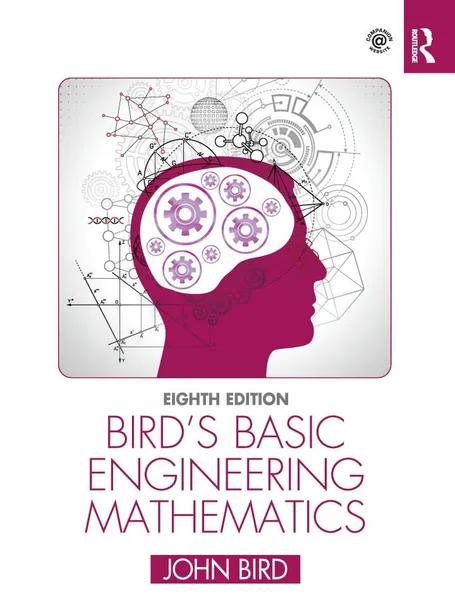
Bird's Basic Engineering Mathematics
by John Bird
8th Edition
Publisher: Routledge
Book Details
| Print ISBN | 9780367643706 |
| eText ISBN | 9781000299366 |
| Publisher | Routledge |
| Publishing Year | 2021 |
| Edition | 8th Edition |
| Language | English |
| Pages | 438 |
Bird's Basic Engineering Mathematics, 8th Edition, provides an accessible introduction to core mathematical principles used across technical fields. John Bird connects mathematical theory directly to practical applications to help students prepare for coursework and technical examinations.
The volume covers arithmetic foundations, algebra, trigonometry, coordinate systems, and basic calculus. Key subjects include indices, simultaneous equations, straight line graphs, geometric areas and volumes, and introductory differentiation and integration.
Designed for introductory engineering programs such as mechanical, electrical, aeronautical, and construction disciplines, the textbook aligns with BTEC, City & Guilds, and GCSE syllabuses. Around 1,000 flagged problems demonstrate the importance of mathematics in real-world engineering contexts.
Table of Contents
Chapter 1: Basic arithmetic
Chapter 2: Fractions
Chapter 3: Decimals
Chapter 4: Using a calculator
Chapter 5: Percentages
Chapter 6: Ratio and proportion
Chapter 7: Powers, roots and laws of indices
Chapter 8: Units, prefixes and engineering notation
Chapter 9: Basic algebra
Chapter 10: Further algebra
Chapter 11: Solving simple equations
Chapter 12: Transposing formulae
Chapter 13: Solving simultaneous equations
Chapter 14: Solving quadratic equations
Chapter 15: Logarithms
Chapter 16: Exponential functions
Chapter 17: Straight line graphs
Chapter 18: Graphs reducing non-linear laws to linear form
Chapter 19: Graphical solution of equations
Chapter 20: Graphs with logarithmic scales
Chapter 21: Angles and triangles
Chapter 22: Introduction to trigonometry
Chapter 23: Trigonometric waveforms
Chapter 24: Non-right angled triangles and some practical applications
Chapter 25: Cartesian and polar co-ordinates
Chapter 26: Areas of common shapes
Chapter 27: The circle and its properties
Chapter 28: Volumes and surface areas of common solids
Chapter 29: Irregular areas and volumes and mean values
Chapter 30: Vectors
Chapter 31: Methods of adding alternating waveforms
Chapter 32: Presentation of statistical data
Chapter 33: Mean, median, mode and standard deviation
Chapter 34: Probability
Chapter 35: Introduction to differentiation
Chapter 36: Standard integration
Chapter 37: Number sequences
Chapter 38: Binary, octal and hexadecimal
Customer Reviews
0.0
0 reviews
No reviews yet. Be the first to review this book!
Write a Review
Reviewed by GradeFocus Editorial Team