Book Details
| Print ISBN | 9780367643782 |
| eText ISBN | 9781000352009 |
| Publisher | Routledge |
| Publishing Year | 2021 |
| Edition | 9th Edition |
| Language | English |
| Pages | 544 |
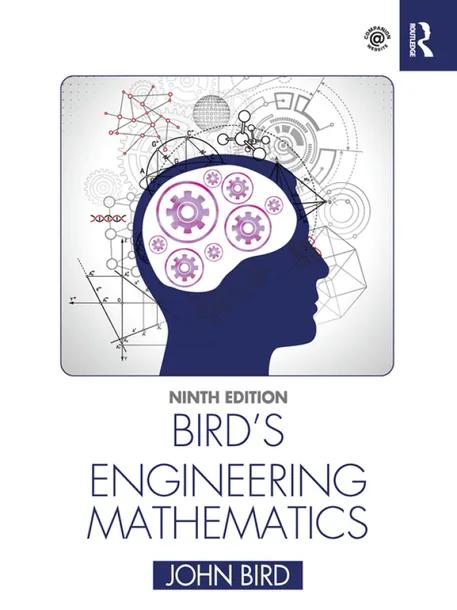
Bird's Engineering Mathematics, 9th Edition, is a textbook by John Bird that explains mathematical theories through practical engineering examples. Published by Routledge in 2021, the volume connects mathematical concepts to technical practice across multiple engineering disciplines.
The text covers foundational arithmetic and algebra, trigonometry, coordinate systems, and graphs. It also introduces vector analysis, complex numbers, differential calculus, and introductory statistics.
To show that engineering relies on quantitative methods, the text flags approximately 1,300 engineering problems and situations. This instructional approach supports learners studying Level 2 and Level 3 engineering courses as well as related technical syllabuses.
Table of Contents
Chapter 1: Revision of fractions, decimals and percentages
Chapter 2: Indices, engineering notation and metric conversions
Chapter 3: Binary, octal and hexadecimal numbers
Chapter 4: Calculations and evaluation of formulae
Chapter 5: Algebra
Chapter 6: Further algebra
Chapter 7: Partial fractions
Chapter 8: Solving simple equations
Chapter 9: Transposition of formulae
Chapter 10: Solving simultaneous equations
Chapter 11: Solving quadratic equations
Chapter 12: Inequalities
Chapter 13: Logarithms
Chapter 14: Exponential functions
Chapter 15: Number sequences
Chapter 16: The binomial series
Chapter 17: Introduction to trigonometry
Chapter 18: Trigonometric waveforms
Chapter 19: Cartesian and polar co-ordinates
Chapter 20: Triangles and some practical applications
Chapter 21: Trigonometric identities and equations
Chapter 22: Compound angles
Chapter 23: Areas of common shapes
Chapter 24: The circle and its properties
Chapter 25: Volumes and surface areas of common solids
Chapter 26: Irregular areas and volumes and mean values of waveforms
Chapter 27: Straight line graphs
Chapter 28: Reduction of non-linear laws to linear form
Chapter 29: Graphs with logarithmic scales
Chapter 30: Graphical solution of equations
Chapter 31: Functions and their curves
Chapter 32: Complex numbers
Chapter 33: De Moivre’s theorem
Chapter 34: Vectors
Chapter 35: Methods of adding alternating waveforms
Chapter 36: Introduction to differentiation
Chapter 37: Methods of differentiation
Chapter 38: Some applications of differentiation
Chapter 39: Solving equations by Newton's method
Chapter 40: Maclaurin’s series
Chapter 41: Differentiation of parametric equations
Chapter 42: Differentiation of implicit functions
Chapter 43: Logarithmic differentiation
Chapter 44: Standard integration
Chapter 45: Integration using algebraic substitutions
Chapter 46: Integration using trigonometric substitutions
Chapter 47: Integration using partial fractions
Chapter 48: The t = tan θ/2 substitution
Chapter 49: Integration by parts
Chapter 50: Numerical integration
Chapter 51: Areas under and between curves
Chapter 52: Mean and root mean square values
Chapter 53: Volumes of solids of revolution
Chapter 54: Centroids of simple shapes
Chapter 55: Second moments of area
Chapter 56: Introduction to differential equations
Chapter 57: Boolean algebra and logic circuits
Chapter 58: The theory of matrices and determinants
Chapter 59: The solution of simultaneous equations by matrices and determinants
Chapter 60: Presentation of statistical data
Chapter 61: Mean, median, mode and standard deviation
Chapter 62: Probability
Chapter 63: The binomial and Poisson distribution
Chapter 64: The normal distribution
Chapter 65: Linear correlation
Chapter 66: Linear regression
Chapter 67: Sampling and estimation theories
Chapter List of essential formulae: List of essential formulae
Chapter Answers to Practice Exercises: Answers to Practice Exercises
Customer Reviews
0.0
0 reviews
No reviews yet. Be the first to review this book!
Write a Review
Reviewed by GradeFocus Editorial Team