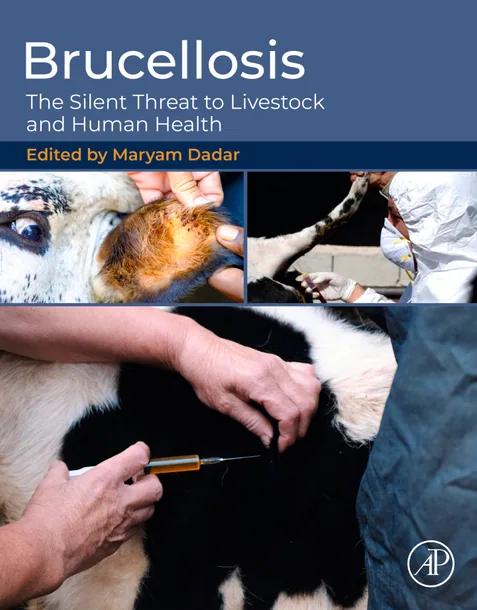
Brucellosis
The Silent Threat to Livestock and Human Health
by Maryam Dadar
1st Edition
Publisher: Academic Press
Book Details
| Print ISBN | 9780443300677 |
| eText ISBN | 9780443300684 |
| Publisher | Academic Press |
| Publishing Year | 2025 |
| Edition | 1st Edition |
| Language | English |
Brucellosis: The Silent Threat to Livestock and Human Health, 1st Edition, is edited by Maryam Dadar and published by Academic Press. This reference volume reviews the infection dynamics, diagnostic tools, and clinical presentation of brucellosis across cattle, goats, sheep, swine, and human populations. It establishes a grounded foundation for understanding how the pathogen affects diverse animal hosts and human health.
The text details current treatment strategies, control measures, and prevention protocols for agricultural and clinical settings. Through real-world case studies of outbreaks in livestock and human groups, the work illustrates specific transmission pathways and management responses. It further analyzes the global epidemiology and zoonotic transmission trends that influence disease persistence across international boundaries.
By organizing its content around a One Health approach, the volume bridges veterinary science with public health practice. This text supports veterinarians, animal health professionals in agricultural systems, and research scientists specializing in epidemiology and infectious disease control.
Table of Contents
Chapter 1: Historical context and background of brucellosis in the world
- • 1.1. History and spread of brucellosis across the world
- • 1.2. Conclusion
Chapter 2: Brucellosis throughout human history
- • 2.1. Introduction
- • 2.2. Early evidence of human brucellosis
- • 2.3. Discovery of Brucella
- • 2.3.1. An investigation on the island of Malta
- • 2.4. Three diseases in one
- • 2.5. Conclusion
Chapter 3: The genetic diversity of Brucella species
- • 3.1. Introduction
- • 3.2. General characteristics of Brucella spp
- • 3.3. Techniques to assess Brucella genetic diversity
- • 3.3.1. Multiple-Locus Variable Number Tandem Repeat Analysis
- • 3.3.2. WGS (Pangenome and SNP)
- • 3.4. Evolution of Brucella from Ochrobactrum
- • 3.5. Division into classical and atypical
- • 3.6. Classical Brucella
- • 3.6.1. Brucella melitensis
- • 3.6.2. Brucella abortus
- • 3.6.3. Brucella suis
- • 3.6.4. Brucella ovis
- • 3.6.5. Brucella neotomae
- • 3.6.6. Brucella canis
- • 3.6.7. Brucella ceti
- • 3.6.8. Brucella pinnipedialis
- • 3.6.9. Brucella microti
- • 3.6.10. Brucella papionis
- • 3.6.11. Brucella amazoniensis sp. nov
- • 3.6.12. Brucella sp. F5/99
- • 3.6.13. Brucella sp . BCCN84-3 and B. nosferati
- • 3.7. Atypical Brucella
- • 3.7.1. Brucella inopinata
- • 3.7.2. BO2
- • 3.7.3. Australian rodent Brucella strains
- • 3.7.4. 09RB8471 and 10RB9215
- • 3.7.5. Brucella vulpis
- • 3.7.6. 141012304
- • 3.7.7. B13-0095
- • 3.7.8. 191011898
- • 3.7.9. BO3
- • 3.8. Conclusions
Chapter 4: Pathogenesis and immunopathological phenomena around Brucella infections
- • 4.1. Clinical manifestations of human brucellosis
- • 4.2. Inflammation induced by Brucella infections
- • 4.3. Osteoarticular brucellosis
- • 4.3.1. Bone structure: Interplay between forming and resorbing cells
- • 4.3.2. Brucella and osteoblasts/ osteocytes: Dangerous liaisons
- • 4.3.3. Brucella and synoviocytes: Beyond bone
- • 4.3.4. Osteoclast activation by Brucella
- • 4.4. Interactions of immune cells with bone cells in the context of Brucella infection
- • 4.5. Brucella placental infection and pathological findings in the female reproductive tract
- • 4.5.1. Trophoblasts at the center of the stage
- • 4.5.2. In vitro approaches to understand Brucella abortion in humans
- • 4.5.3. Immune response to Brucella infection in the maternal—fetal interface
- • 4.6. Neurobrucellosis
- • 4.6.1. Getting there: Brucella and the Trojan horse mechanism
- • 4.6.2. Once inside: The negative loop between glial cells and BBB
- • 4.6.3. Inflammation in the middle of the scene
- • 4.6.4. Neurons as the ultimate target of the inflammation storm or neurons as the victim of this crime
- • 4.7. Epididymoorchitis
- • 4.8. Hepatic brucellosis
- • 4.9. Cardiovascular brucellosis
- • 4.10. Conclusion
Chapter 5: Immunopathology in osteoarticular Brucella infection
- • 5.1. Clinical aspect of osteoarticular human brucellosis
- • 5.2. Spinal brucellosis
- • 5.2.1. Spondylitis, spondylodiscitis, and discitis
- • 5.2.2. Sacroiliitis
- • 5.2.3. Peripheral skeleton
- • 5.3. Bone and immune system cross-talk
- • 5.4. Classical pathways in bone cells formation
- • 5.5. Nonclassical pathways in bone cell formation
- • 5.6. Interaction between Brucella and bone cells
- • 5.6.1. Osteoclasts
- • 5.6.2. Mesenchymal stem cells
- • 5.6.3. Osteoblasts
- • 5.6.4. Osteocytes
- • 5.6.5. Synoviocytes
- • 5.7. Animal model insights
- • 5.8. Concluding remarks
Chapter 6: Brucellosis in livestock and companion animals
- • 6.1. Introduction
- • 6.2. Public health significance
- • 6.3. Brucellosis in livestock
- • 6.3.1. Cattle
- • 6.3.2. Goat
- • 6.3.3. Sheep
- • 6.3.4. Pig
- • 6.3.5. Camel
- • 6.3.6. Horse
- • 6.4. Brucellosis in companion animal species
- • 6.4.1. Dog
- • 6.5. Etiology
- • 6.6. Pathogenesis
- • 6.6.1. Brucella invasion strategies and intracellular niche establishment
- • 6.6.2. Target tissues and cellular tropism
- • 6.6.3. Sialic acid-mediated adherence and invasion: A gateway for Brucella pathogenesis
- • 6.6.4. Orchestrating cellular entry: The role of cytoskeletal dynamics in Brucella invasion
- • 6.6.5. Divergent host inflammatory responses to Brucella invasion routes
- • 6.6.6. Oxidative stress and immune modulation
- • 6.7. Intracellular survival and replication
- • 6.7.1. Modulating phagosomal acidification
- • 6.7.2. Inhibiting macrophage apoptosis
- • 6.8. Brucella’s atypical virulence arsenal
- • 6.8.1. Type IV secretion system (virB T4SS)
- • 6.8.2. Brucella lipopolysaccharide
- • 6.8.3. Pathogen-associated molecular patterns
- • 6.8.4. Two-component sensory and regulatory system (BvrS/BvrR)
- • 6.8.5. Cyclic β-glucan
- • 6.9. Brucella dissemination, target tissues, and manipulation of host processes
- • 6.9.1. Dissemination and tissue tropism
- • 6.9.2. A selective tropism for the reproductive tract
- • 6.9.3. Brucella—host interactions in the placenta
- • 6.9.4. Erythritol: A complex role in pathogenesis
- • 6.9.5. Targeted replication and placental disruption
- • 6.9.6. Endothelial invasion and villous necrosis
- • 6.9.7. A cascade culminating in pregnancy loss
- • 6.10. Clinical signs
- • 6.10.1. Factors influencing clinical presentation
- • 6.10.2. Reproductive sequelae in female animals
- • 6.10.3. Mammary gland pathology
- • 6.10.4. Testicular inflammation and impaired fertility
- • 6.10.5. Musculoskeletal manifestations
- • 6.10.6. Reproductive disruption in doe and ewe
- • 6.10.7. Reproductive pathology in buck and ram
- • 6.10.8. Equine brucellosis
- • 6.10.9. Porcine brucellosis
- • 6.10.10. Canine brucellosis
- • 6.11. Epidemiology
- • 6.12. Geographic distribution of Brucella species and biovars
- • 6.12.1. Asia
- • 6.12.2. Africa
- • 6.12.3. America
- • 6.12.4. Europe
- • 6.13. Risk factors
- • 6.13.1. Livestock production practices and brucellosis prevalence
- • 6.13.2. Seasonal and sex-based epidemiological patterns in brucellosis
- • 6.13.3. Breed and brucellosis susceptibility: A complex relationship
- • 6.13.4. Age-dependent susceptibility in bovine brucellosis
- • 6.14. Transmission
- • 6.14.1. Ingestion: The predominant route in livestock
- • 6.14.2. Inhalation
- • 6.14.3. Direct contact and fomite transmission
- • 6.14.4. Introduction of infected animals: A critical consideration
- • 6.14.5. Vertical and perinatal transmission: A potential concern
- • 6.14.6. Venereal transmission
- • 6.14.7. Per-conjunctival transmission
- • 6.14.8. Urinary excretion
- • 6.14.9. B. abortus shedding in equine hosts
- • 6.14.10. Wildlife reservoirs
- • 6.14.11. Ticks as vectors
- • 6.15. Economic impact of brucellosis
- • 6.15.1. Direct production losses
- • 6.15.2. Indirect economic consequences
- • 6.15.3. Economic modeling and impact on individual animals
- • 6.15.4. Reproductive losses in ovine herds
- • 6.15.5. Distinct challenges in swine production
- • 6.15.6. Economic considerations for brucellosis control programs
- • 6.15.7. Global economic significance of brucellosis control
- • 6.16. Prevention and control
- • 6.17. Success stories and ongoing challenges
- • 6.18. Challenges and future directions: Novel strategies and data exploration
- • AI disclosure
Chapter 7: Brucellosis in dogs: epidemiology, diagnosis, and public health concerns
- • 7.1. Introduction
- • 7.2. Epidemiology
- • 7.3. The pathogenesis of B. canis
- • 7.4. Clinical manifestations
- • 7.5. Diagnosis
- • 7.6. Prognosis and treatment in dogs
- • 7.7. Control and prevention
- • 7.8. Risk factor
- • 7.9. Public health concerns
- • 7.10. Conclusion
Chapter 8: Brucellosis in aquatic mammals
- • 8.1. Introduction
- • 8.2. Brucella infection in aquatic mammals
- • 8.2.1. Marine Brucella in other species
- • 8.3. Distribution
- • 8.4. Impact on the health of aquatic mammals
- • 8.4.1. Clinical signs
- • 8.4.2. Lesions
- • 8.4.3. Consequences for populations
- • 8.5. Transmission
- • 8.5.1. Transmission routes
- • 8.5.2. Risk factors
- • 8.6. Diagnosis of Brucella in aquatic mammals
- • 8.6.1. Direct diagnosis
- • 8.6.2. Indirect diagnosis
- • 8.6.3. Diagnostic challenges
- • 8.7. Zoonosis and health surveillance
- • 8.8. Conclusions
- • AI disclosure
Chapter 9: Wildlife as reservoirs of brucellosis and its transmission
- • 9.1. Introduction
- • 9.2. Diagnosis of Brucella in wildlife
- • 9.3. Wildlife as a potential reservoir
- • 9.4. Terrestrial reservoirs
- • 9.4.1. Brucellosis in wild avian species
- • 9.4.2. Brucellosis in amphibians
- • 9.4.3. Brucellosis in large terrestrial animals
- • 9.4.4. Brucellosis in small and mediumsized terrestrial animals
- • 9.4.5. Brucellosis in bovidae
- • 9.4.6. Brucellosis in cervidae
- • 9.4.7. Brucellosis in wild snake
- • 9.4.8. Brucellosis in rodents
- • 9.4.9. Ticks as biological carrier
- • 9.5. Aquatic reservoir
- • 9.6. Transmission
- • 9.6.1. Transmission of brucellosis between animals
- • 9.6.2. Factors influencing susceptibility and transmission in wildlife populations
- • 9.6.3. Interactions between infected wildlife and domestic animals
- • 9.6.4. Strategies for minimizing transmission within and between wildlife populations
- • 9.7. Human health concerns
- • 9.7.1. Routes of transmission from wildlife to humans
- • 9.7.2. Epidemiology of human brucellosis cases linked to wildlife exposure
- • 9.7.3. Prevention and control measures for at-risk populations
- • 9.8. Conclusion
Chapter 10: Occupational exposure to Brucella spp. and risk behaviors in exposed professions
- • 10.1. History, epidemiology, and contextualization
- • 10.2. Occupational character
- • 10.2.1. Farmers, rural workers, and cowboys
- • 10.2.2. Butchers
- • 10.2.3. Veterinarians
- • 10.2.4. Vaccine industry workers
- • 10.2.5. Microbiologists
- • 10.2.6. Kennel employees and animal shelter workers
- • 10.2.7. Hunters
- • 10.3. Clinical signs
- • 10.4. Diagnosis
- • 10.5. Treatment
- • 10.6. Control and prevention
- • 10.7. Health education
- • 10.8. Conclusions
Chapter 11: Brucellosis in Tanzania and Rwanda: Current status, challenges, and control strategies
- • 11.1. Introduction
- • 11.2. Epidemiology and prevalence of brucellosis in Tanzania and Rwanda
- • 11.3. Economic impact of brucellosis in Tanzania and Rwanda
- • 11.4. Risk factors and transmission of brucellosis in Tanzania and Rwanda
- • 11.4.1. Limited community awareness and education
- • 11.4.2. Diverse livestock management practices
- • 11.4.3. Wildlife-livestock interface and brucellosis transmission
- • 11.4.4. Lack of biosecurity practices
- • 11.4.5. Cross-border livestock movement and trade
- • 11.4.6. Cultural considerations and gender roles
- • 11.5. Current control strategies for brucellosis
- • 11.5.1. Test-and-slaughter programs
- • 11.5.2. Vaccination programs
- • 11.6. Proposed control strategies
- • 11.7. Research and funding needs
- • 11.8. Implementation challenges and critical requirements for brucellosis control
- • 11.9. Conclusion
- • AI disclosure
Chapter 12: Diagnostic tools and techniques for Brucella detection
- • 12.1. Introduction
- • 12.2. Safety considerations
- • 12.3. Indirect diagnosis
- • 12.3.1. Acidified antigen modifications (RBT and BPAT)
- • 12.3.2. Serum agglutination test (SAT)
- • 12.3.3. Complement fixation test
- • 12.3.4. Rivanol precipitation
- • 12.3.5. Milk ring test
- • 12.3.6. Fluorescence polarization assay (FPA)
- • 12.3.7. Native hapten test (NHT)
- • 12.3.8. Enzyme-linked immunosorbent assay (ELISA)
- • 12.3.9. Precipitation tests
- • 12.3.10. Brucellin skin test (BST)
- • 12.4. Direct methods
- • 12.4.1. Culture methods
- • 12.4.2. Polymerase chain reaction (PCR)
- • 12.4.3. Real-time PCR (RT-PCR)
- • 12.4.4. Nested and seminested PCR
- • 12.5. Advanced techniques
- • 12.5.1. Matrix-assisted laser desorption/ionization time-offlight mass spectrometry (MALDI-TOF MS)
- • 12.5.2. Next-generation sequencing (NGS)
- • 12.6. Detection of smooth and rough isolates of Brucella spp
- • 12.7. Sensitivity and specificity of tests
- • 12.8. Conclusion
Chapter 13: Pathology of brucellosis in livestock
- • 13.1. Introduction
- • 13.2. Pathology of brucellosis in small ruminants
- • 13.2.1. Brucella melitensis
- • 13.2.2. Brucella ovis
- • 13.2.3. Brucella abortus
- • 13.3. Pathology of brucellosis in cattle and other domestic bovids
- • 13.3.1. Brucella abortus
- • 13.3.2. Brucella suis
- • 13.3.3. Brucella melitensis
- • 13.4. Pathology of brucellosis in pigs
- • 13.4.1. Brucella suis
- • 13.4.2. Brucella melitensis and B. abortus
- • 13.5. Pathology of brucellosis in domestic camelids
- • 13.5.1. Brucella melitensis
- • 13.5.2. Brucella abortus
- • 13.5.3. Brucella suis
- • 13.6. Pathology of brucellosis in other animals raised for human consumption
- • 13.6.1. Brucella abortus and Brucella suis in horses
- • 13.6.2. Brucella microti-like infection in frogs raised for human consumption
- • 13.6.3. A note on Brucella spp. infection in the hunting and fishing context
Chapter 14: Brucellosis: Clinical manifestations in humans
- • 14.1. Introduction
- • 14.2. Systemic brucellosis
- • 14.3. Focal brucellosis
- • 14.3.1. Osteoarticular infections
- • 14.3.2. Genitourinary infections
- • 14.3.3. Skin and soft tissue manifestations
- • 14.3.4. Neurobrucellosis
- • 14.3.5. Cardiovascular infections
- • 14.3.6. Digestive system infections
- • 14.3.7. Respiratory infections
- • 14.3.8. Ocular manifestations
- • 14.4. Relapses and chronic brucellosis
- • 14.5. Brucellosis in children
- • 14.6. Brucellosis in pregnant women
- • 14.7. Brucellosis in the immunocompromised and transplanted patient
- • 14.8. Differential diagnosis of brucellosis
- • 14.9. Conclusion
Chapter 15: Rare cases of human brucellosis
- • 15.1. Introduction
- • 15.2. Rare clinical cases of brucellosis
- • 15.2.1. Focal osteoarticular disease
- • 15.2.2. Cardiovascular rare cases
- • 15.2.3. Pulmonary rare cases
- • 15.2.4. Neurological rare cases
- • 15.2.5. Rare hematological cases
- • 15.2.6. Skin lesions
- • 15.2.7. Rare cases of the digestive system
- • 15.2.8. Focal hepatic disease
- • 15.2.9. Focal ophthalmologic disease
- • 15.2.10. Urogenital brucellosis
- • 15.2.11. Miscellaneous
- • 15.3. Brucella in the immunocompromised host
- • 15.4. Rare ways of Brucella transmission to humans
- • 15.5. Human infection by rare Brucella species
- • 15.6. Conclusion
Chapter 16: The science of brucellosis elimination
- • 16.1. Introduction
- • 16.2. Historical examples of brucellosis elimination
- • 16.3. Principles of brucellosis control
- • 16.4. Animal—human brucellosis transmission models
- • 16.5. Framework conditions for elimination
- • 16.6. Case studies on brucellosis control
- • 16.6.1. Brucellosis control in Mongolia
- • 16.6.2. Brucellosis control in Armenia
- • 16.6.3. Brucellosis control in the Middle East
- • 16.6.4. Brucellosis in Ethiopia
- • 16.7. Cross-sector economics of brucellosis control
- • 16.8. Toward a game-theoretical approach to brucellosis elimination
- • 16.9. Assessment of freedom of brucellosis
- • 16.10. Conclusion
Chapter 17: Brucellosis control, eradication, and prevention
- • 17.1. Introduction
- • 17.2. Definitions
- • 17.3. Choosing an appropriate strategy
- • 17.3.1. Factors influencing strategy selection
- • 17.3.2. Strategy selection framework
- • 17.3.3. One Health perspective
- • 17.3.4. Adaptive management
- • 17.3.5. Statement of objectives and definition of indicators to
Customer Reviews
0.0
0 reviews
No reviews yet. Be the first to review this book!
Write a Review
Reviewed by GradeFocus Editorial Team
▶Research Sources (17)
- Brucellosis - 1st Edition - Elsevier Shop
- [PDF] Brucellosis by Maryam Dadar | 9780443300684 - Perlego
- Historical context and background of brucellosis in the world ...
- Brucellosis in Tanzania and Rwanda: Current status, challenges, and ...
- Brucellosis - E-bok (9780443300684) | Adlibris nätbokhandel
- eBook: Brucellosis von Maryam Dadar | ISBN 978-0-443-30068-4 ...
- Brucellosis: The Silent Threat to Livestock and Human Health
- Brucellosis throughout human history | Documents - Universidad ...
- Please verify you are human - Captcha
- Brucellosis - ScienceDirect.com
- Brucellosis: epidemiology, pathogenesis, diagnosis and ... - PMC
- Brucellosis - Infectious Disease - Merck Manual Professional Edition
- About Brucellosis - CDC
- Brucellosis - World Health Organization (WHO)
- NVAP Reference Guide: Brucellosis (Control and Eradication) | APHIS
- Brucellosis: The Silent Threat to Livestock and Human Health
- Brucellosis: Background, Etiology, Pathophysiology
Related Books
Veterinary Necropsy Guide
Sean P. McDonough

Pathology of Laboratory Rodents and Rabbits
Stephen W. Barthold

Seizures in Dogs and Cats
Sean Sanders
Veterinary Euthanasia Techniques
Kathleen A. Cooney

Companion Animal End of Life Care for the Veterinary Technician
Alyssa Eslinger

Veterinary Oral and Maxillofacial Pathology
Brian G. Murphy