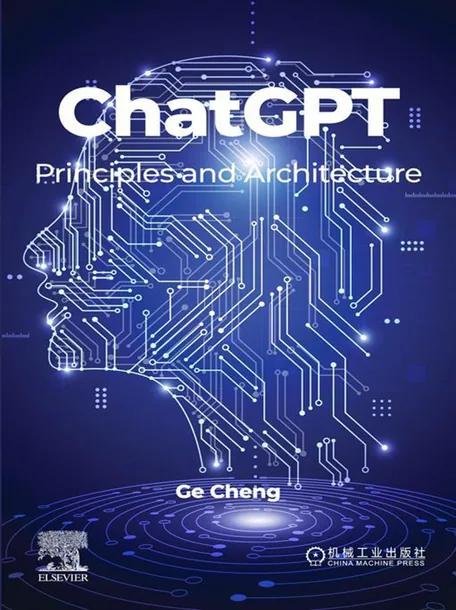
ChatGPT
Principles and Architecture
by Ge Cheng
1st Edition
Publisher: Elsevier
Book Details
| Print ISBN | 9780443274367 |
| eText ISBN | 9780443274374 |
| Publisher | Elsevier |
| Publishing Year | 2025 |
| Edition | 1st Edition |
| Language | English |
| Pages | 230 |
Ge Cheng authors ChatGPT: Principles and Architecture, 1st Edition, to explain the underlying mechanics of large language models for software developers, artificial intelligence researchers, and students in AI and computer science. Published by Elsevier in 2025 across 230 pages, this publication provides a clear theoretical foundation for modern generative artificial intelligence systems.
The main thematic coverage focuses on Transformer architecture, analyzing self-attention mechanisms, multi-head attention, and position encoding concepts. The content details generative pretraining methodologies, pretraining strategies for large language models, unsupervised multi-task execution, and zero-shot learning frameworks. It also examines sparse attention implementations alongside content-based learning methods in GPT-3.
Subsequent sections address human feedback reinforcement learning, proximal policy optimization algorithms, low-compute domain transfer, and middleware programming. The text offers structured material intended to assist engineers dealing with large-scale data processing and analysis, alongside IT professionals, technical managers, and AI product managers evaluating artificial intelligence architectures.
Table of Contents
Chapter 1: The New Milestone in AI - ChatGPT
- • 1.1 Development History of ChatGPT
- • 1.2 Capability Level of ChatGPT
- • 1.3 Evolution of Large Language Models
- • 1.3.1 From Symbolism to Connectionism
- • 1.3.2 Transformer Architecture
- • 1.3.3 Unsupervised Pretraining
- • 1.3.4 Supervised Fine-tuning
- • 1.3.5 Reinforcement Learning from Human Feedback
- • 1.4 Technology Stack of Large Language Models
- • 1.5 Impact of Large Language Models
- • 1.6 Barriers to Replication of Large Language Models
- • 1.6.1 Computational Bottlenecks
- • 1.6.2 Data Bottlenecks
- • 1.6.3 Engineering Bottlenecks
- • 1.7 Limitations and Improvement Directions for Large Language Models
- • 1.8 Summary
Chapter 2: In-Depth Understanding of Transformer Architecture
- • 2.1 Introduction to Transformer Architecture
- • 2.2 Self-attention Mechanism
- • 2.2.1 Calculation Process of Self-attention
- • 2.2.2 Essence of Self-attention Mechanism
- • 2.2.3 Advantages and Limitations of Self-attention
- • 2.3 Multi-head Attention
- • 2.3.1 Implementation of Multi-head Attention
- • 2.3.2 Role of Multi-head Attention
- • 2.3.3 Optimization of Multi-head Attention
- • 2.4 Feed-forward Neural Networks
- • 2.5 Residual Connections
- • 2.6 Layer Normalization
- • 2.7 Position Encoding
- • 2.7.1 Design and Implementation of Position Encoding
- • 2.7.2 Variants of Position Encoding
- • 2.7.3 Advantages and Limitations of Position Encoding
- • 2.8 Training and Optimization
- • 2.8.1 Loss Functions
- • 2.8.2 Optimizers
- • 2.8.3 Learning Rate Adjustment Strategies
- • 2.8.4 Regularization
- • 2.8.5 Other Training and Optimization Techniques
- • 2.9 Summary
Chapter 3: Generative Pretraining
- • 3.1 Introduction to Generative Pretraining
- • 3.2 GPT's Transformer Architecture
- • 3.3 Process of Generative Pretraining
- • 3.3.1 Objectives of Generative Pretraining
- • 3.3.2 Error Backpropagation in Generative Pretraining
- • 3.4 Supervised Fine-tuning
- • 3.4.1 Principles of Supervised Fine-tuning
- • 3.4.2 Specific Tasks for Supervised Fine-tuning
- • 3.4.3 Steps of Fine-tuning for Specific Tasks
- • 3.5 Summary
Chapter 4: Unsupervised Multi-task and Zero-shot Learning
- • 4.1 Encoder and Decoder in GPT-2
- • 4.2 Transformer Architecture of GPT-2
- • 4.2.1 Layer Normalization
- • 4.2.2 Orthogonal Initialization
- • 4.2.3 Reversible Tokenization Methods
- • 4.2.4 Learnable Relative Position Encoding
- • 4.3 Unsupervised Multi-task Learning
- • 4.4 Relationship between Multi-task and Zero-shot Learning
- • 4.5 Autoregressive Generation Process in GPT-2
- • 4.5.1 Token Embedding Matrices
- • 4.5.2 Autoregressive Process
- • 4.6 Summary
Chapter 5: Sparse Attention and Content-based Learning in GPT-3
- • 5.1 Architecture of GPT-3
- • 5.2 Sparse Attention Mechanism
- • 5.2.1 Characteristics of Sparse Transformer
- • 5.2.2 Local Band Attention
- • 5.2.3 Cross-layer Sparse Connections
- • 5.3 Meta-learning and Content-based Learning
- • 5.3.1 Meta-learning
- • 5.3.2 Content-based Learning
- • 5.4 Bayesian Inference of Concept Distribution
- • 5.4.1 Implicit Fine-tuning
- • 5.4.2 Bayesian Reasoning
- • 5.5 Reasoning Capability of Thought Chains
- • 5.6 Summary
Chapter 6: Pretraining Strategies for Large Language Models
- • 6.1 Pretraining Datasets
- • 6.2 Data Processing for Pretraining
- • 6.3 Distributed Training Modes
- • 6.3.1 Data Parallelism
- • 6.3.2 Model Parallelism
- • 6.4 Distributed Training Architectures
- • 6.4.1 Pathways
- • 6.4.2 Megatron-LM
- • 6.4.3 ZeRO
- • 6.5 Examples of Training Strategies
- • 6.5.1 Training Frameworks
- • 6.5.2 Parameter Stability
- • 6.5.3 Adjustments in Training Settings
- • 6.5.4 BF16 Optimization
- • 6.5.5 Other Factors
- • 6.6 Summary
Chapter 7: Proximal Policy Optimization Algorithms
- • 7.1 Policy Gradient Methods
- • 7.1.1 Basic Principles of Policy Gradient Methods
- • 7.1.2 Importance Sampling
- • 7.1.3 Introduction of Advantage Functions
- • 7.2 Actor-critic Algorithms
- • 7.2.1 Basic Steps of the Algorithm
- • 7.2.2 Value Functions and Policy Updates
- • 7.2.3 Challenges and Problems in Actor-critic Algorithms
- • 7.3 Trust Region Policy Optimization
- • 7.3.1 Policy Optimization Objectives in TRPO
- • 7.3.2 Limitations of TRPO Algorithm
- • 7.4 Principles of PPO Algorithm
- • 7.4.1 Objective Functions
- • 7.4.2 Loss and Reward Functions
- • 7.5 Summary
Chapter 8: Human Feedback Reinforcement Learning
- • 8.1 Role of Reinforcement Learning in ChatGPT Iterations
- • 8.2 Training Datasets for InstructGPT/ChatGPT
- • 8.2.1 Sources of Fine-tuning Dataset
- • 8.2.2 Annotation Standards
- • 8.2.3 Data Analysis
- • 8.3 Stages of Human Feedback Reinforcement Learning
- • 8.3.1 Supervised Fine-tuning Stage
- • 8.3.2 Reward Modeling Stage
- • 8.3.3 Reinforcement Learning Stage
- • 8.4 Reward Modeling Algorithms
- • 8.4.1 Algorithm Concepts
- • 8.4.2 Loss Functions
- • 8.5 Application of PPO in InstructGPT
- • 8.6 Multi-turn Dialogue Capabilities
- • 8.7 Necessity of Human Feedback Reinforcement Learning
- • 8.8 Summary
Chapter 9: Low-Compute Domain Transfer for Large Language Models
- • 9.1 Bootstrapping Instructions
- • 9.2 AI Feedback in Low-compute Environments
- • 9.3 Low-Rank Adaptation
- • 9.3.1 Training and Deployment of Low-rank Adaptation Models
- • 9.3.2 Choice of Rank in Low-rank Adaptation
- • 9.4 Quantization - Reducing Compute Requirements for Deployment
- • 9.5 SparseGPT Pruning Algorithm
- • 9.6 Low-compute Transfer Cases of Open-source Large Language Models
- • 9.6.1 Baseline Models
- • 9.6.2 Bootstrapped Instruction Fine-tuning of the Llama Series
- • 9.6.3 Chinese Solutions
- • 9.6.4 Medical Domain Transfer Cases
- • 9.6.5 Legal Domain Transfer Cases
- • 9.7 Summary
Chapter 10: Middleware Programming
- • 10.1 Filling the Gap - LangChain Comes at the Right Time
- • 10.2 Multimodal Fusion Middleware
- • 10.2.1 Task Planning
- • 10.2.2 Model Selection
- • 10.2.3 Task Execution
- • 10.2.4 Response Generation
- • 10.3 AutoGPT Autonomous Agents and Task Planning
- • 10.4 Competitive Middleware Frameworks
- • 10.5 Summary
Chapter 11: The Future Path of Large Language Models
- • 11.1 Path to Strong AI
- • 11.2 Data Resource Depletion
- • 11.3 Limitations of Autoregressive Models
- • 11.4 Embodied Intelligence
- • 11.4.1 Challenges of Embodied Intelligence
- • 11.4.2 PaLM-E
- • 11.4.3 ChatGPT for Robotics
- • 11.5 Summary
Customer Reviews
0.0
0 reviews
No reviews yet. Be the first to review this book!
Write a Review
Reviewed by GradeFocus Editorial Team
▶Research Sources (14)
- ChatGPT : Principles and Architecture
- ChatGPT, eBook by Ge Cheng | Principles and Architecture
- [PDF] ChatGPT by Ge Cheng | 9780443274374
- ChatGPT - 1st Edition
- Parentheses
- Please verify you are human - Captcha
- Psychology & Personal Growth Archives
- Shop Bestselling Counseling Books
- ChatGPT : Principles and Architecture - DOKUMEN.PUB
- ChatGPT : Principles and Architecture / Cheng, Ge (9780443274367)
- ChatGPT - ScienceDirect.com
- ChatGPT Business - Release Notes - OpenAI Help Center
- ChatGPT : Principles and Architecture by Ge Cheng - Books-A-Million
- Explore GPTs - ChatGPT