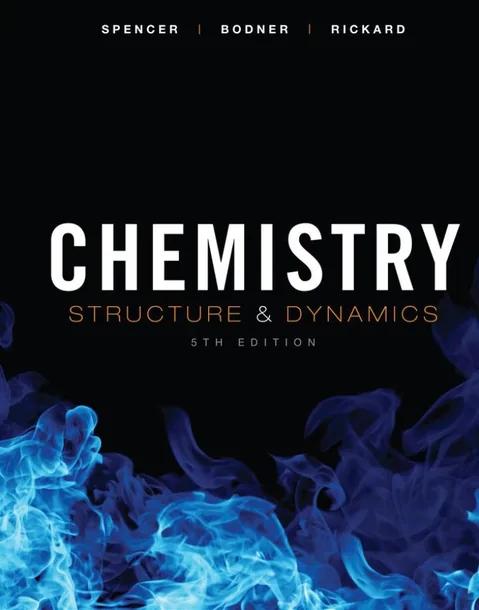
Chemistry: Structure and Dynamics
by James N. Spencer, George M. Bodner, Lyman H. Rickard
5th Edition
Publisher: Wiley
Book Details
| Print ISBN | 9780470587119 |
| eText ISBN | 9781118139806 |
| Publisher | Wiley |
| Publishing Year | 2011 |
| Edition | 5th Edition |
| Language | English |
| Pages | 928 |
Chemistry: Structure and Dynamics, 5th Edition is a general chemistry textbook structured around core chemical principles. Developed in conjunction with recommendations from the ACS Task Force on the General Chemistry Curriculum, the text links content through the process of science, the relationship between molecular structure and properties, and connections between microscopic and macroscopic scales.
Core chapters examine elements and compounds, the mole, atomic structure, and chemical bonding, along with liquids, solutions, chemical thermodynamics, and organic chemistry. End-of-chapter special topics further supplement key principles.
The text supports instruction in both small and large lecture courses, using data, models, and leading questions to guide students in formulating concepts.
Table of Contents
Chapter 1: Elements and Compounds
- • 1.1 Chemistry: A Definition
- • 1.2 Elements, Compounds, and Mixtures
- • 1.3 Atomic Symbols
- • 1.4 Chemical Formulas
- • 1.5 Evidence for the Existence of Atoms
- • 1.6 The Role of Measurement in Chemistry
- • 1.7 The Structure of Atoms
- • 1.8 Atomic Number and Mass Number
- • 1.9 Isotopes
- • 1.10 The Difference Between Atoms and Ions
- • 1.11 Polyatomic Ions
- • 1.12 The Periodic Table
- • 1.13 The Macroscopic, Atomic and Symbolic Worlds of Chemistry
- • 1.14 The Mass of an Atom
- • 1.15 Chemical Reactions and the Law of Conservation of Atoms
- • 1.16 Chemical Equations as a Representation of Chemical Reactions
- • 1.17 Balancing Chemical Equations
Chapter 2: The Mole: The Link between the Macroscopic and the Atomic Worlds of Chemistry
- • 2.1 The Mole as the Bridge Between the Macroscopic and Atomic Scales
- • 2.2 The Mole as a Collection of Atoms
- • 2.3 Converting Grams into Moles and Number of Atoms
- • 2.4 The Mole as a Collection of Molecules
- • 2.5 Percent by Mass
- • 2.6 Determining the Formula of a Compound
- • 2.7 Two Views of Chemical Equations: Molecules Versus Moles
- • 2.8 Mole Ratios and Chemical Equations
- • 2.9 Stoichiometry
- • 2.10 The Stoichiometry of the Breathalyzer
- • 2.11 The Nuts and Bolts of Limiting Reagents
- • 2.12 Density
- • 2.13 Solute, Solvent, and Solution
- • 2.14 Concentration
- • 2.15 Molarity as a Way to Count Particles in a Solution
- • 2.16 Dilution Calculations
- • 2.17 Solution Stoichiometry
- • Problems
Chapter 3: The Structure of the Atom
- • 3.1 Rutherford’s Model of the Atom
- • 3.2 Particles and Waves
- • 3.3 Light and Other Forms of Electromagnetic Radiation
- • 3.4 Atomic Spectra
- • 3.5 The Wave-Packet Model of Electromagnetic Radiation
- • 3.6 The Bohr Model of the Atom
- • 3.7 The Energy States of the Hydrogen Atom
- • 3.8 Electromagnetic Radiation and Color
- • 3.9 The First Ionization Energy
- • 3.10 The Shell Model
- • 3.11 The Shell Model and the Periodic Table
- • 3.12 Photoelectron Spectroscopy and the Structure of Atoms
- • 3.13 Electron Configurations from Photoelectron Spectroscopy
- • 3.14 Allowed Combinations of Quantum Numbers
- • 3.15 Shells and Subshells of Orbitals
- • 3.16 Orbitals and the Pauli Exclusion Principle
- • 3.17 Predicting Electron Configurations
- • 3.18 Electron Configurations and the Periodic Table
- • 3.19 Electron Configurations and Hund’s Rules
- • 3.20 The Sizes of Atoms: Metallic Radii
- • 3.21 The Sizes of Atoms: Covalent Radii
- • 3.22 The Relative Sizes of Atoms and Their Ions
- • 3.23 Patterns in Ionic Radii
- • 3.24 Second, Third, Fourth, and Higher Ionization Energies
- • 3.25 Average Valence Electron Energy (AVEE)
- • 3.26 AVEE and Metallicity
- • Problems
Chapter 4: The Covalent Bond
- • 4.1 Valence Electrons
- • 4.2 The Covalent Bond
- • 4.3 How Does the Sharing of Electrons Bond Atoms?
- • 4.4 Using Lewis Structures to Understand the Formation of Bonds
- • 4.5 Drawing Skeleton Structures
- • 4.6 A Step-by-Step Approach to Writing Lewis Structures
- • 4.7 Molecules That Don’t Seem to Satisfy the Octet Rule
- • 4.8 Bond Lengths
- • 4.9 Resonance Hybrids
- • 4.10 Electronegativity
- • 4.11 Partial Charge
- • 4.12 Formal Charge
- • 4.13 The Shapes of Molecules
- • 4.14 Predicting the Shapes of Molecules (The Electron Domain Model)
- • 4.15 The Role of Nonbonding Electrons in the ED Model
- • 4.16 Bond Angles
- • 4.17 The Difference Between Polar Bonds and Polar Molecules
- • Problems
- • Special Topics
- • 4A.1 Valence Bond Theory
- • 4A.2 Hybrid Atomic Orbitals
- • 4A.3 Molecules with Double and Triple Bonds
- • 4A.4 Molecular Orbital Theory
Chapter 5: Ionic and Metallic Bonds
- • 5.1 Metals, Nonmetals, and Semimetals
- • 5.2 The Active Metals
- • 5.3 Main-Group Metals and Their Ions
- • 5.4 Main-Group Nonmetals and Their Ions
- • 5.5 Transition Metals and Their Ions
- • 5.6 Chemistry and Color
- • 5.7 Predicting the Formulas of Ionic Compounds
- • 5.8 Predicting the Products of Reactions That Produce Ionic Compounds
- • 5.9 Oxides, Peroxides, and Superoxides
- • 5.10 The Ionic Bond
- • 5.11 Structures of Ionic Compounds
- • 5.12 Metallic Bonds
- • 5.13 The Relationship among Ionic, Covalent, and Metallic Bonds
- • 5.14 Bond-Type Triangles
- • 5.15 Properties of Metallic, Covalent, and Ionic Compounds
- • 5.16 Oxidation Numbers
- • 5.17 Calculating Oxidation Numbers
- • 5.18 Oxidation–Reduction Reactions
- • 5.19 Nomenclature
- • Problems
Chapter 6: Gases
- • 6.1 Temperature
- • 6.2 Temperature as a Property of Matter
- • 6.3 The States of Matter
- • 6.4 Elements or Compounds That Are Gases at Room Temperature
- • 6.5 The Properties of Gases
- • 6.6 Pressure versus Force
- • 6.7 Atmospheric Pressure
- • 6.8 Boyle’s Law
- • 6.9 Amontons’ Law
- • 6.10 Charles’ Law
- • 6.11 Gay-Lussac’s Law
- • 6.12 Avogadro’s Hypothesis
- • 6.13 The Ideal Gas Equation
- • 6.14 Dalton’s Law of Partial Pressures
- • 6.15 Ideal Gas Calculations: Part I
- • 6.16 Ideal Gas Calculations: Part II
- • 6.17 The Kinetic Molecular Theory
- • 6.18 How the Kinetic Molecular Theory Explains the Gas Laws
- • 6.19 Graham’s Laws of Diffusion and Effusion
- • Problems
- • Special Topics
- • 6A.1 Deviations from Ideal Gas Law Behavior: The van der Waals Equation
- • 6A.2 Analysis of the van der Waals Constants
Chapter 7: Making and Breaking of Bonds
- • 7.1 Energy
- • 7.2 Heat
- • 7.3 Heat and the Kinetic Molecular Theory
- • 7.4 Specific Heat
- • 7.5 State Functions
- • 7.6 The First Law of Thermodynamics
- • 7.7 Work
- • 7.8 The Enthalpy of a System
- • 7.9 Enthalpies of Reaction
- • 7.10 Enthalpy as a State Function
- • 7.11 Standard-State Enthalpies of Reaction
- • 7.12 Calculating Enthalpies of Reaction
- • 7.13 Enthalpies of Atom Combination
- • 7.14 Using Enthalpies of Atom Combination to Probe Chemical Reactions
- • 7.15 Bond Length and the Enthalpy of Atom Combination
- • 7.16 Hess’s Law
- • 7.17 Enthalpies of Formation
- • Problems
Chapter 8: Liquids and Solutions
- • 8.1 The Structure of Gases, Liquids, and Solids
- • 8.2 Intermolecular Forces
- • 8.3 Relative Strengths of Intermolecular Forces
- • 8.4 The Kinetic Theory of Liquids
- • 8.5 The Vapor Pressure of a Liquid
- • 8.6 Melting Point and Freezing Point
- • 8.7 Boiling Point
- • 8.8 Phase Diagrams
- • 8.9 Hydrogen Bonding and the Anomalous Properties of Water
- • 8.10 Solutions: Like Dissolves Like
- • 8.11 Hydrophilic and Hydrophobic Molecules
- • 8.12 Soaps, Detergents, and Dry-Cleaning Agents
- • 8.13 Why Do Some Solids Dissolve in Water?
- • 8.14 Solubility Equilibria
- • 8.15 Solubility Rules
- • 8.16 Net Ionic Equations
- • Problems
- • Special Topics
- • 8A.1 Colligative Properties
- • 8A.2 Depression of the Partial Pressure of a Solvent
- • 8A.3 Boiling Point Elevation
- • 8A.4 Freezing Point Depression
Chapter 9: Solids
- • 9.1 Types of Solids
- • 9.2 Molecular and Network Covalent Solids
- • 9.3 The Physical Properties of Molecular and Network Covalent Solids
- • 9.4 Metallic Solids
- • 9.5 Physical Properties That Result from the Structure of Metals
- • 9.6 The Structure of Metals
- • 9.7 Coordination Numbers and the Structures of Metals
- • 9.8 Unit Cells: The Simplest Repeating Unit in a Crystal
- • 9.9 Solid Solutions and Intermetallic Compounds
- • 9.10 Semimetals
- • 9.11 Ionic Solids
- • 9.12 The Search for New Materials
- • 9.13 Measuring the Distance Between Particles in a Unit Cell
- • 9.14 Determining the Unit Cell of a Crystal
- • 9.15 Calculating the Size of an Atom or Ion
- • Problems
- • Special Topics
- • 9A.1 Defects
- • 9A.2 Metals, Semiconductors, and Insulators
- • 9A.3 Thermal Conductivity
- • 9A.4 Thermal Expansion
- • 9A.5 Glass and Other Ceramics
Chapter 10: The Connection Between Kinetics and Equilibrium
- • 10.1 Reactions That Don’t Go to Completion
- • 10.2 Gas-Phase Reactions
- • 10.3 The Rate of a Chemical Reaction
- • 10.4 The Collision Theory Model of Gas-Phase Reactions
- • 10.5 Equilibrium Constant Expressions
- • 10.6 Reaction Quotients: A Way to Decide Whether a Reaction is at Equilibrium
- • 10.7 Changes in Concentration That Occur as a Reaction Comes to Equilibrium
- • 10.8 Hidden Assumptions That Make Equilibrium Calculations Easier
- • 10.9 What Do We Do When the Assumption Fails?
- • 10.10 The Effect of Temperature on an Equilibrium Constant
- • 10.11 Le Châtelier’s Principle
- • 10.12 Le Châtelier’s Principle and the Haber Process
- • 10.13 What Happens When a Solid Dissolves in Water?
- • 10.14 The Solubility Product Expression
- • 10.15 The Relationship Between Ksp and the Solubility of a Salt
- • 10.16 The Role of the Ion Product (Qsp) in Solubility Calculations
- • 10.17 The Common-Ion Effect
- • Problems
Chapter 11: Acids and Bases
- • 11.1 Properties of Acids and Bases
- • 11.2 The Arrhenius Definition of Acids and Bases
- • 11.3 The Brønsted–Lowry Definition of Acids and Bases
- • 11.4 Conjugate Acid–Base Pairs
- • 11.5 The Role of Water in the Brønsted Model
- • 11.6 To What Extent Does Water Dissociate to Form Ions?
- • 11.7 pH as a Measure of the Concentration of the H3O+ Ion
- • 11.8 Relative Strengths of Acids and Bases
- • 11.9 Relative Strengths of Conjugate Acid–Base Pairs
- • 11.10 Relative Strengths of Different Acids and Bases
- • 11.11 Relationship of Structure to Relative Strengths of Acids and Bases
- • 11.12 Strong Acid pH Calculations
- • 11.13 Weak Acid pH Calculations
- • 11.14 Base pH Calculations
- • 11.15 Mixtures of Acids and Bases: Buffers
- • 11.16 Buffers and Buffer Capacity
- • 11.17 Buffers in the Body
- • 11.18 Acid–Base Reactions
- • 11.19 pH Titration Curves
- • Problems
- • Special Topics
- • 11A.1 Diprotic Acids
- • 11A.2 Diprotic Bases
- • 11A.3 Compounds That Could Be Either Acids or Bases
Chapter 12: Oxidation–Reduction Reactions
- • 12.1 Common Oxidation–Reduction Reactions
- • 12.2 Determining Oxidation Numbers
- • 12.3 Recognizing Oxidation–Reduction Reactions
- • 12.4 Voltaic Cells
- • 12.5 Standard Cell Potentials
- • 12.6 Oxidizing and Reducing Agents
- • 12.7 Relative Strengths of Oxidizing and Reducing Agents
- • 12.8 Batteries
- • 12.9 Electrochemical Cells at Nonstandard Conditions: The Nernst Equation
- • 12.10 Electrolysis and Faraday’s Law
- • 12.11 Electrolysis of Molten NaCl
- • 12.12 Electrolysis of Aqueous NaCl
- • 12.13 Electrolysis of Water
- • 12.14 The Hydrogen Economy
- • Problems
- • Special Topics
- • 12.A1 Balancing Oxidation–Reduction Equations
- • 12.A2 Redox Reactions in Acidic Solutions
- • 12.A3 Redox Reactions in Basic Solutions
- • 12.A4 Molecular Redox Reactions
Chapter 13: Chemical Thermodynamics
- • 13.1 Spontaneous Chemical and Physical Processes
- • 13.2 Entropy and Disorder
- • 13.3 Entropy and the Second Law of Thermodynamics
- • 13.4 Standard-State Entropies of Reaction
- • 13.5 The Third Law of Thermodynamics
- • 13.6 Calculating Entropy Changes for Chemical Reactions
- • 13.7 Gibbs Free Energy
- • 13.8 The Effect of Temperature on the Free Energy of a Reaction
- • 13.9 Beware of Oversimplifications
- • 13.10 Standard-State Free Energies of Reaction
- • 13.11 Equilibria Expressed in Partial Pressures
- • 13.12 Interpreting Standard-State Free Energy of Reaction Data
- • 13.13 The Relationship between Free Energy and Equilibrium Constants
- • 13.14 The Temperature Dependence of Equilibrium Constants
- • 13.15 Gibbs Free Energies of Formation and Absolute Entropies
- • Problems
Chapter 14: Kinetics
- • 14.1 The Forces That Control a Chemical Reaction
- • 14.2 Chemical Kinetics
- • 14.3 Is the Rate of Reaction Constant?
- • 14.4 Instantaneous Rates of Reaction
- • 14.5 Rate Laws and Rate Constants
- • 14.6 The Rate Law Versus the Stoichiometry of a Reaction
- • 14.7 Order and Molecularity
- • 14.8 A Collision Theory Model of Chemical Reactions
- • 14.9 The Mechanisms of Chemical Reactions
- • 14.10 Zero-Order Reactions
- • 14.11 Determining the Order of a Reaction from Rates of Reaction
- • 14.12 The Integrated Form of Zero-, First-, and Second-Order Rate Laws
- • 14.13 Determining the Order of a Reaction with the Integrated Form of Rate Laws
- • 14.14 Reactions That Are First-Order in Two Reactants
- • 14.15 The Activation Energy of Chemical Reactions
- • 14.16 Catalysts and the Rates of Chemical Reactions
- • 14.17 Determining the Activation Energy of a Reaction
- • 14.18 The Kinetics of Enzyme-Catalyzed Reactions
- • Problems
- • Special Topics
- • 14A.1 Deriving the Integrated Rate Laws
Chapter 15: Nuclear Chemistry
- • 15.1 Radioactivity
- • 15.2 The Structure of the Atom
- • 15.3 Modes of Radioactive Decay
- • 15.4 Neutron-Rich Versus Neutron-Poor Nuclides
- • 15.5 Binding Energy Calculations
- • 15.6 The Kinetics of Radioactive Decay
- • 15.7 Dating by Radioactive Decay
- • 15.8 Ionizing Versus Nonionizing Radiation
- • 15.9 Biological Effects of Ionizing Radiation
- • 15.10 Natural Versus Induced Radioactivity
- • 15.11 Nuclear Fission
- • 15.12 Nuclear Fusion
- • 15.13 Nuclear Synthesis
- • 15.14 Nuclear Medicine
- • Problems
Chapter 16: Organic Chemistry
- • 16.1 What Is an Organic Compound?
- • 16.2 The Saturated Hydrocarbons or Alkanes
- • 16.3 Rotation Around C—C Bonds
- • 16.4 The Nomenclature of Alkanes
- • 16.5 The Unsaturated Hydrocarbons: Alkenes and Alkynes
- • 16.6 Aromatic Hydrocarbons and Their Derivatives
- • 16.7 The Chemistry of Petroleum Products
- • 16.8 The Chemistry of Coal
- • 16.9 Functional Groups
- • 16.10 Oxidation-Reduction Reactions
- • 16.11 Alkyl Halides
- • 16.12 Alcohols and Ethers
- • 16.13 Aldehydes and Ketones
- • 16.14 Reactions at the Carbonyl Group
- • 16.15 Carboxylic Acids and Carboxylate Ions
- • 16.16 Esters
- • 16.17 Amines, Alkaloids, and Amides
- • 16.18 Alkene Stereoisomers
- • 16.19 Stereogenic Atoms
- • 16.20 Optical Activity
- • Problems
Chapter Appendix A: Appendix A
- • A.1 Systems of Units
- • The English Units of Measurement
- • SI Units of Measurement
- • Derived SI Units
- • Non-SI Units
- • Conversion Factors
- • A.2 Uncertainty in Measurement
- • Systematic and Random Errors
- • Accuracy and Precision
- • A.3 Significant figures
- • Addition and Subtraction with Significant Figures
- • Multiplication and Division with Significant Figures
- • Rounding Off
- • A.4 Scientific Notation
- • A.5 The Graphical Treatment of Data
- • A.6 Significant Figures and Unit Conversion Worksheet
- • Significant Figures
- • Counting Significant Figures in a Measurement
- • Measurements versus Definitions
- • Unit Conversions
Chapter Appendix B: Appendix B
- • Table B.1 Values of Selected Fundamental Constants
- • Table B.2 Selected Conversion Factors
- • Table B.3 The Vapor Pressure of Water
- • Table B.4 Radii of Atoms and Ions
- • Table B.5 Ionization Energies
- • Table B.6 Electron Affinities
- • Table B.7 Electronegativities
- • Table B.8 Acid-Dissociation Equilibrium Constants
- • Table B.9 Base-Ionization Equilibrium Constants
- • Table B.10 Solubility Product Equilibrium Constants
- • Table B.11 Complex Formation Equilibrium Constants
- • Table B.12 Standard Reduction Potentials
- • Table B.13 Standard-State Enthalpies, Free Energies and Entropies of Atom Combination
- • Table B.14 Bond-Dissociation Enthalpies
- • Table B.15 Electron Configuration of the First 86 Elements
- • Table B.16 Standard-State Enthalpy of Formation, Free Energy of Formation and Absolute Entropy Data
Chapter Appendix C: Answers to Selected Problems
Chapter Appendix D: Answers to Checkpoints
Chapter Module 1: Chemistry of the Nonmetals
Chapter Module 2: Transition Metal Chemistry
Chapter Module 3: Complex Ion Equilibria
Chapter Module 4: Organic Chemistry: Structure and Nomenclature of Hydrocarbons
Chapter Module 5: Organic Chemistry: Functional Groups
Chapter Module 6: Organic Chemistry: Reaction Mechanisms
Chapter Module 7: Polymer Chemistry
Chapter Module 8: Biochemistry
Chapter Module 9: Chemical Analysis
Customer Reviews
0.0
0 reviews
No reviews yet. Be the first to review this book!
Write a Review
Reviewed by GradeFocus Editorial Team