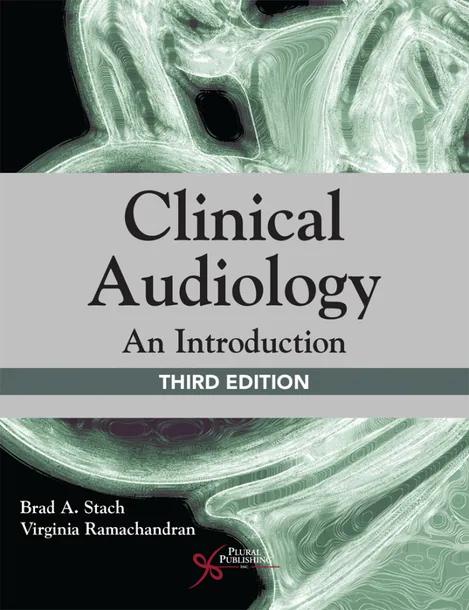
Clinical Audiology
An Introduction
by Brad A. Stach, Virginia Ramachandran
3rd Edition
Publisher: Plural Publishing, Inc.
Book Details
| Print ISBN | 9781944883713 |
| eText ISBN | 9781944883720 |
| Publisher | Plural Publishing, Inc. |
| Publishing Year | 2021 |
| Edition | 3rd Edition |
| Language | English |
| Pages | 645 |
Clinical Audiology: An Introduction, 3rd Edition, is an introductory textbook designed to familiarize students with the challenging questions and clinical responsibilities encountered in audiology practice. The volume introduces the nature of sound, auditory pathology, and the scope of the profession in the United States.
Core subject areas include audiological diagnosis, intervention and treatment approaches, and vestibular system assessment. The text connects diagnostic procedures with rehabilitative management, utilizing case studies designed to help prospective clinicians avoid clinical errors.
Intended primarily for beginning-level undergraduate or graduate students taking their first major courses in audiology and speech-language pathology, this edition provides foundational preparation for clinical decision-making across diverse patient populations.
Table of Contents
Chapter 1: The Profession of Audiology in the United States
- • Learning Objectives
- • What Is an Audiologist?
- • What Is an Audiologist's Role?
- • Where Do Audiologists Practice?
- • Relation to Other Professions
- • The Evolution of Audiology
- • Professional Requirements
- • Summary
- • Discussion Questions
- • Information Sources
- • Organizations
- • Resources
Chapter 2: The Nature of Hearing
- • Learning Objectives
- • The Nature of Sound
- • The Auditory System
- • How We Hear
- • Summary
- • Discussion Questions
- • Resources
Chapter 3: The Nature of Hearing Disorder
- • Learning Objectives
- • Degree and Configuration of Hearing Sensitivity Loss
- • Ear Specificity of Hearing Disorder
- • Type of Hearing Loss
- • Timing Factors Impacting Hearing Disorder
- • Summary
- • Discussion Questions
- • Resources
Chapter 4: Causes of Hearing Disorder
- • Learning Objectives
- • Auditory Pathology
- • Conductive Hearing Disorders
- • Sensory Hearing Disorders
- • Neural Hearing Disorders
- • Summary
- • Discussion Questions
- • Resources
- • Articles and Books
- • Web Sites
Chapter 5: Introduction to Audiological Diagnosis
- • Learning Objectives
- • The First Question
- • The Audiologist's Challenges
- • Summary
- • Discussion Questions
- • Resources
- • Articles and Books
- • Web Sites
Chapter 6: Audiological Diagnostic Tools: Pure Tone Audiometry
- • Learning Objectives
- • Equipment and Test Environment
- • The Audiogram
- • Establishing the Pure-Tone Audiogram
- • Summary
- • Discussion Questions
- • Resources
Chapter 7: Audiological Diagnostic Tools: Speech Audiometry
- • Learning Objectives
- • Speech Audiometry
- • Summary
- • Discussion Questions
- • Resources
Chapter 8: Audiological Diagnostic Tools: Immittance Measures
- • Learning Objectives
- • Immittance Audiometry
- • Instrumentation
- • Measurement Technique
- • Basic Immittance Measures
- • Principles of Interpretation
- • Clinical Applications
- • Summary
- • Discussion Questions
- • Resources
Chapter 9: Audiological Diagnostic Tools: Physiologic Measures
- • Learning Objectives
- • Auditory Evoked Potentials
- • Summary
- • Otoacoustic Emissions
- • Discussion Questions
- • Resources
Chapter 10: The Test-battery Approach to Audiological Diagnosis
- • Learning Objectives
- • Determination of Auditory Disorder
- • The Test Battery Approach in Adults
- • The Test Battery Approach in Pediatrics
- • Different Approaches for Different Populations
- • Summary
- • Discussion Questions
- • Resources
Chapter 11: Communicating Audiometric Results
- • Learning Objectives
- • Talking to Patients
- • Writing Reports
- • Making Referrals
- • Summary
- • Discussion Questions
- • Resources
Chapter 12: Introduction to Audiological Treatment
- • Learning Objectives
- • The First Questions
- • The Audiologist's Challenge
- • Summary
- • Discussion Questions
- • Resources
Chapter 13: Audiological Treatment Tools: Hearing Aids
- • Learning Objectives
- • Hearing Instrument Anatomy
- • Hearing Instrument Physiology
- • Consideration for Hearing Aid Options
- • Summary
- • Discussion Questions
- • Resources
Chapter 14: Audiological Treatment Tools: Implantable Hearing Technology
- • Learning Objectives
- • Cochlear Implants
- • Bone-Conduction Implants
- • Middle-Ear Implants
- • Summary
- • Discussion Questions
- • Resources
Chapter 15: Audiological Treatment Tools: Hearing Assistive and Connectivity Technologies
- • Learning Objectives
- • The Challenges of Complex Environments
- • Hearing Assistive Technology
- • Telecommunication Access Technologies
- • Assistive Listening Devices
- • Summary
- • Discussion Questions
- • Resources
Chapter 16: Audiological Treatment Tools: Verification and Outcome Measures
- • Learning Objectives
- • Hearing Aid Selection and Fitting
- • Orientation, Counseling, and Follow-up
- • Assessing Outcomes
- • Post-Fitting Rehabilitation
- • Summary
- • Discussion Questions
- • Resources
Chapter 17: Different Treatment Approaches for Different Populations
- • Learning Objectives
- • Adult Populations
- • Pediatric Populations
- • Other Populations
- • Summary
- • Discussion Questions
- • Resources
Chapter 18: Introduction to Balance Function and Assessment
- • Learning Objectives
- • The Vestibular System
- • Disorders of Dizziness and Balance
- • The Balance Function Test Battery
- • The Test Battery in Action
- • Summary
- • Discussion Questions
- • Resources
Customer Reviews
0.0
0 reviews
No reviews yet. Be the first to review this book!
Write a Review
Reviewed by GradeFocus Editorial Team