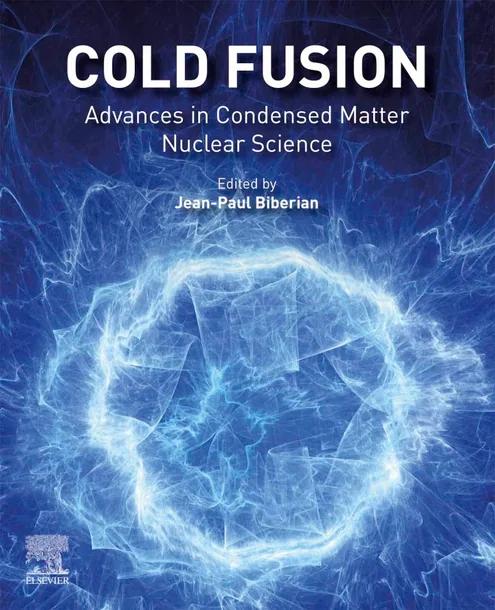
Cold Fusion
Advances in Condensed Matter Nuclear Science
by Jean-Paul Biberian
1st Edition
Publisher: Elsevier
Book Details
| Print ISBN | 9780128159446 |
| eText ISBN | 9780128159453 |
| Publisher | Elsevier |
| Publishing Year | 2020 |
| Edition | 1st Edition |
| Language | English |
| Pages | 398 |
Cold Fusion: Advances in Condensed Matter Nuclear Science, 1st Edition, provides a concise overview of technological methods in cold fusion and low energy nuclear reaction engineering. The volume systemizes expanding research across the discipline to establish fundamental scientific principles for understanding cold fusion systems.
The text addresses underlying chemistry, physics, materials, and processes while tracing the historical development of cold fusion engineering. It presents critical analyses of theoretical and experimental results, including observations of helium production during reaction experiments.
Prepared by an international group of contributors from academia and industry under editor Jean-Paul Biberian, this reference supports PhD students and researchers in physical chemistry, materials chemistry, and chemical and nuclear physics.
Table of Contents
Chapter 1: Production of helium in cold fusion experiments
Chapter 2: Review of Pd/D co-deposition
Chapter 3: Electrochemical loading to produce the Fleischmann-Pons heat effect (FPHE)
Chapter 4: Fundamentals of isoperibolic calorimetric measurements in cold fusion experiments
Chapter 5: Can clean and stable deuterium loading and well-tailored microstructure improve reproducibility?
Chapter 6: Gas phase
Chapter 7: Electrically induced anomalous thermal phenomena in nanostructured wires
Chapter 8: Experimental procedures for excess heat generation from cold fusion reactions
Chapter 9: Heat generation experiments using nano-sized metal composite and hydrogen gas
Chapter 10: Screening energy for low energy nuclear reactions in condensed matter
Chapter 11: Review of permeation-induced nuclear transmutation reaction
Chapter 12: Effective LENR and transmutation of stable and radioactive isotopes in growing biological systems
Chapter 13: Trasnmutations and isotopic shifts in LENR experiments
Chapter 14: The basic nature of the cold fusion effect
Chapter 15: Models based on phonon-nuclear coupling
Chapter 16: A study on electron deep orbits by quantum relativistic methods
Chapter 17: Universal mechanism of LENR in physical and biological systems on the base of coherent correlated states of interacting particles
Customer Reviews
0.0
0 reviews
No reviews yet. Be the first to review this book!
Write a Review
Reviewed by GradeFocus Editorial Team