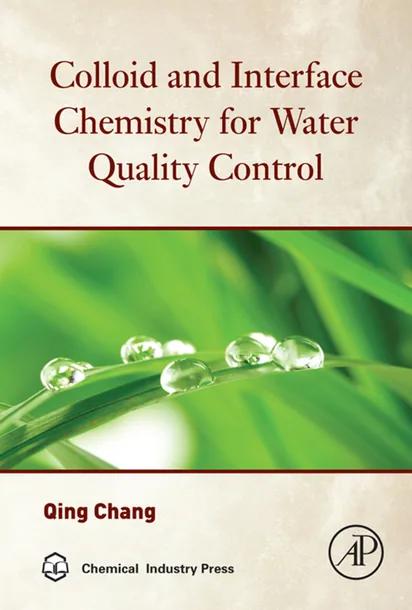
Colloid and Interface Chemistry for Water Quality Control
by Qing Chang
1st Edition
Publisher: Academic Press
Book Details
| Print ISBN | 9780128093153 |
| eText ISBN | 9780128093153 |
| Publisher | Academic Press |
| Publishing Year | 2016 |
| Edition | 1st Edition |
| Language | English |
| Pages | 276 |
Colloid and Interface Chemistry for Water Quality Control, 1st Edition, examines fundamental physical-chemistry principles through the framework of water treatment. The textbook connects colloid and surface chemistry concepts directly to water quality control technologies and methods.
The volume addresses core colloidal behavior alongside interfacial phenomena. Topics include diffusion, Brownian motion, sedimentation under gravity and centrifugal forces, and the electrical properties governing particle stability. It also explores liquid, solution, and solid surfaces, as well as emulsion, foam, and gel systems.
Featuring exercises, problems, and solutions to test understanding, this text supports graduate students, researchers, and engineers working in water supply, drainage, environmental science, and environmental engineering.
Table of Contents
Chapter 1: Brief History of Colloid and Interface Chemistry and Basic Concepts
- • Abstract
- • 1.1. Origin of the term “colloid”
- • 1.2. Classification of the colloidal system
- • 1.3. Dispersion degree and specific surface area
- • 1.4. Shape of colloidal particles
- • 1.5. Polydispersity and the average size of colloidal particles
- • 1.6. Colloidal pollutants in natural waters
Chapter 2: Diffusion and Brownian Motion
- • Abstract
- • 2.1. Diffusion
- • 2.2. Brownian motion
- • 2.3. Application of diffusion
- • 2.4. Role of diffusion theory in water treatment and natural water
Chapter 3: Sedimentation
- • Abstract
- • 3.1. Sedimentation in the gravity field
- • 3.2. Sedimentation in centrifugal force field
- • 3.3. Applications of sedimentation in water treatment
Chapter 4: Osmotic Pressure
- • Abstract
- • 4.1. Osmotic pressure of ideal solutions
- • 4.2. Osmotic pressure of macromolecule solutions
- • 4.3. Donnan equilibrium and osmotic pressure
- • 4.4. Measurement of osmotic pressure
- • 4.5. Application of reverse osmosis in water treatment
Chapter 5: Optical Properties
- • Abstract
- • 5.1. Light scattering of colloid systems
- • 5.2. Rayleigh equation of light scattering
- • 5.3. Polarized components and space distribution of scattered light
- • 5.4. Light scattering of large particles
- • 5.5. Light scattering of macromolecule solutions
- • 5.6. Turbidity of water
Chapter 6: Rheology Properties
- • Abstract
- • 6.1. Basic concept and basic theory
- • 6.2. Measurement of viscosity
- • 6.3. Viscosity of dilute colloidal solutions
- • 6.4. Rheology properties of concentrated dispersion systems
- • 6.5. Rheology properties of sludge produced in water treatment
Chapter 7: Electrical Properties
- • Abstract
- • 7.1. Origin of the surface charge of colloids in natural waters
- • 7.2. Electrokinetic phenomena
- • 7.3. Model of electric double layer
- • 7.4. Electrokinetic theory and experiment
- • 7.5. Coagulation thermodynamics: DLVO theory of colloid stability
- • 7.6. Kinetics of coagulation
- • 7.7. Effect of macromolecules on colloid stability
- • 7.8. Coagulation in natural waters and water treatment
Chapter 8: Surface of Liquid
- • Abstract
- • 8.1. Surface tension and surface free energy
- • 8.2. Relation between liquid pressure and surface curvature
- • 8.3. Relation between vapor pressure of liquid and surface curvature
- • 8.4. Contact angle
- • 8.5. Measurement of surface tension
- • 8.6. Cohesion work and adhesion work
- • 8.7. Spreading of one liquid on another liquid
- • 8.8. Fowkes theory of interfacial tension
- • 8.9. Insoluble monomolecular film
Chapter 9: Surface of Solution
- • Abstract
- • 9.1. Surface activity
- • 9.2. Surface excess and Gibbs adsorption equation
- • 9.3. Surfactant
Chapter 10: Surface of Solids
- • Abstract
- • 10.1. Basic principles
- • 10.2. Adsorption of gas at a solid surface
- • 10.3. Adsorption from solution
- • 10.4. Wetting of solid surface
- • 10.5. Measurement of properties of adsorbents
- • 10.6. Analysis of the surface of adsorbents
- • 10.7. Adsorption in natural water and water treatment
Chapter 11: Emulsion, Foam, and Gel
- • Abstract
- • 11.1. Emulsion
- • 11.2. Foam
- • 11.3. Gel
Chapter Appendix: A
Chapter Appendix: B
Chapter Appendix: C
Customer Reviews
0.0
0 reviews
No reviews yet. Be the first to review this book!
Write a Review
Reviewed by GradeFocus Editorial Team