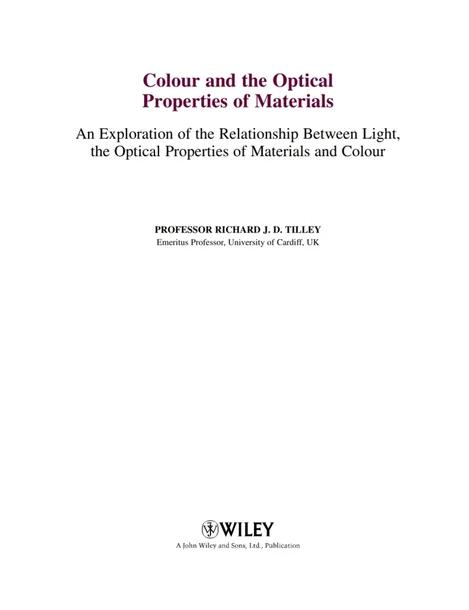
Colour and the Optical Properties of Materials
An Exploration of the Relationship Between Light, the Optical Properties of Materials and Colour
by Richard J. D. Tilley
2nd Edition
Publisher: Wiley-Blackwell
Book Details
| Print ISBN | 9780470746967 |
| eText ISBN | 9780470974766 |
| Publisher | Wiley-Blackwell |
| Publishing Year | 2010 |
| Edition | 2nd Edition |
| Language | English |
| Pages | 528 |
Colour and the Optical Properties of Materials: An Exploration of the Relationship Between Light, the Optical Properties of Materials and Colour, 2nd Edition, is a textbook exploring how light interacts with matter to generate colour.
The volume covers physical optics including refraction, dispersion, reflection, scattering, and diffraction. It also addresses polarization in crystals, electronic transitions in atoms and molecules, luminescence, and the optical behaviour of metals, semiconductors, and insulators.
Designed for undergraduate courses across science and engineering programmes, the book supports students in physics, chemistry, architecture, and the arts, while serving as a useful reference for active researchers in colour and materials sciences.
Table of Contents
Chapter 1: Light and Colour
- • 1.1 Colour and light
- • 1.2 Colour and energy
- • 1.3 Light waves
- • 1.4 Interference
- • 1.5 Light waves and colour
- • 1.6 Black body radiation and incandescence
- • 1.7 The colour of incandescent objects
- • 1.8 Photons
- • 1.9 Lamps and lasers
- • 1.10 Vision
- • 1.11 Colour perception
- • 1.12 Additive coloration
- • 1.13 The interaction of light with a material
- • 1.14 Subtractive coloration
- • 1.15 Electronic “paper”
- • 1.16 Appearance and transparency
- • Appendix 1.1 Definitions, units and conversion factors
- • Further reading
Chapter 2: Colours due to Refraction and Dispersion
- • 2.1 Refraction and the refractive index of a material
- • 2.2 Total internal reflection
- • 2.3 Refractive index and polarisability
- • 2.4 Refractive index and density
- • 2.5 Invisible animals, GRINS and mirages
- • 2.6 Dispersion and colours produced by dispersion
- • 2.7 Rainbows and halos
- • 2.8 Halos
- • 2.9 Fibre optics
- • 2.10 Negative refractive index materials
- • Further reading
Chapter 3: The Production of Colour by Reflection
- • 3.1 Reflection from a single surface
- • 3.2 Interference at a single thin film in air
- • 3.3 The colour of a single thin film in air
- • 3.4 The reflectivity of a single thin film in air
- • 3.5 The colour of a single thin film on a substrate
- • 3.6 The reflectivity of a single thin film on a substrate
- • 3.7 Low-reflection and high-reflection films
- • 3.8 Multiple thin films
- • 3.9 Fibre Bragg Gratings
- • 3.10 “Smart” windows
- • 3.11 Photonic engineering in nature
- • 3.12 Further reading
- • 3.13 Problems and exercises
- • Appendix 3.1 The colour of a thin film in white light
- • Further Reading
Chapter 4: Polarisation and crystals
- • 4.1 Polarisation of light
- • 4.2 Polarisation by reflection
- • 4.3 Polars
- • 4.4 Crystal symmetry and refractive index
- • 4.5 Double refraction: calcite as an example
- • 4.6 The description of double refraction effects
- • 4.7 Colour produced by polarisation and birefringence
- • 4.8 Pleochroism and dichroism
- • 4.9 Nonlinear effects
- • 4.10 Frequency matching and phase matching
- • 4.11 More on second harmonic generation
- • 4.12 Optical activity
- • 4.13 Liquid crystals
- • Further reading
Chapter 5: Colour due to Scattering
- • 5.1 Scattering and extinction
- • 5.2 Tyndall blue and Rayleigh scattering
- • 5.3 Blue skies, red sunsets
- • 5.4 Scattering and polarisation
- • 5.5 Mie scattering
- • 5.6 Blue eyes and some blue feathers
- • 5.7 Paints, sunscreens and related matters
- • 5.8 Multiple scattering
- • 5.9 Gold sols and ruby glass
- • 5.10 The Lycurgus Cup
- • Further reading
Chapter 6: Colour due to Diffraction
- • 6.1 Diffraction and colour production by a slit
- • 6.2 Diffraction and colour production by a rectangular aperture
- • 6.3 Diffraction and colour production by a circular aperture
- • 6.4 The diffraction limit of optical instruments
- • 6.5 Colour production by linear diffraction gratings
- • 6.6 Two-dimensional gratings
- • 6.7 Estimation of the wavelength of light by diffraction
- • 6.8 Diffraction by crystals and crystal-like structures
- • 6.9 Disordered diffraction gratings
- • 6.10 Diffraction by sub-wavelength structures
- • 6.11 Holograms
- • Further reading
Chapter 7: Colour from Atoms and Ions
- • 7.1 The spectra of atoms and ions
- • 7.2 Terms and levels
- • 7.3 Atomic spectra and chemical analysis
- • 7.4 Fraunhofer lines and stellar spectra
- • 7.5 Neon signs and early plasma displays
- • 7.6 The helium-neon laser
- • 7.7 Sodium and mercury street lights
- • 7.8 Transition metals and crystal field colours
- • 7.9 Crystal field splitting, energy levels and terms
- • 7.10 The colour of ruby
- • 7.11 Transition-metal-ion lasers
- • 7.12 Emerald, alexandrite and crystal field strength
- • 7.13 Crystal field colours in minerals and gemstones
- • 7.14 Colour as a structural probe
- • 7.15 Colours from lanthanide ions
- • 7.16 The neodymium (Nd3+) solid state laser: a four level laser
- • 7.17 Amplification of optical fibre signals
- • 7.18 Transition metal and lanthanide pigments
- • 7.19 Spectral hole formation
- • 7.20 Further reading
- • 7.21 Problems and exercises
- • Appendix 7.1 Electron configurations
- • Appendix 7.2 Terms and levels
- • Further Reading
Chapter 8: Colour from Molecules
- • 8.1 The energy levels of molecules
- • 8.2 The colours arising in some simple inorganic molecules
- • 8.3 The colour of water
- • 8.4 Chromophores, chromogens and auxochromes
- • 8.5 Conjugated bonds in organic molecules: the carotenoids
- • 8.6 Conjugated bonds circling metal atoms: porphyrins and phthalocyanines
- • 8.7 Naturally occurring colorants: flavonoid pigments
- • 8.8 Autumn leaves
- • 8.9 Some dyes and pigments
- • 8.10 Charge transfer colours
- • 8.11 Colour change sensors
- • 8.12 Dye lasers
- • 8.13 Photochromic organic molecules
- • Further reading
Chapter 9: Luminescence
- • 9.1 Luminescence
- • 9.2 Activators, sensitizers and fluorophores
- • 9.3 Atomic processes in photoluminescence
- • 9.4 Fluorescent lamps
- • 9.5 Plasma displays
- • 9.6 Cathodoluminescence and cathode ray tubes (CRTs)
- • 9.7 Field emission displays (FEDs)
- • 9.8 Phosphor electroluminescent displays
- • 9.9 Upconversion
- • 9.10 Quantum cutting
- • 9.11 Fluorescent molecules
- • 9.12 Fluorescent nanoparticles
- • 9.13 Fluorescent markers and sensors
- • 9.14 Chemiluminescence and Bioluminescence
- • 9.15 Triboluminescence
- • 9.16 Scintillators
- • Further reading
Chapter 10: Colour in Metals, Semiconductors and Insulators
- • 10.1 The colours of insulators
- • 10.2 Excitons
- • 10.3 Impurity colours in insulators
- • 10.4 Impurity colours in diamond
- • 10.5 Colour centres
- • 10.6 The colours of semiconductors
- • 10.7 The colours of semiconductor alloys
- • 10.8 Light emitting diodes (LEDs)
- • 10.9 Semiconductor diode lasers
- • 10.10 Semiconductor nanostructures
- • 10.11 Organic semiconductors and electroluminescence
- • 10.12 Electrochromic films
- • 10.13 Photovoltaics
- • 10.14 Digital photography
- • 10.15 The colours of metals
- • 10.16 The colours of metal nanoparticles
- • 10.17 Extraordinary light transmission and plasmonic crystals
- • Further Reading
Customer Reviews
0.0
0 reviews
No reviews yet. Be the first to review this book!
Write a Review
Reviewed by GradeFocus Editorial Team
Related Books
Elastomer-Based Composites and Nanocomposites
Hamid Essabir
Piezoelectric Materials
Christopher R. Bowen
Functionalized Biopolymers
Swati Sharma
Inorganic Biomaterials for Drug Delivery
Amit Kumar Nayak

Hydrogels for Wound Healing
Sabu Thomas
Nanobiomaterials and Nanomedicines for Metabolic Disorders
Subhash C. Mandal