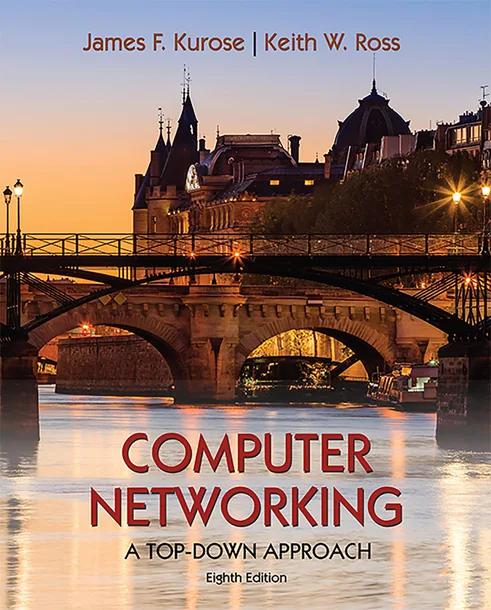
Computer Networking
A Top-Down Approach
by James F. Kurose, Keith W. Ross
8th Edition
Publisher: Pearson
Book Details
| Print ISBN | 9780136681557 |
| eText ISBN | 9780135928523 |
| Publisher | Pearson |
| Publishing Year | 2021 |
| Edition | 8th Edition |
| Language | English |
Published by Pearson, Computer Networking, 8th Edition introduces fundamental networking concepts and internet architecture for undergraduate students in computer science and electrical engineering. Authors James F. Kurose and Keith W. Ross present all subject matter through a top-down, layered approach that begins directly with the application layer before descending into lower protocol mechanisms.
By starting at the application layer, the text enables students to examine functional network services prior to analyzing complex underlying infrastructure. The main technical coverage spans transport layer interactions, link layer protocols, and local area networks. Readers analyze how high-level application demands dictate communication procedures, data transport strategies, and local network operations across interconnected devices.
In addition to traditional protocol layers, the 8th Edition incorporates updated coverage of software-defined networking alongside 4G and 5G cellular networks. This structured framework provides direct support for core curriculum requirements in computer science and electrical engineering programs.
Table of Contents
Chapter 1: Computer Networks and the Internet
- • 1.1 What Is the Internet?
- • 1.1.1 A Nuts-and-Bolts Description
- • 1.1.2 A Services Description
- • 1.1.3 What Is a Protocol?
- • 1.2 The Network Edge
- • 1.2.1 Access Networks
- • 1.2.2 Physical Media
- • 1.3 The Network Core
- • 1.3.1 Packet Switching
- • 1.3.2 Circuit Switching
- • 1.3.3 A Network of Networks
- • 1.4 Delay, Loss, and Throughput in Packet-Switched Networks
- • 1.4.1 Overview of Delay in Packet-Switched Networks
- • 1.4.2 Queuing Delay and Packet Loss
- • 1.4.3 End-to-End Delay
- • 1.4.4 Throughput in Computer Networks
- • 1.5 Protocol Layers and Their Service Models
- • 1.5.1 Layered Architecture
- • 1.5.2 Encapsulation
- • 1.6 Networks Under Attack
- • 1.7 History of Computer Networking and the Internet
- • 1.7.1 The Development of Packet Switching: 1961—1972
- • 1.7.2 Proprietary Networks and Internetworking: 1972—1980
- • 1.7.3 A Proliferation of Networks: 1980—1990
- • 1.7.4 The Internet Explosion: The 1990s
- • 1.7.5 The New Millennium
- • 1.8 Summary
- • Homework Problems and Questions
- • Wireshark Lab
Chapter 2: Application Layer
- • 2.1 Principles of Network Applications
- • 2.1.1 Network Application Architectures
- • 2.1.2 Processes Communicating
- • 2.1.3 Transport Services Available to Applications
- • 2.1.4 Transport Services Provided by the Internet
- • 2.1.5 Application-Layer Protocols
- • 2.1.6 Network Applications Covered in This Book
- • 2.2 The Web and HTTP
- • 2.2.1 Overview of HTTP
- • 2.2.2 Non-Persistent and Persistent Connections
- • 2.2.3 HTTP Message Format
- • 2.2.4 User-Server Interaction: Cookies
- • 2.2.5 Web Caching
- • 2.2.6 HTTP/2
- • 2.3 Electronic Mail in the Internet
- • 2.3.1 SMTP
- • 2.3.2 Mail Message Formats
- • 2.3.3 Mail Access Protocols
- • 2.4 DNS–The Internet’s Directory Service
- • 2.4.1 Services Provided by DNS
- • 2.4.2 Overview of How DNS Works
- • 2.4.3 DNS Records and Messages
- • 2.5 Peer-to-Peer Applications
- • 2.5.1 P2P File Distribution
- • 2.6 Video Streaming and Content Distribution Networks
- • 2.6.1 Internet Video
- • 2.6.2 HTTP Streaming and DASH
- • 2.6.3 Content Distribution Networks
- • 2.6.4 Case Studies: Netflix and YouTube
- • 2.7 Socket Programming: Creating Network Applications
- • 2.7.1 Socket Programming with UDP
- • 2.7.2 Socket Programming with TCP
- • 2.8 Summary
- • Homework Problems and Questions
- • Socket Programming Assignments
- • Wireshark Labs: HTTP, DNS
Chapter 3: Transport Layer
- • 3.1 Introduction and Transport-Layer Services
- • 3.1.1 Relationship Between Transport and Network Layers
- • 3.1.2 Overview of the Transport Layer in the Internet
- • 3.2 Multiplexing and Demultiplexing
- • 3.3 Connectionless Transport: UDP
- • 3.3.1 UDP Segment Structure
- • 3.3.2 UDP Checksum
- • 3.4 Principles of Reliable Data Transfer
- • 3.4.1 Building a Reliable Data Transfer Protocol
- • 3.4.2 Pipelined Reliable Data Transfer Protocols
- • 3.4.3 Go-Back-N (GBN)
- • 3.4.4 Selective Repeat (SR)
- • 3.5 Connection-Oriented Transport: TCP
- • 3.5.1 The TCP Connection
- • 3.5.2 TCP Segment Structure
- • 3.5.3 Round-Trip Time Estimation and Timeout
- • 3.5.4 Reliable Data Transfer
- • 3.5.5 Flow Control
- • 3.5.6 TCP Connection Management
- • 3.6 Principles of Congestion Control
- • 3.6.1 The Causes and the Costs of Congestion
- • 3.6.2 Approaches to Congestion Control
- • 3.7 TCP Congestion Control
- • 3.7.1 Classic TCP congestion Control
- • 3.7.2 Network-Assisted Explicit Congestion Notification and Delay-based Congestion Control
- • 3.7.3 Fairness
- • 3.8 Evolution of transport-layer functionality
- • 3.9 Summary
- • Homework Problems and Questions
- • Programming Assignments
- • Wireshark Labs: Exploring TCP, UDP
Chapter 4: The Network Layer: Data Plane
- • 4.1 Overview of Network Layer
- • 4.1.1 Forwarding and Routing: The Network Data and Control Planes
- • 4.1.2 Network Service Models
- • 4.2 What’s Inside a Router?
- • 4.2.1 Input Port Processing and Destination-Based Forwarding
- • 4.2.2 Switching
- • 4.2.3 Output Port Processing
- • 4.2.4 Where Does Queuing Occur?
- • 4.2.5 Packet Scheduling
- • 4.3 The Internet Protocol (IP): IPv4, Addressing, IPv6, and More
- • 4.3.1 IPv4 Datagram Format
- • 4.3.2 IPv4 Addressing
- • 4.3.3 Network Address Translation (NAT)
- • 4.3.4 IPv6
- • 4.4 Generalized Forwarding and SDN
- • 4.4.1 Match
- • 4.4.2 Action
- • 4.4.3 OpenFlow Examples of Match-plus-action in Action
- • 4.5 Middleboxes
- • 4.6 Summary
- • Homework Problems and Questions
- • Wireshark Lab: IP
Chapter 5: The Network Layer: Control Plane
- • 5.1 Introduction
- • 5.2 Routing Algorithms
- • 5.2.1 The Link-State (LS) Routing Algorithm
- • 5.2.2 The Distance-Vector (DV) Routing Algorithm
- • 5.3 Intra-AS Routing in the Internet: OSPF
- • 5.4 Routing Among the ISPs: BGP
- • 5.4.1 The Role of BGP
- • 5.4.2 Advertising BGP Route Information
- • 5.4.3 Determining the Best Routes
- • 5.4.4 IP-Anycast
- • 5.4.5 Routing Policy
- • 5.4.6 Putting the Pieces Together: Obtaining Internet Presence
- • 5.5 The SDN Control Plane
- • 5.5.1 The SDN Control Plane: SDN Controller and SDN Control Applications
- • 5.5.2 OpenFlow Protocol
- • 5.5.3 Data and Control Plane Interaction: An Example
- • 5.5.4 SDN: Past and Future
- • 5.6 ICMP: The Internet Control Message Protocol
- • 5.7 Network Management, SNMP, and NETCONF/YANG
- • 5.7.1 The Network Management Framework
- • 5.7.2 The Simple Network Management Protocol (SNMP)
- • 5.7.3 NETCONF and YANG
- • 5.8 Summary
- • Homework Problems and Questions
- • Socket Programming Assignment
- • Programming Assignment
- • Wireshark Lab: ICMP
Chapter 6: The Link Layer and LANs
- • 6.1 Introduction to the Link Layer
- • 6.1.1 The Services Provided by the Link Layer
- • 6.1.2 Where Is the Link Layer Implemented?
- • 6.2 Error-Detection and -Correction Techniques
- • 6.2.1 Parity Checks
- • 6.2.2 Checksumming Methods
- • 6.2.3 Cyclic Redundancy Check (CRC)
- • 6.3 Multiple Access Links and Protocols
- • 6.3.1 Channel Partitioning Protocols
- • 6.3.2 Random Access Protocols
- • 6.3.3 Taking-Turns Protocols
- • 6.3.4 DOCSIS: The Link-Layer Protocol for Cable Internet Access
- • 6.4 Switched Local Area Networks
- • 6.4.1 Link-Layer Addressing and ARP
- • 6.4.2 Ethernet
- • 6.4.3 Link-Layer Switches
- • 6.4.4 Virtual Local Area Networks (VLANs)
- • 6.5 Link Virtualization: A Network as a Link Layer
- • 6.5.1 Multiprotocol Label Switching (MPLS)
- • 6.6 Data Center Networking
- • 6.6.1 Data Center Architectures
- • 6.6.2 Trends in Data Center Networking
- • 6.7 Retrospective: A Day in the Life of a Web Page Request
- • 6.7.1 Getting Started: DHCP, UDP, IP, and Ethernet
- • 6.7.2 Still Getting Started: DNS and ARP
- • 6.7.3 Still Getting Started: Intra-Domain Routing to the DNS Server
- • 6.7.4 Web Client-Server Interaction: TCP and HTTP
- • 6.8 Summary
- • Homework Problems and Questions
- • Wireshark Labs: Ethernet and Home Networking
Chapter 7: Wireless and Mobile Networks
- • 7.1 Introduction
- • 7.2 Wireless Links and Network Characteristics
- • 7.2.1 CDMA
- • 7.3 Wireless LANs
- • 7.3.1 The 802.11 Architecture
- • 7.3.2 The 802.11 MAC Protocol
- • 7.3.3 The IEEE 802.11 Frame
- • 7.3.4 Mobility in the Same IP Subnet
- • 7.3.5 Advanced Features in 802.11
- • 7.3.6 Bluetooth
- • 7.4 Cellular Networks: 4G and 5G
- • 7.4.1 4G LTE Cellular Networks: Architecture and Elements
- • 7.4.2 LTE Protocol Stacks
- • 7.4.3 LTE Radio Access Network
- • 7.4.4 LTE Network Attachment and Power Management
- • 7.4.5 The Global Cellular Network: a Network of Networks
- • 7.4.6 5G Cellular Networks
- • 7.5 Mobility Management: Principles
- • 7.5.1 Device Mobility: a Network-layer Perspective
- • 7.5.2 Home Networks and Roaming on Visited Networks
- • 7.5.3 Direct and Indirect Routing to/from a Mobile Device
- • 7.6 Mobile Management in Practice
- • 7.6.1 Mobility Management in 4G/5G Networks
- • 7.6.2 Mobile IP
- • 7.7 Wireless and Mobility: Impact on Higher-Layer Protocols
- • 7.8 Summary
- • Homework Problems and Questions
- • Wireshark Lab: 802.11
Chapter 8: Security in Computer Networks
- • 8.1 What Is Network Security?
- • 8.2 Principles of Cryptography
- • 8.2.1 Symmetric Key Cryptography
- • 8.2.2 Public Key Encryption
- • 8.3 Message Integrity and Digital Signatures
- • 8.3.1 Cryptographic Hash Functions
- • 8.3.2 Message Authentication Code
- • 8.3.3 Digital Signatures
- • 8.4 End-Point Authentication
- • 8.4.1 Building an Authentication Protocol
- • 8.5 Securing E-Mail
- • 8.5.1 Secure E-Mail
- • 8.5.2 PGP
- • 8.6 Securing TCP Connections: SSL
- • 8.6.1 The Big Picture
- • 8.6.2 A More Complete Picture
- • 8.7 Network-Layer Security: IPsec and Virtual Private Networks
- • 8.7.1 IPsec and Virtual Private Networks (VPNs)
- • 8.7.2 The AH and ESP Protocols
- • 8.7.3 Security Associations
- • 8.7.4 The IPsec Datagram
- • 8.7.5 IKE: Key Management in IPsec
- • 8.8 Securing Wireless LANs and 4G/5G Cellular Networks
- • 8.8.1 Authentication and Key Agreement in 802.11 Wireless LANs
- • 8.8.2 Authentication and Key Agreement in 4G/5G Cellular Networks
- • 8.9 Operational Security: Firewalls and Intrusion Detection Systems
- • 8.9.1 Firewalls
- • 8.9.2 Intrusion Detection Systems
- • 8.10 Summary
- • Homework Problems and Questions
- • Wireshark Lab: SSL
- • IPsec Lab
Customer Reviews
0.0
0 reviews
No reviews yet. Be the first to review this book!
Write a Review
Reviewed by GradeFocus Editorial Team
▶Research Sources (13)
- Computer Networking: A Top Down Approach - SCU Campus Store
- Computer Networking: A Top Down Approach | Rent | 9780135928523
- Based on this Textbook Computer Networking, 8th Edition ISBN ...
- Buy Computer Networking by Kurose James at Low Price in India
- Computer Networking: A Top-Down Approach (8th Edition)
- [PDF] [Ebook] Computer Networking 8th Edition by James Kurose
- Computer Networking [Rental Edition]
- computer networking
- A Top-Down Approach 8th edition by Jim Kurose and Keith Ross
- Computer Networking A Top-Down Approach, Global Edition, 8ed
- Computer Networking : A Top-Down Approach Featuring the Internet
- Kurose & Ross Computer Networking 8E | PDF
- A Top-Down Approach. 8th Edition By: James Kurose; Keith Ross ISBN ...