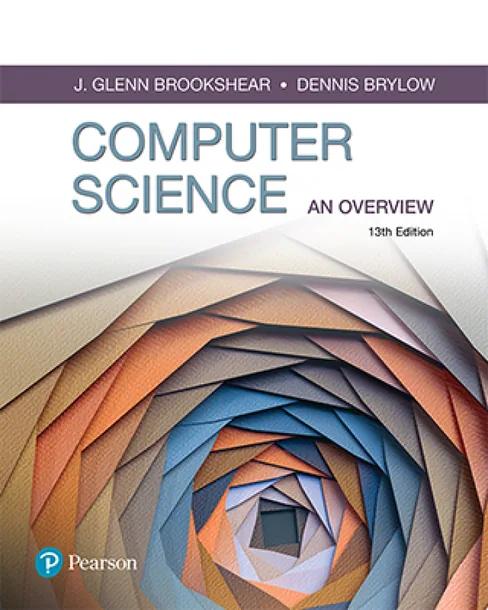
Computer Science: An Overview
by J. Glenn Brookshear, Dennis Brylow
13th Edition
Publisher: Pearson
Book Details
| Print ISBN | 9780134875460 |
| eText ISBN | 9780134875583 |
| Publisher | Pearson |
| Publishing Year | 2019 |
| Edition | 13th Edition |
| Language | English |
| Pages | 736 |
Computer Science: An Overview, 13th Edition, is an introductory textbook written for computer science majors and students from other academic disciplines. The text surveys core principles of computing while encouraging a realistic understanding of the field.
Coverage introduces fundamental areas such as data storage, operating systems, and networking alongside topics in software engineering, artificial intelligence, and the theory of computation.
To aid learning, the textbook incorporates Python to provide programming tools for exploration and experimentation. Independent chapters permit instructors to present topics in any sequence that fits their course syllabus.
Table of Contents
Chapter 0: Introduction
- • 0.1 The Role of Algorithms
- • 0.2 The History of Computing
- • 0.3 An Outline of Our Study
- • 0.4 The Overarching Themes of Computer Science
Chapter 1: Data Storage
- • 1.1 Bits and Their Storage
- • 1.2 Main Memory
- • 1.3 Mass Storage
- • 1.4 Representing Information as Bit Patterns
- • *1.5 The Binary System
- • *1.6 Storing Integers
- • *1.7 Storing Fractions
- • *1.8 Data and Programming
- • *1.9 Data Compression
- • *1.10 Communication Errors
Chapter 2: Data Manipulation
- • 2.1 Computer Architecture
- • 2.2 Machine Language
- • 2.3 Program Execution
- • *2.4 Arithmetic/Logic Instructions
- • *2.5 Communicating with Other Devices
- • *2.6 Programming Data Manipulation
- • *2.7 Other Architectures
Chapter 3: Operating Systems
- • 3.1 The History of Operating Systems
- • 3.2 Operating System Architecture
- • 3.3 Coordinating the Machine’s Activities
- • *3.4 Handling Competition Among Processes
- • 3.5 Security
Chapter 4: Networking and the Internet
- • 4.1 Network Fundamentals
- • 4.2 The Internet
- • 4.3 The World Wide Web
- • *4.4 Internet Protocols
- • *4.5 Simple Client Server
- • 4.6 Cybersecurity
Chapter 5: Algorithms
- • 5.1 The Concept of an Algorithm
- • 5.2 Algorithm Representation
- • 5.3 Algorithm Discovery
- • 5.4 Iterative Structures
- • 5.5 Recursive Structures
- • 5.6 Efficiency and Correctness
Chapter 6: Programming Languages
- • 6.1 Historical Perspective
- • 6.2 Traditional Programming Concepts
- • 6.3 Procedural Units
- • 6.4 Language Implementation
- • 6.5 Object-Oriented Programming
- • *6.6 Programming Concurrent Activities
- • *6.7 Declarative Programming
Chapter 7: Software Engineering
- • 7.1 The Software Engineering Discipline
- • 7.2 The Software Life Cycle
- • 7.3 Software Engineering Methodologies
- • 7.4 Modularity
- • 7.5 Tools of the Trade
- • 7.6 Quality Assurance
- • 7.7 Documentation
- • 7.8 The Human-Machine Interface
- • 7.9 Software Ownership and Liability
Chapter 8: Data Abstractions
- • 8.1 Basic Data Structures
- • 8.2 Related Concepts
- • 8.3 Implementing Data Structures
- • 8.4 A Short Case Study
- • 8.5 Customized Data Types
- • 8.6 Classes and Objects
- • *8.7 Pointers in Machine Language
Chapter 9: Database Systems
- • 9.1 Database Fundamentals
- • 9.2 The Relational Model
- • *9.3 Object-Oriented Databases
- • *9.4 Maintaining Database Integrity
- • *9.5 Traditional File Structures
- • 9.6 Data Mining
- • 9.7 Social Impact of Database Technology
Chapter 10: Computer Graphics
- • 10.1 The Scope of Computer Graphics
- • 10.2 Overview of 3D Graphics
- • 10.3 Modeling
- • 10.4 Rendering
- • *10.5 Dealing with Global Lighting
- • 10.6 Animation
Chapter 11: Artificial Intelligence
- • 11.1 Intelligence and Machines
- • 11.2 Perception
- • 11.3 Reasoning
- • 11.4 Additional Areas of Research
- • 11.5 Artificial Neural Networks
- • 11.6 Robotics
- • 11.7 Considering the Consequences
Chapter 12: Theory of Computation
- • 12.1 Functions and Their Computation
- • 12.2 Turing Machines
- • 12.3 Universal Programming Languages
- • 12.4 A Noncomputable Function
- • 12.5 Complexity of Problems
- • *12.6 Public-Key Cryptography
Chapter Appendices: Appendices
- • A. ASCII
- • B. Circuits to Manipulate Two’s Complement Representations
- • C. Vole: A Simple Machine Language
- • D. High-Level Programming Languages
- • E. The Equivalence of Iterative and Recursive Structures
- • F. Answers to Questions & Exercises
Customer Reviews
0.0
0 reviews
No reviews yet. Be the first to review this book!
Write a Review
Reviewed by GradeFocus Editorial Team