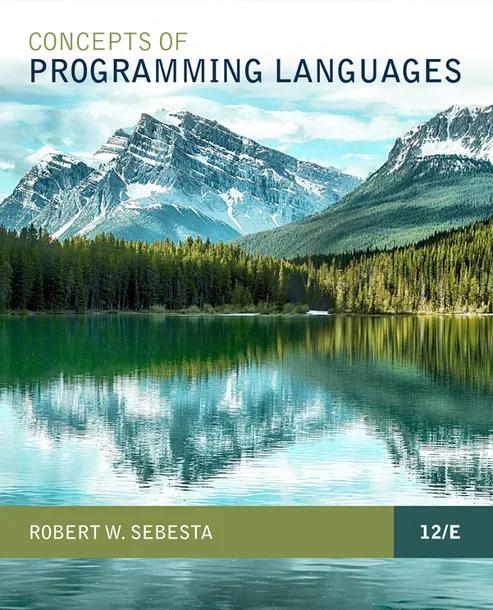
Concepts of Programming Languages
by Robert W. Sebesta
12th Edition
Publisher: Pearson
Book Details
| Print ISBN | 9780134997186 |
| eText ISBN | 9780135102251 |
| Publisher | Pearson |
| Publishing Year | 2019 |
| Edition | 12th Edition |
| Language | English |
| Pages | 784 |
The textbook Concepts of Programming Languages, 12th Edition, introduces key constructs found in contemporary computer programming languages while offering tools for critical evaluation. Written for undergraduate and graduate computer science students, the text builds a framework for analyzing structural design choices across traditional and modern systems.
The material links formal description techniques with concrete execution paradigms. Readers explore syntax specification through Backus-Naur Form (BNF) and attribute grammars, followed by formal semantic frameworks that include operational, denotational, and axiomatic models. The text further examines functional programming principles using Scheme, ML, Haskell, and F#, as well as logic programming concepts demonstrated through Prolog.
Updated content in this edition incorporates modern programming features from Swift and Python. The textbook fits computer programming courses seeking to prepare students for evaluating language paradigms and syntax architecture.
Table of Contents
Chapter 1: Preliminaries
- • 1.1 Reasons for Studying Concepts of Programming Languages
- • 1.2 Programming Domains
- • 1.3 Language Evaluation Criteria
- • 1.4 Influences on Language Design
- • 1.5 Language Categories
- • 1.6 Language Design Trade-Offs
- • 1.7 Implementation Methods
- • 1.8 Programming Environments
Chapter 2: Evolution of the Major Programming Languages
- • 2.1 Zuse’s Plankalkül
- • 2.2 Pseudocodes
- • 2.3 The IBM 704 and Fortran
- • 2.4 Functional Programming: Lisp
- • 2.5 The First Step Toward Sophistication: ALGOL 60
- • 2.6 Computerizing Business Records: COBOL
- • 2.7 The Beginnings of Timesharing: Basic
- • 2.8 Everything for Everybody: PL/I
- • 2.9 Two Early Dynamic Languages: APL and SNOBOL
- • 2.10 The Beginnings of Data Abstraction: SIMULA 67
- • 2.11 Orthogonal Design: ALGOL 68
- • 2.12 Some Early Descendants of the ALGOLs
- • 2.13 Programming Based on Logic: Prolog
- • 2.14 History’s Largest Design Effort: Ada
- • 2.15 Object-Oriented Programming: Smalltalk
- • 2.16 Combining Imperative and Object-Oriented Features: C++
- • 2.17 An Imperative-Based Object-Oriented Language: Java
- • 2.18 Scripting Languages
- • 2.19 The Flagship .NET Language: C#
- • 2.20 Markup-Programming Hybrid Languages
Chapter 3: Describing Syntax and Semantics
- • 3.1 Introduction
- • 3.2 The General Problem of Describing Syntax
- • 3.3 Formal Methods of Describing Syntax
- • 3.4 Attribute Grammars
- • 3.5 Describing the Meanings of Programs: Dynamic Semantics
Chapter 4: Lexical and Syntax Analysis
- • 4.1 Introduction
- • 4.2 Lexical Analysis
- • 4.3 The Parsing Problem
- • 4.4 Recursive-Descent Parsing
- • 4.5 Bottom-Up Parsing
Chapter 5: Names, Bindings, and Scopes
- • 5.1 Introduction
- • 5.2 Names
- • 5.3 Variables
- • 5.4 The Concept of Binding
- • 5.5 Scope
- • 5.6 Scope and Lifetime
- • 5.7 Referencing Environments
- • 5.8 Named Constants
Chapter 6: Data Types
- • 6.1 Introduction
- • 6.2 Primitive Data Types
- • 6.3 Character String Types
- • 6.4 Enumeration Types
- • 6.5 Array Types
- • 6.6 Associative Arrays
- • 6.7 Record Types
- • 6.8 Tuple Types
- • 6.9 List Types
- • 6.10 Union Types
- • 6.11 Pointer and Reference Types
- • 6.12 Optional Types
- • 6.13 Type Checking
- • 6.14 Strong Typing
- • 6.15 Type Equivalence
- • 6.16 Theory and Data Types
Chapter 7: Expressions and Assignment Statements
- • 7.1 Introduction
- • 7.2 Arithmetic Expressions
- • 7.3 Overloaded Operators
- • 7.4 Type Conversions
- • 7.5 Relational and Boolean Expressions
- • 7.6 Short-Circuit Evaluation
- • 7.7 Assignment Statements
- • 7.8 Mixed-Mode Assignment
Chapter 8: Statement-Level Control Structures
- • 8.1 Introduction
- • 8.2 Selection Statements
- • 8.3 Iterative Statements
- • 8.4 Unconditional Branching
- • 8.5 Guarded Commands
- • 8.6 Conclusions
Chapter 9: Subprograms
- • 9.1 Introduction
- • 9.2 Fundamentals of Subprograms
- • 9.3 Design Issues for Subprograms
- • 9.4 Local Referencing Environments
- • 9.5 Parameter-Passing Methods
- • 9.6 Parameters That Are Subprograms
- • 9.7 Calling Subprograms Indirectly
- • 9.8 Design Issues for Functions
- • 9.9 Overloaded Subprograms
- • 9.10 Generic Subprograms
- • 9.11 User-Defined Overloaded Operators
- • 9.12 Closures
- • 9.13 Coroutines
Chapter 10: Implementing Subprograms
- • 10.1 The General Semantics of Calls and Returns
- • 10.2 Implementing “Simple” Subprograms
- • 10.3 Implementing Subprograms with Stack-Dynamic Local Variables
- • 10.4 Nested Subprograms
- • 10.5 Blocks
- • 10.6 Implementing Dynamic Scoping
Chapter 11: Abstract Data Types and Encapsulation Constructs
- • 11.1 The Concept of Abstraction
- • 11.2 Introduction to Data Abstraction
- • 11.3 Design Issues for Abstract Data Types
- • 11.4 Language Examples
- • 11.5 Parameterized Abstract Data Types
- • 11.6 Encapsulation Constructs
- • 11.7 Naming Encapsulations
Chapter 12: Support for Object-Oriented Programming
- • 12.1 Introduction
- • 12.2 Object-Oriented Programming
- • 12.3 Design Issues for Object-Oriented Languages
- • 12.4 Support for Object-Oriented Programming in Specific Languages
- • 12.5 Implementation of Object-Oriented Constructs
- • 12.6 Reflection
Chapter 13: Concurrency
- • 13.1 Introduction
- • 13.2 Introduction to Subprogram-Level Concurrency
- • 13.3 Semaphores
- • 13.4 Monitors
- • 13.5 Message Passing
- • 13.6 Ada Support for Concurrency
- • 13.7 Java Threads
- • 13.8 C# Threads
- • 13.9 Concurrency in Functional Languages
- • 13.10 Statement-Level Concurrency
Chapter 14: Exception Handling and Event Handling
- • 14.1 Introduction to Exception Handling
- • 14.2 Exception Handling in C++
- • 14.3 Exception Handling in Java
- • 14.4 Exception Handling in Python and Ruby
- • 14.5 Introduction to Event Handling
- • 14.6 Event Handling with Java
- • 14.7 Event Handling in C#
Chapter 15: Functional Programming Languages
- • 15.1 Introduction
- • 15.2 Mathematical Functions
- • 15.3 Fundamentals of Functional Programming Languages
- • 15.4 The First Functional Programming Language: Lisp
- • 15.5 An Introduction to Scheme
- • 15.6 Common Lisp
- • 15.7 ML
- • 15.8 Haskell
- • 15.9 F#
- • 15.10 Support for Functional Programming in Primarily Imperative Languages
- • 15.11 A Comparison of Functional and Imperative Languages
Chapter 16: Logic Programming Languages
- • 16.1 Introduction
- • 16.2 A Brief Introduction to Predicate Calculus
- • 16.3 Predicate Calculus and Proving Theorems
- • 16.4 An Overview of Logic Programming
- • 16.5 The Origins of Prolog
- • 16.6 The Basic Elements of Prolog
- • 16.7 Deficiencies of Prolog
- • 16.8 Applications of Logic Programming
Customer Reviews
0.0
0 reviews
No reviews yet. Be the first to review this book!
Write a Review
Reviewed by GradeFocus Editorial Team
▶Research Sources (12)
- CONCEPTS OF PROGRAMMING LANGUAGES
- Concepts of Programming Languages | Rent | 9780135102251
- Concepts of Programming Languages by: Robert W. Sebesta
- Concepts of Programming Languages... | Rent | 9780134997186
- Concepts of Programming Languages - ISBN 9780134997186
- Concepts Of Programming Languages 12th Edition, Sebesta
- Concepts of Programming Languages [Rental Edition]
- Robert W. Sebesta Concepts of Programming Languages.pdf
- Concepts of Programming Languages: Twelfth Edition
- Concepts of Programming Languages, 12e, Global Edition
- Concepts of Programming Languages (12th edition)
- PROGRAMMING LANGUAGES - Pearson Higher Education