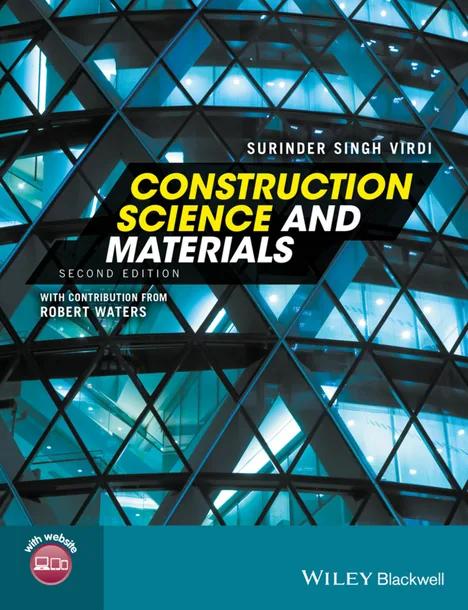
Construction Science and Materials
by Surinder Singh Virdi, Robert Waters
2nd Edition
Publisher: Wiley-Blackwell
Book Details
| Print ISBN | 9781119245056 |
| eText ISBN | 9781119245100 |
| Publisher | Wiley-Blackwell |
| Publishing Year | 2017 |
| Edition | 2nd Edition |
| Language | English |
| Pages | 368 |
Construction Science and Materials, 2nd Edition, is a textbook that introduces scientific and material principles for construction studies. The text supports learners enrolled in Pearson programmes across construction, civil engineering, and building services, alongside City and Guilds Level 3 Construction Techbac courses.
Across 17 chapters, the volume addresses foundational physics and chemistry before examining construction technology, building services, structural mechanics, fluid flow, and building materials. Explanations are supplemented with solved examples and diagrams.
Geared toward students who have not studied science since GCSE level, the book covers topics studied at levels 2 through 5 on Construction HND programmes and supports first-year undergraduates in building surveying, architectural technology, and quantity surveying.
Table of Contents
Chapter 1: Introduction to Physics
- • 1.1 Speed and Velocity
- • 1.2 Acceleration
- • 1.3 Mass
- • 1.4 Gravitation
- • 1.5 Weight
- • 1.6 Volume
- • 1.7 Density
- • 1.8 Specific Gravity
- • 1.9 Newton’s First Law of Motion
- • 1.10 Newton’s Second Law of Motion
- • 1.11 Newton’s Third Law of Motion
- • 1.12 Friction
- • 1.13 Work
- • 1.14 Energy
- • 1.15 Power
- • Exercise 1.1
- • Reference/Further reading
Chapter 2: Introduction to chemistry
- • 2.1 Introduction
- • 2.2 Electrovalency and covalency
- • 2.3 Elements and Compounds
- • 2.4 Symbols and Formulae
- • 2.5 Acids and bases
- • Exercise 2.1
- • References/Further reading
Chapter 3: Effects of Chemicals and the Atmosphere on Materials
- • 3.1 Introduction
- • 3.2 Oxidation
- • 3.3 Electrolysis
- • 3.4 Electrolytic Corrosion
- • 3.5 Applications of Electrolysis
- • 3.6 Acid rain
- • References/Further Reading
Chapter 4: Electricity
- • 4.1 Introduction
- • 4.2 Coulomb’s law
- • 4.3 Electric current
- • 4.4 Potential difference
- • 4.5 Electromotive force (e.m.f.)
- • 4.6 Ohm’s law
- • 4.7 Electrical resistivity and conductivity
- • 4.8 Resistors in Series/Parallel
- • 4.9 Transformers
- • 4.10 Power generation
- • 4.11 Power distribution
- • 4.12 Supply to small buildings
- • Exercise 4.1
- • Reference/Further reading
Chapter 5: Introduction to Construction Technology
- • 5.1 Introduction
- • 5.2 Substructure and Superstructure
- • 5.3 Foundations
- • 5.4 Forms of Construction
- • 5.5 The External Envelope
- • References/Further Reading
Chapter 6: Introduction to Building Services
- • 6.1 Introduction
- • 6.2 Cold Water Supply
- • 6.3 Hot Water Supply
- • 6.4 Central Heating Systems
- • 6.5 Underfloor Heating Systems
- • 6.6 Drainage Systems
- • 6.7 Integration of Services into Building Design
- • References/Further Reading
Chapter 7: Thermal Energy 1
- • 7.1 Introduction
- • 7.2 Temperature
- • 7.3 Units of Heat
- • 7.4 States of Matter
- • 7.5 Expansion and Contraction of Solids
- • 7.6 Heat Transfer
- • Exercise 7.1
- • References/Further Reading
Chapter 8: Thermal Energy 2 (Including Humidity)
- • 8.1 Introduction
- • 8.2 Thermal Insulation
- • 8.3 Heat Transmission
- • 8.4 Thermal Transmittance
- • 8.5 Heat Loss from Buildings
- • 8.6 Temperature Drop Through Materials
- • 8.7 Humidity
- • 8.8 Condensation
- • Exercise 8.1
- • References/Further Reading
Chapter 9: Forces and Structures 1
- • 9.1 Introduction
- • 9.2 Force
- • 9.3 Bending
- • 9.4 Types of Loading
- • 9.5 Stress and Strain
- • 9.6 Elasticity
- • Exercise 9.1
- • References/Further Reading
Chapter 10: Forces and structures 2
- • 10.1 Moment of a force
- • 10.2 Laws of equilibrium
- • 10.3 Analysis of beams
- • 10.4 Triangle of forces
- • Exercise 10.1
- • References/Further reading
Chapter 11: Forces and structures 3
- • 11.1 Introduction
- • 11.2 Beams
- • 11.3 Reinforced concrete (R.C.) beams
- • 11.4 Steel beams
- • 11.5 Timber joists
- • 11.6 Slabs
- • 11.7 Columns
- • 11.8 Foundations
- • References/Further reading
Chapter 12: Fluid mechanics
- • 12.1 Introduction
- • 12.2 Pressure of fluids at rest
- • 12.3 Why do Liquids Flow?
- • 12.4 Centre of pressure
- • 12.5 The flow of a fluid
- • Exercise 12.1
- • References/Further reading
Chapter 13: Sound
- • 13.1 Introduction
- • 13.2 Frequency, wavelength and velocity of sound
- • 13.3 Measurement of sound
- • 13.4 Addition of Sound Levels
- • 13.5 Transmission of sound in buildings
- • 13.6 Sound absorption
- • 13.7 Sound‐level Meter
- • Exercise 13.1
- • References/Further reading
Chapter 14: Light
- • 14.1 Introduction
- • 14.2 Additive and Subtractive Colours
- • 14.3 Measuring light
- • 14.4 Inverse Square Law of Illuminance
- • 14.5 Lambert’s Cosine Law of Illuminance
- • 14.6 Lamps and luminaires
- • 14.7 Design of Interior Lighting
- • 14.8 Light meter
- • 14.9 Daylighting
- • Exercise 14.1
- • References/Further reading
Chapter 15: Human Comfort
- • 15.1 Introduction
- • 15.2 Temperature
- • 15.3 Air movement
- • 15.4 Humidity
- • 15.5 Ventilation
- • 15.6 Predicted Mean Vote
- • 15.7 Noise
- • 15.8 Lighting
- • References/Further Reading
Chapter 16: Construction materials
- • 16.1 Introduction
- • 16.2 Bricks
- • 16.3 Aerated Concrete Blocks
- • 16.4 Cement
- • 16.5 Concrete
- • 16.6 Metals
- • 16.7 Timber
- • 16.8 Plastics
- • 16.9 Glass
- • References/Further reading
Chapter 17: Assignments
- • 17.1 Assignments for Level 2 courses
- • 17.2 Assignments for Level 3/4 courses
Chapter Appendix 1: Formulae for Example 8.2
Chapter Appendix 2: Solutions for Example 13.10
Chapter Appendix 3: Answers to exercises
Customer Reviews
0.0
0 reviews
No reviews yet. Be the first to review this book!
Write a Review
Reviewed by GradeFocus Editorial Team