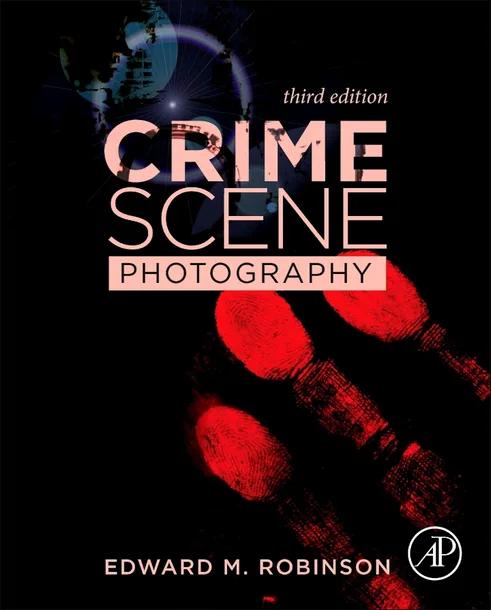
Crime Scene Photography
by Edward M. Robinson
3rd Edition
Publisher: Academic Press
Book Details
| Print ISBN | 9780128027646 |
| eText ISBN | 9780128027684 |
| Publisher | Academic Press |
| Publishing Year | 2016 |
| Edition | 3rd Edition |
| Language | English |
Crime Scene Photography, 3rd Edition, is a textbook by Edward M. Robinson published by Academic Press. It teaches the foundational principles and technical practices required to produce investigative images that can withstand challenges in court.
Coverage spans composition, nonflash exposure concepts, focus, depth of field, and electronic flash. The volume also addresses specialized forensic methods, including ultraviolet, infrared, and fluorescence photography, alongside photogrammetry and digital imaging technologies.
Supported by more than 100 practical exercises, the text is required reading for certification through the International Association for Identification. It serves undergraduate and postgraduate students in forensic and criminal justice programs, police academies, and law enforcement agencies.
Table of Contents
Chapter 1: History of Forensic Imaging
- • My Inspiration
- • The Practical Value
- • The History
- • Summary
Chapter 2: Composition and Cardinal Rules
- • Use-Once Camera Versus a Professional Camera System
- • Composition and Cardinal Rules
- • Cardinal Rules of Crime Scene Photography
- • Discussion Questions
- • Exercises
Chapter 3: Crime Scene Photography
- • Photo Documentation Forms
- • “As Found,” “As Is,” or “In Situ” Photographs
- • Exterior Overall Photographs—Crime Scene
- • Midrange Photographs
- • Close-Up Photographs
- • The Photographic Documentation of Bodies and Wounds
- • Learning Objectives, Revisited
- • Discussion Questions
- • Exercises
Chapter 4: Basic Exposure (Nonflash) Concepts
- • The Proper Exposure Triangle
- • Shutter Speed as Motion Control
- • Reciprocal Exposures
- • The Reflective Light Meter
- • “Normal” and “Non-normal” Scenes
- • Tools for Determining “Proper” Exposures With Tricky Scenes
- • Bracketing
- • The f/16 Sunny Day Rule
- • The Eye Cup Cover
- • Learning Objectives, Revisited
- • Discussion Questions
- • Exercises
Chapter 5: Focus, Depth of Field, and Lenses
- • Focus
- • Depth of Field
- • Lenses
- • Learning Objectives, Revisited
- • Discussion Questions
- • Exercises (All Nonflash Shots)
Chapter 6: Electronic Flash
- • Guide Numbers
- • Flash Sync Speeds
- • Manual Flash Mode
- • The Inverse Square Law
- • Automatic and Dedicated Flash Exposure Modes
- • Built-In Flash Units
- • Fill-In Flash
- • Oblique Light, Both Flash and Nonflash (Flashlight)
- • Bounce Flash
- • Painting With Light3
- • Learning Objectives, Revisited
- • Discussion Questions
- • Exercises
Chapter 7: Ultraviolet, Infrared, and Fluorescence
- • The Electromagnetic Spectrum
- • Ultraviolet Light
- • Infrared Light on the Electromagnetic Spectrum
- • Visible Light Fluorescence
- • Learning Objectives, Revisited
- • Discussion Questions
- • Exercises
Chapter 8: Photogrammetry
- • Introduction to Photogrammetry
- • Perspective Grid Photogrammetry
- • Perspective Disc Photogrammetry
- • Natural Grid Photogrammetry
- • Reverse Projection Photogrammetry
- • Rhino Photogrammetry
- • Summary
- • Discussion Questions
- • Exercises
Chapter 9: Special Photography Situations
- • Subchapter 9.1. Aerial and Elevated View Photography
- • Subchapter 9.2. Autopsy Photography
- • Subchapter 9.3. Bloodstain Pattern Analysis and Photography
- • Subchapter 9.4. Drones
- • Subchapter 9.5. Photographic Documentation of Shooting Incidents
- • Subchapter 9.6. Surveillance Photography
- • Subchapter 9.7. Underwater Photography
- • Subchapter 9.8. Vehicle Crash Photography
Chapter 10: Digital Imaging Technologies
- • The Cliché
- • Bias and Uncertainty
- • Bits, Bytes, Pixels, and Dots Exposed
- • Make a Strategy for the Entire Imaging Process
- • The Science of Digital Imaging Is Getting a Bit Deeper
- • Joint Photographic Expert Group
- • Tagged Image File
- • Digital Forensics Is Like the Wild West
- • Summary
Chapter 11: Digital Image Processing of Evidentiary Photography
- • Introduction
- • Standard Operating Procedure
- • Image-Processing Guidelines
- • Image-Processing Techniques and Procedures
- • Summary
Chapter 12: Legal Issues Related to Photographs and Digital Images
- • Criteria of Photographs and Digital Images as Evidence
- • The Purpose of Crime Scene Photographs
- • Photographs of Suspects and Evidence
- • Legal Implications of Digital Imaging
- • International Association for Identification Resolution 97-9
Customer Reviews
0.0
0 reviews
No reviews yet. Be the first to review this book!
Write a Review
Reviewed by GradeFocus Editorial Team
▶Research Sources (1)
Related Books

Forensic Serology
Shanan S. Tobe
Human Skeletal Remains
Teresa A. White

Investigative and Predictive DNA Testing
Hirak Ranjan Dash
Mathematical Methods for Accident Reconstruction
Harold Franck

Forensic Science and Quality Management
Roberto C. Parra

Criminalistics: Forensic Science, Crime, and Terrorism
James E. Girard