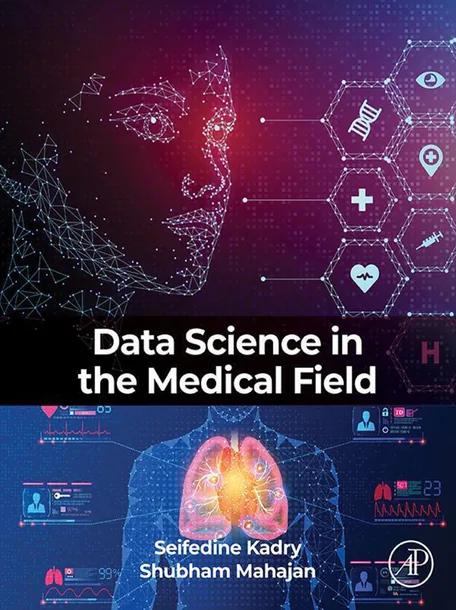
Data Science in the Medical Field
by Seifedine Kadry, Shubham Mahajan
1st Edition
Publisher: Academic Press
Book Details
| Print ISBN | 9780443240287 |
| eText ISBN | 9780443240294 |
| Publisher | Academic Press |
| Publishing Year | 2024 |
| Edition | 1st Edition |
| Language | English |
Published by Academic Press in English, Data Science in the Medical Field, 1st Edition, authored by Seifedine Kadry and Shubham Mahajan, evaluates specialized analytical tools for identifying early signs of illness and tracking patient health. This text provides targeted coverage for clinicians, academic researchers, industrial R&D personnel, final year undergraduate students, and postgraduate students.
The volume synthesizes big data analytics, statistics, pattern recognition, and semantic web technologies for clinical operations. Methodological topics include technological applications of biosensors in disease diagnostics, machine learning classification algorithms for heart disease prediction, and artificial intelligence systems designed to evaluate cancer survival trends.
Computer vision capabilities are highlighted through explainable image recognition models designed to assist radiologists with clinical decision-making. Additional coverage presents automated convolutional neural network models for COVID-19 severity classification alongside U-Net segmentation techniques for brain tumor recognition, establishing a practical resource for advanced medical informatics programs.
Table of Contents
Chapter 1: PPH 4.0: a privacy-preserving health 4.0 framework with machine learning and cellular automata
- • 1.1 Introduction
- • 1.2 A brief survey of related technologies and past important works
- • 1.2.1 Machine learning
- • 1.2.2 MapReduce
- • 1.2.3 Attribute-based encryption
- • 1.2.4 Cellular automata
- • 1.2.5 Elementary cellular automata alignment
- • 1.2.6 Elementary cellular automata rules
- • 1.3 Research methodology and proposed framework
- • 1.3.1 Supervised approach for data dimensionality reduction
- • 1.3.2 Filter methods
- • 1.3.3 Correlation coefficient
- • 1.3.4 Information gain
- • 1.3.5 Fisher score
- • 1.3.6 Mutual information
- • 1.3.7 Chi-square
- • 1.3.8 Wrapper methods
- • 1.3.9 Forward selection approach
- • 1.3.10 Backward elimination approach
- • 1.3.11 Embedded methods
- • 1.3.12 Feature transformation
- • 1.3.13 Linear discriminant analysis
- • 1.3.14 Principal component analysis
- • 1.3.15 Autoencoder
- • 1.3.16 Metric learning
- • 1.4 Discussions
- • 1.4.1 Integration of methods and disciplines to pursue the objectives
- • 1.5 Conclusions and future research direction
- • Acknowledgment
- • Declaration of competing interest
- • References
Chapter 2: An automatic detection and severity levels of COVID-19 using convolutional neural network models
- • 2.1 Introduction
- • 2.2 Related work
- • 2.3 Early diagnosis by deep learning strategies
- • 2.4 Methodology
- • 2.4.1 Preprocessing
- • 2.4.2 Data augmentation
- • 2.4.3 Transfer learning
- • 2.4.4 Segmentation using the U-Net architecture
- • 2.4.5 Classification using ReseNet50 or VGG16
- • 2.5 Dataset and implementation
- • 2.6 Performance evaluation metrics
- • 2.6.1 Accuracy
- • 2.6.2 Sensitivity
- • 2.6.3 Precision
- • 2.6.4 F-score
- • 2.7 Comparison
- • 2.8 Conclusion
- • References
Chapter 3: Biosensors and disease diagnostics in medical field
- • 3.1 Introduction
- • 3.1.1 Importance of disease diagnostics in healthcare
- • 3.1.2 Role of biosensors in disease diagnosis
- • 3.2 Principle of biosensor
- • 3.3 Architecture of biosensor structure
- • 3.4 Different types of medical sensors
- • 3.5 Biosensor technologies in disease diagnosis
- • 3.6 Application of biosensors
- • 3.6.1 Infectious diseases
- • 3.6.2 Cancer
- • 3.6.3 Diabetes
- • 3.6.4 Cardiovascular diseases
- • 3.6.5 Neurological disorders
- • 3.6.6 Autoimmune diseases
- • 3.7 Challenges and limitations of biosensors in disease diagnostics
- • 3.8 Future perspectives and advancements in biosensor technology
- • 3.8.1 Integration of biosensor with artificial intelligence and machine learning
- • 3.8.2 Wearable biosensors and remote monitoring
- • 3.9 Commercial and clinical adoption of biosensors
- • 3.9.1 Current market landscape of biosensors in the medical field
- • 3.9.2 Challenges in commercialization and widespread adoption
- • 3.10 Case studies of biosensor applications
- • 3.11 Conclusion
- • 3.11.1 Future implications of biosensors in healthcare and medical field
- • References
Chapter 4: Brain tumor recognition and classification techniques
- • 4.1 Introduction
- • 4.2 Imaging methods
- • 4.3 Brain tumor detection, segmentation, and classification
- • 4.3.1 Brain tumors detection and segmentation
- • 4.4 Conclusion and discussion for segmentation
- • 4.4.1 Brain tumor classification
- • 4.5 Analysis study
- • 4.6 Conclusion and discussion for classification
- • 4.7 Conclusion and future prospects
- • References
Chapter 5: Identifying the features and attributes of various artificial intelligence-based healthcare models
- • 5.1 Introduction
- • 5.2 Predictive analytics models
- • 5.2.1 IBM Watson Health
- • 5.2.2 Google DeepMind Health
- • 5.2.3 Ayasdi
- • 5.2.4 Cerner
- • 5.2.5 Epic systems
- • 5.2.6 Statistical Analysis System
- • 5.3 Natural Language Processing models
- • 5.3.1 BioBERT
- • 5.3.2 ClinicalBERT
- • 5.3.3 MedBERT
- • 5.3.4 BlueBERT
- • 5.3.5 PubmedBERT
- • 5.3.6 Clinical BERT-based question answering
- • 5.3.7 MedCAT
- • 5.3.8 i2b2 Natural Language Processing framework
- • 5.4 Chatbot models
- • 5.4.1 Microsoft healthcare bot
- • 5.4.2 Woebot
- • 5.4.3 Your.MD
- • 5.4.4 Buoy health
- • 5.4.5 Babylon health
- • 5.4.6 Infermedica
- • 5.4.7 Ada Health
- • 5.5 Computer Vision models
- • 5.5.1 Mammography computer-aided detection systems
- • 5.5.2 Retinal fundus imaging
- • 5.5.3 Histopathology image analysis
- • 5.5.4 Skin lesion analysis
- • 5.5.5 Analysis of radiology imaging
- • 5.5.6 Surgical vision systems
- • 5.6 Conclusion
- • 5.7 Artificial intelligence disclosure
- • References
Chapter 6: Classification algorithms and optimization techniques in healthcare systems representation of dataset in medical applications
- • 6.1 Introduction
- • 6.2 Related works
- • 6.3 Types of classification
- • 6.4 Architecture and methods
- • 6.5 Proposed attributes and methods
- • 6.6 Efficiency and performance
- • 6.7 Experiential result discussion
- • 6.8 Conclusion
- • References
Chapter 7: A knowledge discovery framework for COVID-19 disease from PubMed abstract using association rule hypergraph
- • 7.1 Introduction
- • 7.2 Related works
- • 7.3 Methodology
- • 7.3.1 Data gathering and preprocessing
- • 7.3.2 Keyword extraction using latent Dirichlet allocation with affinity propagation clustering
- • 7.3.3 Generation of the association using affinity propagation-hypergraph
- • 7.4 Experimental analysis
- • 7.4.1 Data gathering and preprocessing
- • 7.4.2 TF-IDF estimation
- • 7.4.3 Latent Dirichlet allocation with affinity propagation
- • 7.4.4 Extracted association
- • 7.4.5 Comparative analysis
- • 7.5 Conclusion
- • Author contribution
- • Acknowledgment
- • References
Chapter 8: Predictive analysis in healthcare using data science: leveraging big data for improved patient care
- • 8.1 Introduction
- • 8.2 Data science in healthcare: an overview
- • 8.2.1 Role of data science in healthcare transformation
- • 8.2.2 Healthcare data science: progress challenges and opportunities
- • 8.3 Predictive analysis techniques in healthcare
- • 8.3.1 Data collection and reprocessing
- • 8.3.2 Feature selection and engineering
- • 8.3.3 Predictive analysis using machine learning models
- • 8.3.4 Predictive model evaluation and validation
- • 8.4 Application of predictive analysis in healthcare
- • 8.4.1 Early disease detection and diagnosis
- • 8.4.2 Personalized treatment planning
- • 8.4.3 Hospital resource management and patient flow optimization
- • 8.4.4 Public health surveillance and outbreak prediction
- • 8.5 Case studies and success stories
- • 8.5.1 Case study: IBM Watson health and chronic disease management
- • 8.5.2 Case study: Pfizer’s predictive analytics for adverse drug reactions
- • 8.5.3 Case study: partners healthcare and hospital readmission reduction
- • 8.6 Conclusion and future research direction
- • References
Chapter 9: Data science in medical field: advantages, challenges, and opportunities
- • 9.1 Introduction
- • 9.2 Literature review
- • 9.3 Overview of data science in medical field
- • 9.4 Applications of data science in medical field
- • 9.4.1 Predictive analytics
- • 9.4.2 Diagnostics tools
- • 9.4.3 Pharmaceutical services
- • 9.4.4 Drug discovery and development
- • 9.4.5 Healthcare resource optimization
- • 9.4.6 Disease surveillance and outbreak prediction
- • 9.4.7 Continuous monitoring and remote patient care
- • 9.5 Advantages of data science in healthcare sector
- • 9.6 Challenges of data science in healthcare sector
- • 9.6.1 Data management
- • 9.6.2 Privacy and security
- • 9.6.3 Data retention
- • 9.6.4 Maintaining cybersecurity
- • 9.7 Opportunities of data science in healthcare sector
- • 9.8 Discussion and future directions
- • 9.9 Conclusion
- • Further reading
Chapter 10: Decentralizing healthcare through parallel blockchain architecture: transmitting internet of medical things data through smart contracts in telecare medical information systems
- • 10.1 Introduction
- • 10.2 Literature review
- • 10.2.1 Telecare medical information systems
- • 10.2.2 Blockchain technology
- • 10.2.3 Internet of medical things
- • 10.2.4 Patientdoctor parallel-chain communication
- • 10.3 Network architecture and implementation
- • 10.3.1 Parallel blockchain architecture
- • 10.3.2 Communication layer
- • 10.4 Application development and smart-contract deployment
- • 10.4.1 Application structure
- • 10.4.2 Smart-contract deployment
- • 10.4.3 User interface/user experience
- • 10.5 Results and discussion
- • 10.6 Conclusion
- • 10.7 Future work
- • References
Chapter 11: Machine learning in heart disease prediction
- • 11.1 Introduction
- • 11.2 Literature review
- • 11.3 Proposed method
- • 11.3.1 Random forest
- • 11.3.2 Supporting vector machine
- • 11.3.3 Artificial neural networks
- • 11.4 Methodology
- • 11.4.1 Data collection
- • 11.4.2 Data exploration
- • 11.4.3 Data set collection
- • 11.4.4 Attribute selection
- • 11.4.5 Data preprocessing
- • 11.4.6 Balancing of data
- • 11.4.7 Disease prediction
- • 11.5 Software requirement
- • 11.5.1 Anaconda
- • 11.5.2 Python
- • 11.5.3 Numpy
- • 11.5.4 Pandas
- • 11.5.5 Sklearn
- • 11.5.6 Tensorflow
- • 11.5.7 Objective and types of testing
- • 11.6 Conclusion
- • References
Chapter 12: U-Net-based approaches for brain tumor segmentation
- • 12.1 Introduction
- • 12.2 Brain tumors
- • 12.3 Magnetic resonance imaging
- • 12.3.1 Radiologists’ role in magnetic resonance imaging image analysis
- • 12.4 Deep learning
- • 12.5 Convolutional neural networks
- • 12.6 U-Net
- • 12.7 Summary of related work
- • 12.7.1 Methodology
- • 12.8 Experimental setup
- • 12.8.1 Process
- • 12.8.2 Data preprocessing
- • 12.9 Model building and training
- • 12.9.1 Data split
- • 12.9.2 Performance evaluation
- • 12.9.3 Implementation and results
- • 12.10 2D U-Net architecture
- • 12.11 2D Modalities results
- • 12.11.1 Optimization algorithm results
- • 12.11.2 Activation function results
- • 12.11.3 Normalization and dropout results
- • 12.12 3D U-Net architecture
- • 12.13 3D modalities results
- • 12.13.1 Normalization and dropout results
- • 12.14 Residual U-Net architecture
- • 12.15 Activation function results
- • 12.16 Normalization and dropout results
- • 12.17 Attention U-Net architecture
- • 12.18 Normalization and dropout results
- • 12.19 Residual attention U-Net architecture
- • 12.20 Normalization and dropout results
- • 12.21 Architecture comparison
- • 12.22 Conclusion
- • 12.23 Research contribution
- • 12.24 Future work
- • References
Chapter 13: Explainable image recognition models for aiding radiologists in clinical decision making
- • 13.1 Introduction
- • 13.2 Literature review
- • 13.3 Proposed work
- • 13.3.1 Data gathering and preparation
- • 13.3.2 Annotation of abnormal regions or abnormalities in the dataset
- • 13.3.3 Preprocessing steps for image enhancement and normalization
- • 13.3.4 Training an abnormality detection model
- • 13.3.5 Abnormality detection and localization
- • 13.4 X-ray
- • 13.5 Magnetic resonance imaging scan
- • 13.5.1 Assessment of the performance of abnormality detection for each scan type
- • 13.5.2 Extraction of abnormality information
- • 13.5.3 Text generation for abnormality narration
- • 13.5.4 Presentation of abnormality narration to the user
- • 13.6 Experimental results
- • 13.6.1 Performance metrics
- • 13.6.2 4.3 Text generation metrics
- • 13.6.3 4.4 Comparison with existing methods
- • 13.7 Concluding remarks and prospects
- • References
Chapter 14: Prediction of heart failure disease using classification algorithms along with performance parameters
- • 14.1 Introduction
- • 14.2 Related work
- • 14.3 Methodology
- • 14.3.1 Data preprocessing
- • 14.3.2 Feature engineering
- • 14.3.3 Feature selection
- • 14.3.4 Traintest split
- • 14.3.5 Machine learning models
- • 14.3.6 Performance parameters
- • 14.3.7 Results and discussion
- • 14.4 Conclusion
- • References
Chapter 15: Cancer survival prediction using artificial intelligence: current status and future prospects
- • 15.1 Introduction
- • 15.2 Literature review
- • 15.2.1 Classical machine learning techniques for cancer survival prediction
- • 15.2.2 Ensemble learning techniques for cancer survival prediction
- • 15.2.3 Deep learning techniques for cancer survival prediction
- • 15.3 Evaluation metrics for cancer survival prediction
- • 15.3.1 Classification metrics
- • 15.3.2 Discriminative metrics
- • 15.3.3 Explainability metrics
- • 15.4 Challenges and limitations of using artificial intelligence techniques
- • 15.4.1 Data availability and quality (the data dilemma)
- • 15.4.2 Interpretation and explainability (the artificial intelligence enigma)
- • 15.4.3 Ethical considerations (guardian of privacy)
- • 15.5 Conclusion and future direction
- • References
Chapter 16: Heart disease prediction in pregnant women with diabetes using machine learning
- • 16.1 Introduction
- • 16.2 Literature review
- • 16.3 Proposed research work
- • 16.3.1 Comprehensive guide to predictive modeling and machine learning
- • 16.3.2 System flow diagram for advanced heart disease prediction in diabetic pregnancy
- • 16.3.3 Potential benefits on early risk prediction during diabetic pregnancy
- • 16.3.4 Advanced machine learning approaches for early detection and risk assessment in diabetic pregnancy
- • 16.4 Results and discussion
- • 16.5 Performance metrics for machine learning models: logistic regression, random forest, and decision tree
- • 16.5.1 Novelty of proposed work
- • 16.6 Conclusion
- • 16.7 Future scope
- • AI disclosure
- • References
Chapter 17: Healthcare using image recognition technology
- • 17.1 Introduction
- • 17.1.1 What is image processing, exactly?
- • 17.1.2 What does medical image processing entail?
- • 17.1.3 What is image classification?
- • 17.1.4 How does image classification work?
- • 17.1.5 What is image processing in medicine?
- • 17.1.6 How does medical image processing work?
- • 17.2 What is machine learning and how does it work?
- • 17.2.1 Exactly what is machine learning?
- • 17.2.2 What is the process of machine learning?
- • 17.2.3 What kinds of machine learning are there?
- • 17.2.4 What is the importance of machine learning?
- • 17.2.5 Machine learning’s principal uses
- • 17.3 Master’s in healthcare
- • 17.3.1 Applications of artificial intelligence in healthcare
- • 17.4 Discussion on medical image processing
- • 17.4.1 Related resources
- • 17.5 Conclusion
- • References
Chapter 18: Integration of deep learning and blockchain technology for a smart healthcare record management system
- • 18.1 Introduction
- • 18.2 Importance of smart healthcare
- • 18.2.1 Internet of Medical Things
- • 18.2.2 Smart e-healthcare
- • 18.3 Emerging technologies in Internet of Medical Things
- • 18.3.1 Artificial intelligence in Internet of Medical Things
- • 18.3.2 Blockchain in Internet of Medical Things
- • 18.3.3 Machine learning in Internet of Medical Things
- • 18.3.4 Cloud computing in Internet of Medical Things
- • 18.4 Digital twins, telemedicine, and metaverse in Internet of Medical Things
- • 18.5 Case study: patient centric heal
Customer Reviews
0.0
0 reviews
No reviews yet. Be the first to review this book!
Write a Review
Reviewed by GradeFocus Editorial Team
▶Research Sources (18)
- 9780443240287
- [PDF] Data Science in the Medical Field by Seifedine Kadry
- Data Science in the Medical Field
- Data Science in the Medical Field - 1st Edition
- 详情
- https://search.lib.buffalo.edu/permalink/01SUNY_BU...
- https://www.icpsr.umich.edu/sites/nanda/view/studi...
- Data Science in Medical and Healthcare: Current Landscape
- https://caccl-laccd.primo.exlibrisgroup.com/permal...
- Untitled
- Data Science in the Medical Field
- Data Science in the Medical Field
- Data Science in Healthcare – Applications, Benefits & ...
- Applications of Data Science in Healthcare
- (PDF) The role of data science in healthcare advancements
- 9780443240287: Data Science in the Medical Field
- How Data Science Is Transforming Healthcare - SCI
- Bridging expertise and practice: Data science in healthcare