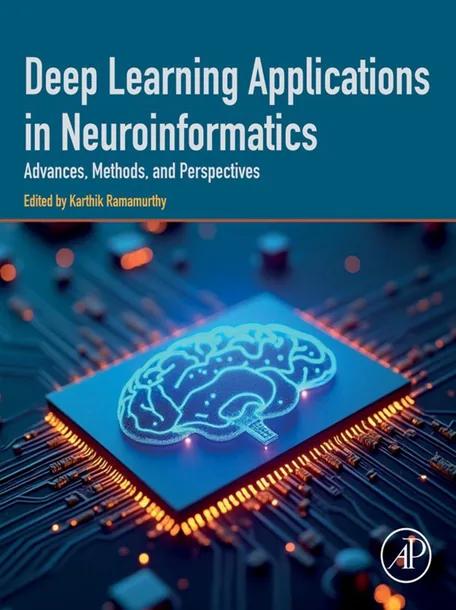
Deep Learning Applications in Neuroinformatics
Advances, Methods, and Perspectives
by Karthik Ramamurthy
1st Edition
Publisher: Academic Press
Book Details
| Print ISBN | 9780443414596 |
| eText ISBN | 9780443414602 |
| Publisher | Academic Press |
| Publishing Year | 2026 |
| Edition | 1st Edition |
| Language | English |
| Pages | 366 |
Deep Learning Applications in Neuroinformatics, 1st Edition, edited by Karthik Ramamurthy, presents a systematic examination of computational learning methods for analyzing diagnostic brain data. The volume offers foundational and applied technical knowledge to support researchers, graduate students, and industry professionals working in computer science, biomedical engineering, medical imaging, and neuroscience.
The text details fundamental deep learning architectures, focusing on Convolutional Neural Networks (CNNs) and Recurrent Neural Networks (RNNs). It details the algorithmic mechanisms required to process complex neuroimaging data modalities, including electroencephalography (EEG) signals, magnetic resonance imaging (MRI) scans, and positron emission tomography (PET) imaging.
Real-world case studies within the volume demonstrate how deep learning enhances research and clinical applications, highlighting specific procedural steps for identifying predictive biomarkers in Alzheimer's disease and stroke. This evidence-based content provides essential reference support for advanced academic courses and technical research initiatives.
Table of Contents
Chapter 1: Introduction to Deep Learning in Neuroinformatics
- • 1.1. Introduction
- • 1.2. Background
- • 1.3. Overview of Neuroinformatics
- • 1.4. Role of Deep Learning in Neuroscience
- • 1.5. Current Trends and Future Directions
- • 1.6. Conclusion
Chapter 2: Fundamentals of Deep Learning in Neuroinformatics
- • 2.1. Introduction
- • 2.2. Background
- • 2.3. Basics of Neural Networks
- • 2.4. Convolutional Neural Networks (CNNs) in Neuroimaging and Signal Processing
- • 2.5. Recurrent Neural Networks (RNNs) for Time-Series Neurodata
- • 2.6. Advanced Architectures (GANs, Transformers) in Neuroinformatics
- • 2.7. Conclusion
Chapter 3: Data Preprocessing and Augmentation Techniques for Neuroinformatics
- • 3.1. Introduction
- • 3.2. Background
- • 3.4. Data Cleaning and Normalization for Neuroimaging and Signal Data
- • 3.5. Augmentation Strategies for Neuroimaging and Signal Datasets
- • 3.6. Handling Imbalanced Neuroimaging and Signal Data
- • 3.7. Data Privacy and Ethical Considerations in Neuroinformatics
- • 3.8. Conclusion Applications of Deep Learning in Neuroinformatics
Chapter 4: Deep Learning for Alzheimer’s Disease and Mild Cognitive Impairment
- • 4.1. Introduction
- • 4.2. Background
- • 4.3. Modalities: EEG, MRI, PET
- • 4.4. Early Detection and Diagnosis using CNNs and RNNs
- • 4.5. Disease Progression Monitoring with Autoencoders
- • 4.6. Treatment Response Prediction using GANs
- • 4.7. Personalized Intervention Strategies with Deep Learning
- • 4.8 Conclusion
Chapter 5: Deep Learning in Stroke Detection and Rehabilitation
- • 5.1. Introduction
- • 5.2. Background
- • 5.3. Modalities: MRI, CT, EEG
- • 5.4. Acute Stroke Detection with CNNs
- • 5.5. Post-Stroke Recovery Analysis using RNNs
- • 5.6. Personalized Rehabilitation Strategies with Reinforcement Learning
- • 5.7. Predictive Modeling for Stroke Recurrence using Deep Learning
- • 5.8. User Role and Trustworthiness of AI in Stroke Management
- • 5.9. Conclusion
Chapter 6: Deep Learning for Autism Spectrum Disorder
- • 6.1. Introduction
- • 6.2. Background
- • 6.3. Modalities: MRI, fMRI, EEG
- • 6.4. Diagnostic Tools using CNNs and RNNs
- • 6.5. Behavioral and Neuroimaging Analysis with Autoencoders
- • 6.6. Early Intervention and Therapy Monitoring using GANs
- • 6.7. Predictive Analysis for Therapy Outcomes with Deep Learning
- • 6.8. User Role and Trustworthiness of AI in ASD
- • 6.9. Conclusion
Chapter 7: Deep Learning in Epilepsy Detection and Management
- • 7.1. Introduction
- • 7.2. Background
- • 7.3. Modalities: EEG, MRI
- • 7.4. Seizure Detection Algorithms using CNNs and LSTMs
- • 7.5. Pre-Surgical Planning with Deep Neural Networks
- • 7.6. Long-Term Monitoring Solutions with RNNs
- • 7.7. Personalized Treatment Plans using Deep Learning
- • 7.8. User Role and Trustworthiness of AI in Epilepsy Management
- • 7.9. Conclusion
Chapter 8: Deep Learning Applications in Parkinson’s Disease and Movement Disorders
- • 8.1. Introduction
- • 8.2. Background
- • 8.3. Modalities: MRI, PET, SPECT
- • 8.4. Early Diagnosis and Monitoring using CNNs
- • 8.5. Motor Function Analysis with LSTMs and RNNs
- • 8.6. Actigraphy and Its Role in Data-Intensive Monitoring
- • 8.7. Treatment Optimization Strategies with GANs
- • 8.8. Predictive Modeling for Disease Progression with Deep Learning
- • 8.9. User Role and Trustworthiness of AI in Parkinson’s Disease Management
- • 8.10. Conclusion
Chapter 9: Deep Learning for Multiple Sclerosis
- • 9.1. Introduction
- • 9.2. Background
- • 9.3. Modalities: MRI, OCT
- • 9.4. Lesion Detection and Segmentation with CNNs
- • 9.5. Disease Progression Tracking using RNNs
- • 9.6. Treatment Response Assessment with Autoencoders
- • 9.7. Predictive Modeling for Relapse using Deep Learning
- • 9.8. Conclusion
Chapter 10: Deep Learning in Traumatic Brain Injury (TBI)
- • 10.1. Introduction
- • 10.2. Background
- • 10.3. Modalities: MRI, CT, EEG
- • 10.4. Detection and Classification using CNNs and RNNs
- • 10.5. Prognosis and Recovery Monitoring with LSTMs
- • 10.6. Rehabilitation Strategies using Reinforcement Learning
- • 10.7. Predictive Analysis for Recovery Outcomes with Deep Learning
- • 10.8. Conclusion
Chapter 11: Deep Learning for Neurodevelopmental and Psychiatric Disorders
- • 11.1. Introduction
- • 11.2. Background
- • 11.3. Modalities: MRI, fMRI, EEG
- • 11.4. DL Techniques for ADHD, Schizophrenia, and Depression
- • 11.5. Diagnostic and Monitoring Tools using CNNs and RNNs
- • 11.6. Personalized Treatment and Intervention Analysis with GANs
- • 11.7. Predictive Modeling for Therapeutic Outcomes with Deep Learning
- • 11.8. Conclusion
Chapter 12: Explainable AI in Neuroinformatics
- • 12.1. Introduction
- • 12.2. Background
- • 12.3. Importance of Explainability in Deep Learning
- • 12.4. Techniques for Interpretability in Neuroimaging and Signal Processing
- • 12.5. Applications and Case Studies
- • 12.6. Conclusion
Chapter 13: Transfer Learning and Domain Adaptation in Neuroinformatics
- • 13.1. Introduction
- • 13.2. Background
- • 13.4. Fundamentals of Transfer Learning for Neuroimaging and Signal Data
- • 13.5. Domain Adaptation Techniques in Neuroinformatics
- • 13.6. Applications in Multi-Modal Data Integration
- • 13.7. Conclusion
Chapter 14: Integrating Multi-Modal Neuroimaging and Signal Data with Deep Learning
- • 14.1. Introduction
- • 14.2. Background
- • 14.3. Challenges in Multi-Modal Data Integration
- • 14.4. Techniques for Combining EEG, MRI, PET, and Other Data
- • 14.5. Deep Learning Approaches for Integration
- • 14.6. Applications and Case Studies
- • 14.7. Conclusion
Chapter 15: Conclusion and Future Perspectives
- • 15.1. Summary of Key Insights in DL and Neuroinformatics
- • 15.2. Impact on Neuroscience and Healthcare
- • 15.3. Emerging Deep Learning Technologies
- • 15.4. Future Research Directions in Neuroinformatics
- • 15.5. Potential Challenges and Solutions
- • 15.6. Final Thoughts and Future Outlook
Customer Reviews
0.0
0 reviews
No reviews yet. Be the first to review this book!
Write a Review
Reviewed by GradeFocus Editorial Team
▶Research Sources (16)
- Deep Learning Applications in Neuroinformatics
- Deep Learning Applications in Neuroinformatics
- Deep Learning Applications in Neuroinformatics E-bok
- Deep Learning Applications in Neuroinformatics
- Thompson Learn.
- Fundamentals of deep learning in neuroinformatics
- Bound To Stay Bound Books, Inc. - Bookstore
- Computer science print books and ebooks - page 3
- Brindha Anbalagan
- Deep Learning Applications in Neuroinformatics
- Deep Learning Applications in Neuroinformatics - Elsevier Shop
- Decoding the application of deep learning in neuroscience - PMC - NIH
- Deep Learning Applications in Neuroinformatics - IPSO
- Application of Neuroinformatics in Alzheimer's Disease Research
- Deep Learning Applications in Neuroinformatics Karthik Ramamurthy
- (PDF) Application of Neuroinformatics in Alzheimer's Disease Research