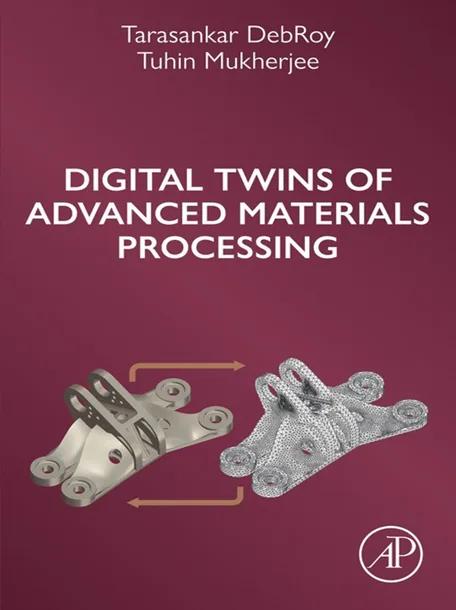
Digital Twins of Advanced Materials Processing
by Tarasankar DebRoy, Tuhin Mukherjee
1st Edition
Publisher: Academic Press
Book Details
| Print ISBN | 9780443329180 |
| eText ISBN | 9780443329197 |
| Publisher | Academic Press |
| Publishing Year | 2026 |
| Edition | 1st Edition |
| Language | English |
| Pages | 259 |
Digital Twins of Advanced Materials Processing, 1st Edition, authored by Tarasankar DebRoy and Tuhin Mukherjee, delivers a structured examination of digital twin technology for students, researchers, and industry professionals. The text defines how computational representations connect with physical equipment to enable data-centric decision-making during advanced processing operations.
The book details the foundational building blocks, testing procedures, validation protocols, and real-world applications of digital twins. It focuses on specific processing environments, including additive manufacturing and fusion welding, demonstrating how virtual systems model physical behavior and thermal processing operations.
Additionally, the volume places digital twin technology directly within the broader context of Industry 4.0 and smart manufacturing frameworks. This thematic structure provides relevant coverage for academic study, research projects, and professional practice across modern industrial engineering sectors.
Table of Contents
Chapter 1: Introduction
- • 1.1 An inspiring event
- • 1.2 What is a digital twin?
- • 1.3 Evolution and history of digital twins
- • 1.4 Capabilities and uses of digital twins in materials processing industries
- • 1.5 Solution of major challenges in materials processing
- • 1.6 Content of this book
Chapter 2: Building blocks of a digital twin
- • 2.1 Introduction
- • 2.2 Mechanistic models
- • 2.3 Machine learning and deep learning
- • 2.4 Surrogate and reduced order models
- • 2.5 Statistical models
- • 2.6 Control models
- • 2.7 Big data and data analytics
- • 2.8 Interconnection among the building blocks
Chapter 3: Mechanistic models
- • 3.1 Introduction
- • 3.2 Mechanistic models of manufacturing processes
- • 3.2.1 Heat transfer and fluid flow modeling
- • 3.2.2 Process modeling
- • 3.3 Mechanistic modeling of microstructure
- • 3.3.1 Solidification morphology
- • 3.3.2 Grain structure
- • 3.3.3 Microstructure evolution
- • 3.4 Mechanistic modeling of mechanical properties
- • 3.5 Mechanistic modeling of performance
- • 3.5.1 Defects
- • 3.5.2 Mitigating composition change - selective vaporization of alloying elements
- • 3.5.3 Modeling residual stress and distortion
- • 3.6 Software for mechanistic modeling of manufacturing
Chapter 4: Surrogate and reduced order models
- • 4.1 Introduction
- • 4.2 Analytical models
- • 4.3 Dimensionless number-based calculations
- • 4.4 Reverse models
- • 4.5 Back of the envelop calculations
- • 4.6 Data-driven surrogate models
- • 4.6.1 Linear regression
- • 4.6.2 Support vector regression
- • 4.6.3 Radial basis functions
- • 4.6.4 Kriging
- • 4.6.5. Mixture of surrogates
- • 4.6.6 Available software
Chapter 5: Machine learning and deep learning
- • 5.1 Introduction
- • 5.2 Machine learning algorithms and applications
- • 5.2.1 Regression algorithms
- • 5.2.2 Classification algorithms
- • 5.3 Deep learning algorithms and applications
- • 5.3.1 Discriminative deep learning
- • 5.3.2 Generative deep learning
- • 5.3.3 Reinforcement learning
- • 5.4 Image processing and feature extraction
- • 5.5 Open-source packages
- • 5.6 Data needs
Chapter 6: Statistical models
- • 6.1 Introduction
- • 6.2 Different statistical models for digital twins
- • 6.2.1 Regression Models
- • 6.2.2 Time Series Analysis
- • 6.2.3 Monte Carlo Simulations
- • 6.2.4 Hidden Markov Models
- • 6.2.5 Principal Component Analysis
- • 6.2.6 Optimization algorithms
- • 6.3 Roles of statistical models in digital twins of materials processing
- • 6.4 Synergy between mechanistic and statistical models
Chapter 7: Sensing and control
- • 7.1 Introduction
- • 7.2 Sensors
- • 7.2.1 Temperature sensing
- • 7.2.2 Pressure measurements
- • 7.2.3 Flow sensors
- • 7.2.4 Vibration sensors
- • 7.2.5 Sensor data for control models
- • 7.3 Operations Research-based control models
- • 7.3.1 Linear programming
- • 7.3.2 Integer programming
- • 7.3.3 Dynamic programming
- • 7.3.4 Queuing theory
- • 7.3.5 Network flow models
- • 7.3.6 Markov decision processes
- • 7.3.7 Model predictive control
- • 7.3.8 Feedback and feed-forward control models
- • 7.4 Fuzzy Logic-based control models
- • 7.5 Data-driven control models
- • 7.6 Proportional-Integral-Derivative control models
- • 7.6.1 Advantages and disadvantages
- • 7.6.2 Types of proportional-integral derivative controllers
- • 7.7 Processing and storage of data for process control in manufacturing
Chapter 8: Digital twin implementation and case studies
- • 8.1 Introduction
- • 8.2 Implementation of digital twin
- • 8.2.1 Hardware and software integration
- • 8.2.2 Internet of things for connectivity
- • 8.2.3 Cyber physical systems in digital twins
- • 8.2.4 Validation and testing of the building blocks
- • 8.2.5 Uncertainty quantification for digital twins
- • 8.3 Examples of important applications
- • 8.3.1 A digital twin of additive manufacturing for part qualification
- • 8.3.2 A digital twin of fusion welding for weld quality control
- • 8.3.3 A digital twin of continuous die casting for quality control
- • 8.3.4 A digital twin for production control and planning
- • 8.3.5 A digital twin for controlling the microstructure of metallic parts
Chapter 9: Current status, research needs, and outlook
- • 9.1 Introduction
- • 9.2 Current status
- • 9.3 Research needs
- • 9.3.1 Data storage
- • 9.3.2 Blockchain
- • 9.3.3 Accessibility
- • 9.3.4 Cybersecurity
- • 9.3.5 Need for quantum computing
- • 9.3.6 High technology readiness level of building blocks
- • 9.3.7 Standardization
- • 9.4 Outlook
- • 9.4.1 Emerging trends
- • 9.4.2 Challenges and barriers to adoption
- • 9.4.3 Path forward
Customer Reviews
0.0
0 reviews
No reviews yet. Be the first to review this book!
Write a Review
Reviewed by GradeFocus Editorial Team
▶Research Sources (15)
- Digital Twins of Advanced Materials Processing
- Digital Twins of Advanced Materials Processing
- Digital Twins of Advanced Materials Processing
- Digital Twins of Advanced Materials Processing
- Digital Twins of Advanced Materials Processing
- Digital Twins of Advanced Materials Processing.
- Pace Press
- Thompson Learn.
- Digital Twins of Advanced Materials Processing
- Digital Twins of Advanced Materials Processing - 1st Edition
- Digital Twins for Materials
- Digital Twins for Materials
- Big data-assisted digital twins for the smart design and ...
- Digital Twin Research and Development for a Metal Additive ...
- Bringing digital twin technology to the classroom
Related Books
Elastomer-Based Composites and Nanocomposites
Hamid Essabir

Piezoelectric Materials
Christopher R. Bowen

Functionalized Biopolymers
Swati Sharma

Inorganic Biomaterials for Drug Delivery
Amit Kumar Nayak

Hydrogels for Wound Healing
Sabu Thomas

Nanobiomaterials and Nanomedicines for Metabolic Disorders
Subhash C. Mandal