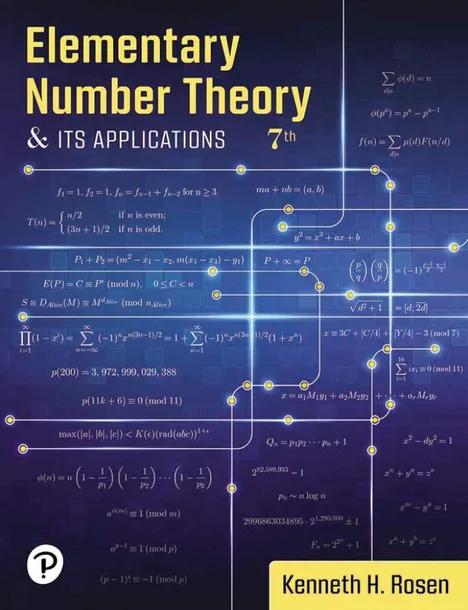
Book Details
| Print ISBN | 9780137356249 |
| eText ISBN | 9780137356157 |
| Publisher | Pearson |
| Publishing Year | 2024 |
| Edition | 7th Edition |
| Language | English |
| Pages | 837 |
Elementary Number Theory, 7th Edition, presents foundational concepts in arithmetic, mathematical induction, and theoretical proofs alongside practical computational methods. The textbook explores core number-theoretic principles through structured examples, applications, and extensive exercise sets.
Broad coverage spans integer representations, greatest common divisors, prime distribution, congruences, and arithmetic functions. The text also examines primitive roots, quadratic residues, continued fractions, and nonlinear Diophantine equations.
Integrated connections with abstract algebra assist students who have already encountered the subject or plan to study it later. Computational exercises and computer projects provide hands-on practice using Maple, Mathematica, Sage Math, and online resources.
Table of Contents
Chapter 1: The Integers
- • Numbers and Sequences
- • Diophantine Approximation
- • Sums and Products
- • Mathematical Induction
- • The Fibonacci Numbers
- • Divisibility
Chapter 2: Integer Representations and Operations
- • Representations of Integers
- • Computer Operations with Integers
- • Complexity of Integer Operations
Chapter 3: Greatest Common Divisors
- • Greatest Common Divisors and Their Properties
- • The Euclidean Algorithm
- • Linear Diophantine Equations
Chapter 4: Prime Numbers
- • Prime Numbers
- • The Distribution of Primes
- • The Fundamental Theorem of Arithmetic
- • Factorization Methods and the Fermat Numbers
Chapter 5: Congruences
- • Introduction to Congruences
- • Linear Congruences
- • The Chinese Remainder Theorem
- • Polynomial Congruences
- • Systems of Linear Congruences
Chapter 6: Applications of Congruences
- • Divisibility Tests
- • The Perpetual Calendar
- • Round-Robin Tournaments
- • Hashing Functions
- • Check Digits
Chapter 7: Some Special Congruences
- • Wilson's Theorem and Fermat's Little Theorem
- • Pseudoprimes
- • Euler's Theorem
Chapter 8: Arithmetic Functions
- • The Euler Phi-Function
- • The Sum and Number of Divisors
- • Perfect Numbers and Mersenne Primes
- • Möbius Inversion
- • Partitions
Chapter 9: Cryptography
- • Character Ciphers
- • Block and Stream Ciphers
- • Exponentiation Ciphers
- • Public Key Cryptography
- • Cryptographic Protocols and Applications
Chapter 10: Primitive Roots
- • The Order of an Integer and Primitive Roots
- • Primitive Roots for Primes
- • The Existence of Primitive Roots
- • Discrete Logarithms and Index Arithmetic
- • Primality Tests Using Orders of Integers and Primitive Roots
- • Universal Exponents
Chapter 11: Applications of Primitive Roots and the Order of an Integer
- • Pseudorandom Numbers
- • The EIGamal Cryptosystem
- • An Application to the Splicing of Telephone Cables
Chapter 12: Quadratic Residues
- • Quadratic Residues and Nonresidues
- • The Law of Quadratic Reciprocity
- • The Jacobi Symbol
- • Euler Pseudoprimes
- • Zero-Knowledge Proofs
Chapter 13: Decimal Fractions and Continued Fractions
- • Decimal Fractions
- • Finite Continued Fractions
- • Infinite Continued Fractions
- • Periodic Continued Fractions
- • Factoring Using Continued Fractions
Chapter 14: Nonlinear Diophantine Equations and Elliptic Curves
- • Pythagorean Triples
- • Fermat's Last Theorem
- • Sum of Squares
- • Pell's Equation
- • Congruent Numbers and Elliptic Curves
- • Elliptic Curves Modulo Primes
- • Applications of Elliptic Curves
Chapter 15: The Gaussian Integers
- • Gaussian Integers and Gaussian Primes
- • Greatest Common Divisors and Unique Factorization
- • Gaussian Integers and Sums of Squares
Customer Reviews
0.0
0 reviews
No reviews yet. Be the first to review this book!
Write a Review
Reviewed by GradeFocus Editorial Team