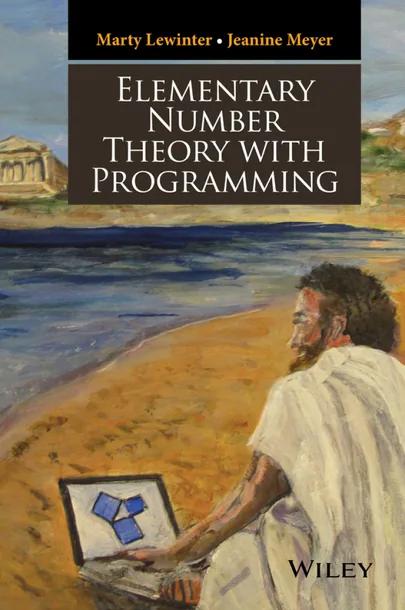
Elementary Number Theory with Programming
by Marty Lewinter, Jeanine Meyer
1st Edition
Publisher: Wiley-Blackwell
Book Details
| Print ISBN | 9781119062769 |
| eText ISBN | 9781119062776 |
| Publisher | Wiley-Blackwell |
| Publishing Year | 2015 |
| Edition | 1st Edition |
| Language | English |
| Pages | 240 |
Elementary Number Theory with Programming, 1st Edition, bridges mathematics and computer science by introducing elementary number theory alongside foundational programming topics. The textbook approaches both disciplines in tandem without assuming advanced prerequisite knowledge in either field.
Core subjects include modular arithmetic, prime decomposition, and integer sequences such as the Fibonacci numbers. Programming applications demonstrate the practical utility of these concepts, showing how modular arithmetic and prime factors provide the mathematical foundation for public-key cryptography.
Designed for undergraduate and graduate students in mathematics or computer science, the work also serves as a reference for software professionals and researchers. Plentiful sample computer programs assist readers who have no prior coding background or want to strengthen their programming practice.
Table of Contents
Chapter 1: Special Numbers: Triangular, Oblong, Perfect, Deficient, and Abundant
- • Triangular Numbers
- • Oblong Numbers and Squares
- • Deficient, Abundant, and Perfect Numbers
- • Exercises
Chapter 2: Fibonacci Sequence, Primes, and the Pell Equation
- • Prime Numbers and Proof by Contradiction
- • Proof by Construction
- • Sums of Two Squares
- • Building a Proof on Prior Assertions
- • Sigma Notation
- • Some Sums
- • Finding Arithmetic Functions
- • Fibonacci Numbers
- • An Infinite Product
- • The Pell Equation
- • Goldbach’s Conjecture
- • Exercises
Chapter 3: Pascal’s Triangle
- • Factorials
- • The Combinatorial Numbers n Choose k
- • Pascal’s Triangle
- • Binomial Coefficients
- • Exercises
Chapter 4: Divisors and Prime Decomposition
- • Divisors
- • Greatest Common Divisor
- • Diophantine Equations
- • Least Common Multiple
- • Prime Decomposition
- • Semiprime Numbers
- • When is a Number an mth Power?
- • Twin Primes
- • Fermat Primes
- • Odd Primes Are Differences of Squares
- • When is n a Linear Combination of a and b?
- • Prime Decomposition of n!
- • No Nonconstant Polynomial with Integer Coefficients Assumes Only Prime Values
- • Exercises
Chapter 5: Modular Arithmetic
- • Congruence Classes Mod k
- • Laws of Modular Arithmetic
- • Modular Equations
- • Fermat’s Little Theorem
- • Multiplicative Inverses
- • Wilson’s Theorem
- • Wilson’s Theorem (2nd Version)
- • Squares and Quadratic Residues
- • Lagrange’s Theorem
- • Reduced Pythagorean Triples
- • Chinese Remainder Theorem
- • Exercises
Chapter 6: Number Theoretic Functions
- • The Tau Function
- • The Sigma Function
- • Multiplicative Functions
- • Perfect Numbers Revisited
- • Mersenne Primes
- • F(n) = Σf(d) Where d is a Divisor of n
- • The Möbius Function
- • The Riemann Zeta Function
- • Exercises
Chapter 7: The Euler Phi Function
- • The Phi Function
- • Euler’s Generalization of Fermat’s Little Theorem
- • Phi of a Product of m and n When gcd(m,n) > 1
- • The Order of a (mod n)
- • Primitive Roots
- • The Index of m (mod p) Relative to a
- • To Be or Not to Be a Quadratic Residue
- • The Legendre Symbol
- • Quadratic Reciprocity
- • Law of Quadratic Reciprocity
- • When Does x2 = a (mod n) Have a Solution?
- • Exercises
Chapter 8: Sums and Partitions
- • An nth Power is the Sum of Two Squares
- • Solutions to the Diophantine Equation a2 + b2 + c2 = d2
- • Row Sums of a Triangular Array of Consecutive Odd Numbers
- • Partitions
- • When is a Number the Sum of Two Squares?
- • Sums of Four or Fewer Squares
- • Exercises
Chapter 9: Cryptography
- • Introduction and History
- • Public-Key Cryptography
- • Factoring Large Numbers
- • The Knapsack Problem
- • Superincreasing Sequences
- • Exercises
Customer Reviews
0.0
0 reviews
No reviews yet. Be the first to review this book!
Write a Review
Reviewed by GradeFocus Editorial Team