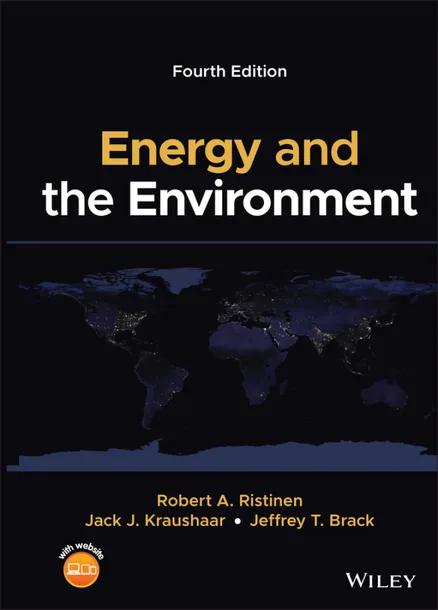
Energy and the Environment
by Robert A. Ristinen, Jack J. Kraushaar, Jeffrey T. Brack
4th Edition
Publisher: Wiley-Blackwell
Book Details
| Print ISBN | 9781119800255 |
| eText ISBN | 9781119800279 |
| Publisher | Wiley-Blackwell |
| Publishing Year | 2022 |
| Edition | 4th Edition |
| Language | English |
| Pages | 368 |
Energy and the Environment (4th Edition) is an academic textbook designed to equip upper-level undergraduate and graduate students with a physical understanding of energy resources and environmental impacts. Written by Robert A. Ristinen, Jack J. Kraushaar, and Jeffrey T. Brack, this volume clarifies fundamental concepts alongside practical resource evaluation.
The material opens with physical fundamentals, including scientific notation, energy forms, and the law of energy conservation. It examines conventional fossil fuel systems, covering petroleum, coal, and natural gas by tracking historical production patterns and future resource availability. Additionally, the text covers nuclear power development, detailing its expansion in China alongside historical power plant accidents.
To address global atmospheric impacts, the text incorporates findings from Intergovernmental Panel on Climate Change reports alongside analyses of carbon budgets, geoengineering, and carbon capture and storage technologies. Published by Wiley-Blackwell, this 368-page volume supports advanced study in physics, environmental science, and engineering curricula.
Table of Contents
Chapter 1: Energy Fundamentals, Energy Use in an Industrial Society
- • 1.1 Introduction
- • 1.2 Why Do We Use So Much Energy?
- • 1.3 Energy Basics
- • 1.3.1 General
- • 1.3.2 Forms of Energy
- • 1.3.3 Power
- • 1.4 Units of Energy
- • 1.4.1 The Joule
- • 1.4.2 The British Thermal Unit
- • 1.4.3 The Calorie
- • 1.4.4 The Foot-Pound
- • 1.4.5 The Electron-Volt
- • 1.5 Scientific Notation
- • 1.6 Energy Consumption in the United States
- • 1.7 The Principle of Energy Conservation
- • 1.8 Transformation of Energy from One Form to Another
- • 1.9 Renewable and Nonrenewable Energy Sources
- • 1.9.1 Nonrenewable Energy Sources
- • 1.9.2 Renewable Energy Sources
- • Key Terms
- • Questions and Problems
- • Multiple Choice Questions
- • Suggested Reading and References
Chapter 2: The Fossil Fuels
- • 2.1 Introduction
- • 2.2 Petroleum
- • 2.3 History of the Production of Petroleum in the United States
- • 2.4 Petroleum Resources of the United States
- • 2.5 World Production of Petroleum
- • 2.6 The Cost of Gasoline in the United States
- • 2.7 Petroleum Refining
- • 2.8 Natural Gas
- • 2.9 The History of Use of Natural Gas
- • 2.10 The Natural Gas Resource Base in the United States
- • 2.11 The Natural Gas Resource Base for the World
- • 2.12 The Formation of Coal
- • 2.13 Coal Resources and Consumption
- • 2.14 Oil Shale
- • 2.15 Tar Sands
- • 2.16 Summary
- • Key Terms
- • Questions and Problems
- • Multiple Choice Questions
- • Suggested Reading and References
Chapter 3: Heat Engines
- • 3.1 The Mechanical Equivalent of Heat
- • 3.2 The Energy Content of Fuels
- • 3.3 The Thermodynamics of Heat Engines
- • 3.4 Generation of Electricity
- • 3.5 Electric Power Transmission
- • 3.6 Practical Heat Engines
- • 3.6.1 Steam Engines
- • 3.6.2 Gasoline Engines
- • 3.6.3 Diesel Engines
- • 3.6.4 Gas Turbines
- • 3.7 Heat Pumps
- • 3.8 Cogeneration
- • Key Terms
- • Questions and Problems
- • Multiple Choice Questions
- • Suggested Reading and References
Chapter 4: Renewable Energy Sources I: Solar Energy
- • 4.1 Introduction
- • 4.2 Energy from the Sun
- • 4.3 A Flat-Plate Collector System
- • 4.4 Passive Solar
- • 4.5 Solar Thermal Electric Power Generation
- • 4.5.1 Power Towers
- • 4.5.2 Parabolic Dishes and Troughs
- • 4.6 The Direct Conversion of Solar Energy to Electrical Energy
- • 4.7 Solar Cooling
- • Key Terms
- • Questions and Problems
- • Multiple Choice Questions
- • Suggested Reading and References
Chapter 5: Renewable Energy Sources II: Alternatives
- • 5.1 Introduction
- • 5.2 Hydropower
- • 5.3 Wind Power
- • 5.4 Ocean Thermal Energy Conversion
- • 5.5 Biomass as an Energy Feedstock
- • 5.6 Biomass: Municipal Solid Waste
- • 5.7 Biomass-Derived Liquid and Gaseous Fuels
- • 5.8 Geothermal Energy
- • 5.9 Tidal Energy
- • 5.10 Wave Energy
- • 5.11 Summary
- • Key Terms
- • Questions and Problems
- • Multiple Choice Questions
- • Suggested Reading and References
Chapter 6: The Promise and Problems of Nuclear Energy
- • 6.1 Introduction
- • 6.2 A Short History of Nuclear Energy
- • 6.3 Radioactivity
- • 6.4 Nuclear Reactors
- • 6.5 The Boiling Water Reactor
- • 6.6 Fuel Cycle
- • 6.7 Uranium Resources
- • 6.8 Environmental and Safety Aspects of Nuclear Energy
- • 6.9 Nuclear Reactor Accidents
- • 6.9.1 The Chernobyl Disaster
- • 6.9.2 Fukushima Daiichi Disaster
- • 6.10 Nuclear Weapons
- • 6.11 The Storage of High-Level Radioactive Waste
- • 6.12 The Cost of Nuclear Power
- • 6.13 Nuclear Fusion as an Energy Source
- • 6.14 Controlled Thermonuclear Reactions
- • 6.15 A Fusion Reactor
- • Key Terms
- • Questions and Problems
- • Multiple Choice Questions
- • Suggested Reading and References
Chapter 7: Energy Conservation
- • 7.1 A Penny Saved Is a Penny Earned
- • 7.2 Space Heating
- • 7.2.1 Thermal Insulation
- • 7.2.2 Air Infiltration
- • 7.2.3 Furnaces, Stoves, and Fireplaces
- • 7.2.4 Solar and Other Sources of Heat Energy
- • 7.2.5 Standards for Home Heating
- • 7.3 Water Heaters, Home Appliances, and Lighting
- • 7.3.1 Water Heating
- • 7.3.2 Appliances
- • 7.3.3 Lighting
- • 7.3.4 The Energy-Conserving House
- • 7.4 Energy Conservation in Industry and Agriculture
- • 7.4.1 Housekeeping
- • 7.4.2 Waste Heat Recovery and Cogeneration
- • 7.4.3 Process Changes
- • 7.4.4 Recycling
- • 7.4.5 New Developments
- • 7.4.6 Help from Public Utilities
- • Key Terms
- • Questions and Problems
- • Multiple Choice Questions
- • Suggested Reading and References
Chapter 8: Transportation
- • 8.1 Introduction
- • 8.2 Power and Energy Requirements
- • 8.3 Electric Batteries, Flywheels, Hybrids, Hydrogen, Alcohol
- • 8.3.1 Electric Vehicles
- • 8.3.2 Flywheel-Powered Vehicles
- • 8.3.3 Hybrid Vehicles
- • 8.3.4 Hydrogen, Fuel Cells
- • 8.3.5 Alcohol as a Transportation Fuel
- • 8.4 Mass Transportation
- • Key Terms
- • Questions and Problems
- • Multiple Choice Questions
- • Suggested Reading and References
Chapter 9: Air Pollution
- • 9.1 Spaceship Earth
- • 9.2 The Earth’s Atmosphere
- • 9.3 Thermal Inversions
- • 9.4 Carbon Monoxide
- • 9.5 The Oxides of Nitrogen
- • 9.6 Hydrocarbon Emissions and Photochemical Smog
- • 9.7 Reduction of Vehicle Emissions
- • 9.8 Sulfur Dioxide in the Atmosphere
- • 9.9 Particulates as Pollutants
- • 9.10 Acid Rain
- • Key Terms
- • Questions and Problems
- • Multiple Choice Questions
- • Suggested Reading and References
Chapter 10: Global Effects
- • 10.1 Introduction
- • 10.2 Ozone Depletion in the Stratosphere
- • 10.3 The Greenhouse Effect and World Climate Changes
- • Key Terms
- • Questions and Problems
- • Multiple Choice Questions
- • Suggested Reading and References
Customer Reviews
0.0
0 reviews
No reviews yet. Be the first to review this book!
Write a Review
Reviewed by GradeFocus Editorial Team
▶Research Sources (14)
- Energy and the Environment | Rent | 9781119800279
- Energy and the Environment - ISBN 9781119800279
- [PDF] Energy and the Environment by Robert A. Ristinen ...
- Energy and the Environment
- eBook: Energy and the Environment von Robert A. Ristinen
- Sourcebooks, LLC.
- Energy and the Environment (ebook), Robert A. Ristinen ... - Bol
- Search Results : Ristinen
- Energy and the Environment
- Introduction to Energy, Environment, and Sustainability
- Energy and the Environment (4TH) - Kinokuniya
- Energy and the Environment
- Energy and the Environment - Book Series
- Energy and the Environment