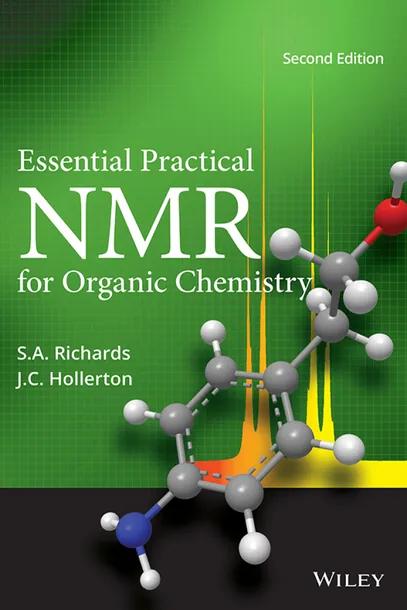
Essential Practical NMR for Organic Chemistry
A hands-on resource advocating an ordered approach to gathering and interpreting NMR data
by S. A. Richards, J. C. Hollerton
2nd Edition
Publisher: Wiley-Blackwell
Book Details
| Print ISBN | 9781119844808 |
| eText ISBN | 9781119844822 |
| Publisher | Wiley-Blackwell |
| Publishing Year | 2022 |
| Edition | 2nd Edition |
| Language | English |
| Pages | 288 |
Essential Practical NMR for Organic Chemistry, 2nd Edition is a practical handbook designed to establish a structured approach to gathering and interpreting spectrum data. The volume guides readers through fundamental spectrometer concepts, initial sample preparation, and systematic data collection.
Early chapters explain core principles such as chemical shift, spin splitting, and peak integration alongside sample quantity requirements, solvent selection, and referencing standards. Technical discussions outline key acquisition parameters, including pulse widths, spectral width, acquisition time, relaxation delays, and shimming procedures. The reference further details data processing methods from zero-filling and apodization to Fourier transformation, phase correction, and baseline adjustments. Interpretation sections focus on identifying signals from common solvents, impurities, exchangeable protons, aldehydes, aromatics, heterocycles, and alkyl groups.
Authors S. A. Richards and J. C. Hollerton bring over 40 years of industrial NMR experience at GlaxoSmithKline R&D to this reference guide. The handbook supports undergraduate organic chemistry students, post-graduate researchers, and practicing chemists who handle their own spectral analysis.
Table of Contents
Chapter 1: Getting Started
- • 1.1 The Technique
- • 1.2 Instrumentation
- • 1.3 Origin of the Chemical Shift
- • 1.4 Origin of ‘Splitting’
- • 1.5 Integration
Chapter 2: Preparing the Sample
- • 2.1 How Much Sample Do I Need?
- • 2.2 Solvent Selection
- • 2.3 Spectrum Referencing (Proton NMR)
- • 2.4 Sample Preparation
Chapter 3: Spectrum Acquisition
- • 3.1 Number of Transients
- • 3.2 Number of Points
- • 3.3 Spectral Width
- • 3.4 Acquisition Time
- • 3.5 Pulse Width/Pulse Angle
- • 3.6 Relaxation Delay
- • 3.7 Number of Increments
- • 3.8 Non-Uniform Sampling (NUS)
- • 3.9 Shimming
- • 3.10 Tuning and Matching
- • 3.11 Frequency Lock
- • 3.12 To Spin or Not to Spin?
Chapter 4: Processing
- • 4.1 Introduction
- • 4.2 Zero-Filling and Linear Prediction
- • 4.3 Apodization
- • 4.4 Fourier Transformation
- • 4.5 Phase Correction
- • 4.6 Baseline Correction
- • 4.7 Integration
- • 4.8 Referencing
- • 4.9 Peak Picking
Chapter 5: Interpreting Your Spectrum
- • 5.1 Common Solvents and Impurities
- • 5.2 Group 1 – Exchangeables and Aldehydes
- • 5.3 Group 2 – Aromatic and Heterocyclic Protons
- • 5.4 Group 3 – Double and Triple Bonds
- • 5.5 Group 4 – Alkyl Protons
Chapter 6: Delving Deeper
- • 6.1 Chiral Centres
- • 6.2 Enantiotopic and Diastereotopic Protons
- • 6.3 Molecular Anisotropy
- • 6.4 Accidental Equivalence
- • 6.5 Restricted Rotation
- • 6.6 Heteronuclear Coupling
- • 6.7 Cyclic Compounds and the Karplus Curve
- • 6.8 Salts, Free Bases and Zwitterions
- • 6.9 Zwitterionic Compounds Are Worthy of Special Mention
Chapter 7: Further Elucidation Techniques – Part 1
- • 7.1 Chemical Techniques
Chapter 8: Further Elucidation Techniques – Part 2
- • 8.1 Introduction
- • 8.2 Spin-Decoupling (Homonuclear, 1-D)
- • 8.3 Correlated Spectroscopy (COSY)
- • 8.4 Total Correlation Spectroscopy (TOCSY) 1- and 2-D
- • 8.5 The Nuclear Overhauser Effect (NOE) and Associated Techniques
Chapter 9: Carbon-13 NMR Spectroscopy
- • 9.1 General Principles and 1-D 13 C
- • 9.2 2-D Proton–Carbon (Single Bond) Correlated Spectroscopy
- • 9.3 2-D Proton–Carbon (Multiple Bond) Correlated Spectroscopy
- • 9.4 Piecing It All Together
- • 9.5 Choosing the Right Tool
Chapter 10: Nitrogen-15 NMR Spectroscopy
- • 10.1 Introduction
- • 10.2 Referencing
- • 10.3 Using 15 N Data
- • 10.4 Amines
- • 10.5 Conjugated Amines
- • 10.6 Amides
- • 10.7 Amidines
- • 10.8 Azides
- • 10.9 Carbamates
- • 10.10 Cyanates and Thiocyanates
- • 10.11 Diazo Compounds
- • 10.12 Formamides
- • 10.13 Hydrazines
- • 10.14 Hydroxamic Acids
- • 10.15 Hydroxylamines
- • 10.16 Imides (Alkyl and Aryl)
- • 10.17 Imines
- • 10.18 Isocyanates and Isothiocyanates
- • 10.19 Nitrogen-Bearing Heterocycles
- • 10.20 Nitriles
- • 10.21 Nitro Compounds
- • 10.22 Nitroso and N-Nitroso Compounds
- • 10.23 N-Oxides
- • 10.24 Oximes
- • 10.25 Sulfonamides
- • 10.26 Ureas and Thioureas
- • 10.27 Other Unusual Compounds
- • 10.28 15 N Topics
Chapter 11: Some Other Techniques and Nuclei
- • 11.1 HPLC-NMR
- • 11.2 Flow NMR
- • 11.3 Solvent Suppression
- • 11.4 MAS (Magic Angle Spinning) NMR
- • 11.5 Pure Shift NMR
- • 11.6 Other 2-D Techniques
- • 11.7 3-D Techniques
- • 11.8 Fluorine (19 F) NMR
- • 11.9 Phosphorus (31 P) NMR
Chapter 12: Dynamics
- • 12.1 Linewidths
- • 12.2 Chemical Shifts
- • 12.3 Splittings
- • 12.4 Relaxation Pathways
- • 12.5 Experimental Techniques
- • 12.6 In Practice
- • 12.7 In Conclusion
Chapter 13: Quantification
- • 13.1 Introduction
- • 13.2 Different Approaches to Quantification
- • 13.3 Things to Watch Out For
- • 13.4 Quantification of Other Nuclei
- • 13.5 Conclusion
Chapter 14: Safety
- • 14.1 Magnetic Fields
- • 14.2 Cryogens
- • 14.3 Sample-Related Injuries
Chapter 15: Software
- • 15.1 Acquisition Software
- • 15.2 Processing Software
- • 15.3 Prediction and Simulation Software
- • 15.6 Structural Verification Software
- • 15.7 Structural Elucidation Software
- • 15.8 Summary
Chapter 16: Problems
- • 16.1 Questions
- • 16.2 Hints
- • 16.3 Answers
- • 16.4 A Closing Footnote
Chapter 17: Raising Your Game
- • 17.1 Spotting the Pitfalls
- • 17.2 The Wrong Solvent
- • 17.3 Choosing the Right Experiment
Customer Reviews
0.0
0 reviews
No reviews yet. Be the first to review this book!
Write a Review
Reviewed by GradeFocus Editorial Team
▶Research Sources (14)
- Essential Practical NMR for Organic Chemistry, eBook by S. A. ...
- [PDF] Essential Practical NMR for Organic Chemistry by S. A. ...
- Essential Practical NMR for Organic Chemistry [2 ed.] 2022035662 ...
- Essential Practical NMR for Organic Chemistry - Librerías Gandhi
- Sourcebooks, LLC.
- Please verify you are human - Captcha
- Thompson Learn.
- All - Inventory Press
- Essential Practical NMR for Organic Chemistry | Rent
- Essential Practical NMR for Organic Chemistry
- (PDF) Essential Practical NMR for Organic Chemistry
- Essential Practical NMR for Organic Chemistry
- Essential Practical NMR for Organic Chemistry, 2nd Edition
- Essential Practical Nmr For Organic Chemistry 2nd Edition ...