Excursions in Modern Mathematics
by Peter Tannenbaum
10th Edition
Publisher: Pearson
Book Details
| Print ISBN | 9780136921967 |
| eText ISBN | 9780136969365 |
| Publisher | Pearson |
| Publishing Year | 2022 |
| Edition | 10th Edition |
| Language | English |
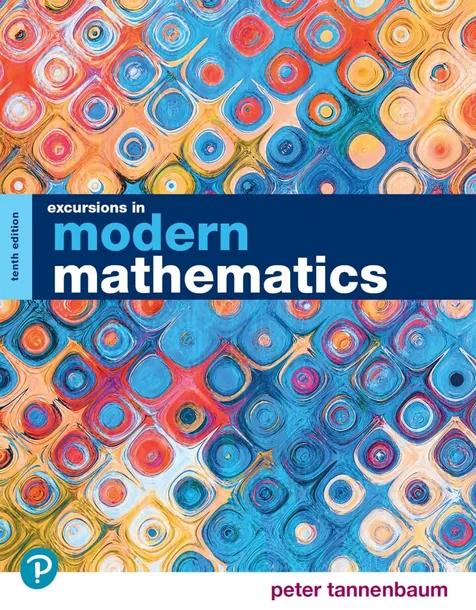
Excursions in Modern Mathematics, 10th Edition, is a mathematics textbook by Peter Tannenbaum that explores practical applications of mathematical reasoning. Published by Pearson, the volume demonstrates accessible quantitative concepts through everyday scenarios.
Coverage is categorized into five broad areas: social choice, management science, growth, shape and form, and statistics. Because these thematic units function independently, chapters can be taught in any order. The material addresses voting systems, fair division, network routing, financial growth, and statistical analysis.
Every chapter concludes with a Key Concepts chart to assist students with study and review. The 2022 edition also provides added resources for instructors and students, alongside updated examples drawn from contemporary science, culture, and politics.
Table of Contents
Chapter 1: The Mathematics of Elections: The Paradoxes of Democracy
- • 1.1 The Basic Elements of an Election
- • 1.2 The Plurality Method
- • 1.3 The Borda Count Method
- • 1.4 The Plurality-with-Elimination Method
- • 1.5 The Method of Pairwise Comparisons
- • 1.6 Fairness Criteria and Arrow's Impossibility Theorem
- • Conclusion
- • Key Concepts
- • Exercises
Chapter 2: The Mathematics of Power: Weighted Voting
- • 2.1 An Introduction to Weighted Voting
- • 2.2 Banzhaf Power
- • 2.3 Shapley-ShubikPower
- • 2.4 Subsets and Permutations
- • Conclusion
- • Key Concepts
- • Exercises
Chapter 3: The Mathematics of Sharing: Fair-Division Games
- • 3.1 Fair-Division Games
- • 3.2 The Divider-Chooser Method
- • 3.3 The Lone-Divider Method
- • 3.4 The Lone-Chooser Method
- • 3.5 The Method of Sealed Bids
- • 3.6 The Method of Markers
- • Conclusion
- • Key Concepts
- • Exercises
Chapter 4: The Mathematics of Apportionment: Making the Rounds
- • 4.1 Apportionment Problems and Apportionment Methods
- • 4.2 Hamilton's Method
- • 4.3 Jefferson's Method
- • 4.4 Adams's and Webster's Methods
- • 4.5 The Huntington-Hill Method
- • 4.6 The Quota Rule and Apportionment Paradoxes
- • Conclusion
- • Key Concepts
- • Exercises
Chapter 5: The Mathematics of Getting Around: Euler Paths and Circuits
- • 5.1 Street-Routing Problems
- • 5.2 An Introduction to Graphs
- • 5.3 Euler's Theorems and Fleury's Algorithm
- • 5.4Eulerizingand Semi-EulerizingGraphs
- • Conclusion
- • Key Concepts
- • Exercises
Chapter 6: The Mathematics of Touring: Traveling Salesman Problems
- • 6.1 What Is a Traveling Salesman Problem?
- • 6.2 Hamilton Paths and Circuits
- • 6.3 The Brute-Force Algorithm
- • 6.4 The Nearest-Neighbor and Repetitive Nearest-Neighbor Algorithms
- • 6.5 The Cheapest-Link Algorithm
- • Conclusion
- • Key Concepts
- • Exercises
Chapter 7: The Mathematics of Networks: The Cost of Being Connected
- • 7.1 Networks and Trees
- • 7.2 Spanning Trees, MSTs, andMaxSTs
- • 7.3 Kruskal's Algorithm
- • Conclusion
- • Key Concepts
- • Exercises
Chapter 8: The Mathematics of Scheduling: Chasing the Critical Path
- • 8.1 An Introduction to Scheduling
- • 8.2 Directed Graphs
- • 8.3 Priority-List Scheduling
- • 8.4 The Decreasing-Time Algorithm
- • 8.5 Critical Paths and the Critical-Path Algorithm
- • Conclusion
- • Key Concepts
- • Exercises
Chapter 9: Population Growth Models: There Is Strength in Numbers
- • 9.1 Sequences and Population Sequences
- • 9.2 The Linear Growth Model
- • 9.3 The Exponential Growth Model
- • 9.4 The Logistic Growth Model
- • Conclusion
- • Key Concepts
- • Exercises
Chapter 10: Financial Mathematics: Money Matters
- • 10.1 Percentages
- • 10.2 Simple Interest
- • 10.3 Compound Interest
- • 10.4 Retirement Savings
- • 10.5 Consumer Debt
- • Conclusion
- • Key Concepts
- • Exercises
Chapter 11: The Mathematics of Symmetry: Beyond Reflection
- • 11.1 Rigid Motions
- • 11.2 Reflections
- • 11.3 Rotations
- • 11.4 Translations
- • 11.5 Glide Reflections
- • 11.6 Symmetries and Symmetry Types
- • 11.7 Patterns
- • Conclusion
- • Key Concepts
- • Exercises
Chapter 12: Fractal Geometry: The Kinky Nature of Nature
- • 12.1 The Koch Snowflake and Self-Similarity
- • 12.2 The Sierpinski Gasket and the Chaos Game
- • 12.3 The Twisted Sierpinski Gasket
- • 12.4 The Mandelbrot Set
- • Conclusion
- • Key Concepts
- • Exercises
Chapter 13: Fibonacci Numbers and the Golden Ratio: Tales of Rabbits and Gnomons
- • 13.1 Fibonacci Numbers
- • 13.2 The Golden Ratio
- • 13.3 Gnomons
- • 13.4 Spiral Growth in Nature
- • Conclusion
- • Key Concepts
- • Exercises
Chapter 14: Censuses, Surveys, Polls, and Studies: The Joys of Collecting Data
- • 14.1 Enumeration
- • 14.2 Measurement
- • 14.3 Cause and Effect
- • Conclusion
- • Key Concepts
- • Exercises
Chapter 15: Graphs, Charts, and Numbers: The Data Show and Tell
- • 15.1 Graphs and Charts
- • 15.2 Means, Medians, and Percentiles
- • 15.3 Ranges and Standard Deviations
- • Conclusion
- • Key Concepts
- • Exercises
Chapter 16: Probabilities, Odds, and Expectations: Measuring Uncertainty and Risk
- • 16.1 Sample Spaces and Events
- • 16.2 The Multiplication Rule, Permutations, and Combinations
- • 16.3 Probabilities and Odds
- • 16.4 Expectations
- • 16.5 Measuring Risk
- • Conclusion
- • Key Concepts
- • Exercises
Chapter 17: The Mathematics of Normality: The Call of the Bell
- • 17.1 Approximately Normal Data Sets
- • 17.2 Normal Curves and Normal Distributions
- • 17.3 Modeling Approximately Normal Distributions
- • 17.4 Normality in Random Events
- • Conclusion
- • Key Concepts
- • Exercises
Customer Reviews
0.0
0 reviews
No reviews yet. Be the first to review this book!
Write a Review
Reviewed by GradeFocus Editorial Team