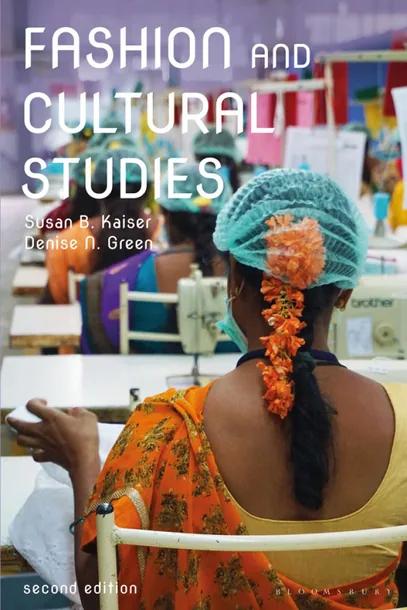
Fashion and Cultural Studies
by Susan B. Kaiser, Denise N. Green
2nd Edition
Publisher: Bloomsbury Publishing
Book Details
| Print ISBN | 9781350104679 |
| eText ISBN | 9781350104693 |
| Publisher | Bloomsbury Publishing |
| Publishing Year | 2021 |
| Edition | 2nd Edition |
| Language | English |
| Pages | 288 |
Fashion and Cultural Studies, 2nd Edition, is a textbook that connects theory and practice by analyzing dress from both fashion studies and cultural studies perspectives. Written by Susan B. Kaiser and Denise N. Green, the volume draws on intersectionality in feminist theory and cultural studies to investigate how identities intersect through embodied fashion.
The text investigates the circuit of style-fashion-dress, examining the relationships among production, regulation, distribution, consumption, and subject formation. Thematic discussions address how race, ethnicity, social class, gender, sexuality, and national identity take shape through everyday dress and style.
Intended for students and scholars, the textbook incorporates cross-cultural case studies. For the 2021 edition, the authors added chapters exploring religion and spirituality as well as dressed embodiment across diverse body sizes, shapes, and dis/abilities.
Table of Contents
Chapter 1: Fashion Studies and Cultural Studies
- • Articulation
- • Style-fashion-dress
- • The fields of fashion studies and cultural studies
- • Conceptualizing culture and fashion
- • Circuit of style-fashion-dress model
- • Production
- • Consumption
- • Distribution
- • Subject formation
- • Regulation
Chapter 2: Intersectional, Transnational Fashion Subjects
- • Assumption 1: Structure-agency dynamics include processes of persuasion, consent, and resistance.
- • Assumption 2: Subject formation through style-fashion-dress is a process of navigating intersectionalities.
- • Assumption 3: Structures of feeling – expressed through subject formation and the fashion process alike – articulate between everyday life and culture through the circuit of style-fashion-dress
- • Ambiguity
- • Cultural Ambivalence
- • Cultural Anxiety
- • Assumption 4: The field of critical fashion studies needs to move from identity nots to identity (k)nots
- • Assumption 5: Fashion is transnational – not merely western or “Euromodern"
- • Assumption 6: The process of negotiating ambiguity is not a level playing field, and it is a material process – especially in a transnational context
Chapter 3: Fashioning the National Subject
- • Nation ? essence
- • Nation as different than: Representing the other
- • Folk costume, national dress and fashion
- • Working the hyphen: Nation-state and style-fashion-dress
- • French Revolution
- • Chinese Cultural Revolution (and beyond)
- • From European expansion to globalization
- • Decolonizing fashion: Beyond the metaphor
- • Globalization
- • Intersectionalities and entanglements
Chapter 4: Racial Rearticulations and Ethnicities
- • Race and ethnicity: Sliding signifiers
- • Racial and ethnic rearticulations
- • Color
- • Hair
- • Ethnic re-articulations: Belongings-in-Difference
- • Sliding into appropriation, sliding into religion
Chapter 5: Religion, Fashion, and Spirituality
- • Subject formation
- • Spirituality, subjectivity, and materiality
- • Modesty
- • Piety, orthodoxy, religiosity
- • Regulation
- • State alignment with religion
- • Freedom from religion
- • Freedom of religion (religious freedom)
- • Production, distribution, and consumption
- • The Jewish diaspora and the textile, clothing, and retail industries
- • The globalization of Muslim fashion
Chapter 6: Class Matters, Fashion Matters
- • Conceptualizing class
- • Caste systems
- • Sumptuary laws, materials, and the “natural” order
- • Class, intersectionalities, and industrial capitalism
- • From textile to apparel production: At home, in the factory, and in protest
- • Class and fast fashion
- • Metaphors of class structure and change: The flows of fashion
- • Status claims and status demurrals
Chapter 7: Gendering Fashion, Fashioning Gender: Beyond Binaries
- • Soft assemblages
- • Marking, unmarking, and remarking gender
- • Sex, gender, and style-fashion-dress: Feminist deconstructions
- • Theorizing the body and style-fashion-dress
- • Transgender studies through bodies and style-fashion-dress
- • Menswear out of the academic closet
- • Multiple masculinities
- • Zoot suit
- • La SAPE in Congo
- • US National Survey of Male Intersectionalities
Chapter 8: Sexual Subjectivities and Style-Fashion-Dress
- • Sexual subjectivities
- • Binary “beginnings” and reversals
- • Homophobic discourses
- • On the protracted coming out of heterosexuality
- • 1960s and 1970s: Social movements and sexual fashions
- • 1980s and beyond: Queering fashion
- • Gazing subjects and positionalities
- • Sexuality through intersectionalities
Chapter 9: Dressed Embodiment
- • From phenomenology to dressed embodiment
- • Abstracting the body and representing embodiment
- • Anthropometrics and sizing
- • Stigmatizing and celebrating fat bodies
- • Sizeism and the fashion industry
- • Flaunting fat
- • Dis/abled bodies
- • Athletics and bodily exceptionalism
- • Addressing ableism
- • Disabling environments and style-fashion-dress
- • Fashioning disability
- • Concealment
- • Diversion and reframing
- • Modifying and making
- • Compensation
- • Social uniqueness
- • Social inclusion
- • Embodied subjectivities
Chapter 10: Bodies in Motion Through Time and Space
- • Time and space (and place)
- • Age/generation and place
- • Fashion's way with time in space: Spatiotemporalities
- • Industrial time
- • Anti/nonlinear time and space
- • Nostalgia
- • Space-Time compression and “speed space”
- • Uchronic temporality and utopian spaces
- • Closing/opening thoughts
Customer Reviews
0.0
0 reviews
No reviews yet. Be the first to review this book!
Write a Review
Reviewed by GradeFocus Editorial Team