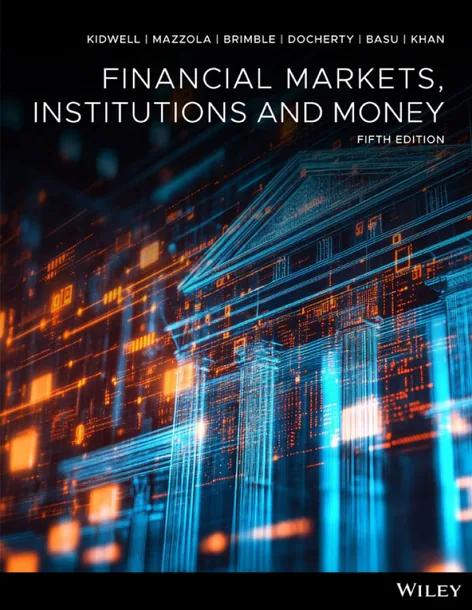
Financial markets, institutions and money
by David S Kidwell, Paul Mazzola, Mark Brimble
5th Edition
Publisher: John Wiley & Sons Australia
Book Details
| Print ISBN | 9781394333905 |
| eText ISBN | 9781394333912 |
| Publisher | John Wiley & Sons Australia |
| Publishing Year | 2026 |
| Edition | 5th Edition |
| Language | English |
Financial markets, institutions and money, 5th Edition, is a textbook that introduces the Australian financial system alongside its global connections. The text outlines the structure of modern financial environments, explaining how money, institutions, and capital markets interact.
The volume addresses fundamental financial sectors, including debt, equity, and foreign exchange markets, as well as the governance of central banking authorities. It also explores the practical operations of commercial banks and nonbank institutions within the broader economic system.
To support analytical problem-solving, quantitative demonstration problems with step-by-step solutions appear throughout the text. These exercises are designed to help students apply analytical skills to core financial problems.
Table of Contents
Chapter 1: The financial system
- • 1.1 The financial system
- • 1.2 Financial markets
- • 1.3 Financial institutes
- • 1.4 International financial markets
- • 1.5 Capital market efficiencies
- • Concept check
- • Summary
- • Key terms
- • Questions and problems
- • Endnotes
- • Acknowledgements
Chapter 2: Financial markets
- • 2.1 Money markets
- • 2.2 Capital markets
- • 2.3 Bond markets
- • 2.4 Equity markets
- • 2.5 Derivative markets
- • 2.6 Foreign exchange markets
- • Concept check
- • Summary
- • Key terms
- • Questions and problems
- • Endnotes
- • Acknowledgements
Chapter 3: The monetary authorities
- • 3.1 The origins and role of central banking authorities
- • 3.2 Reserve Bank of Australia
- • 3.3 Australian Prudential Regulation Authority
- • 3.4 Australian Securities and Investments Commission
- • 3.5 Bank for International Settlements
- • 3.6 Central banking systems around the globe
- • Concept check
- • Summary
- • Key terms
- • Questions and problems
- • Endnotes
- • Acknowledgements
Chapter 4: The Reserve Bank of Australia and interest rates
- • 4.1 Money supply
- • 4.2 Cash rate
- • 4.3 Monetary policy
- • 4.4 Economic activity
- • 4.5 Determinants of interest rates
- • Concept check
- • Summary
- • Key terms
- • Questions and problems
- • Endnotes
- • Acknowledgements
Chapter 5: Financial mathematics
- • 5.1 Cash flows, interest and the time value of money
- • 5.2 Simple interest
- • 5.3 Simple discount using commercial bills
- • 5.4 Compound interest
- • 5.5 Future and present value of several equations
- • 5.6 Present and future value of unequal amounts
- • 5.7 An application of annuities – bonds
- • Concept check
- • Summary
- • Key terms
- • Summary of key equal sums
- • Questions and problems
- • Appendix 1: Pv and fv tables
- • Appendix 2: Maths refresher
- • Endnotes
- • Acknowledgements
Chapter 6: Bond prices and interest rate risk
- • 6.1 The time value of money
- • 6.2 Bond pricing
- • 6.3 Bond yields
- • 6.4 Bond theoroms
- • 6.5 Interest rate risk and duration
- • 6.6 Duration and bond properties
- • Concept check
- • Summary
- • Key terms
- • Summary of key equations
- • Questions and problems
- • Endnotes
- • Acknowledgements
Chapter 7: The structure of interest rates
- • 7.1 The term structure of interest rates
- • 7.2 Default risk
- • 7.3 Marketability
- • 7.4 Options on debt securities
- • Concept check
- • Summary
- • Key terms
- • Questions and problems
- • Endnotes
- • Acknowledgements
Chapter 8: Money markets
- • 8.1 Role of the money markets
- • 8.2 Characteristics of money-market instruments
- • 8.3 The cash market
- • 8.4 Repurchase agreements
- • 8.5 One-name paper
- • 8.6 Treasury notes
- • 8.7 Commercial paper
- • 8.8 Negotiable certificates of deposit
- • 8.9 Asset-backed commercial paper
- • 8.10 Bank-accepted bills
- • 8.11 Money-market participants
- • 8.12 The interrelationship of money-market interest rates
- • Concept check
- • Summary
- • Key terms
- • Questions and problems
- • Endnotes
- • Acknowledgements
Chapter 9: Bond markets and valuation
- • 9.1 Government securities
- • 9.2 Corporate bonds
- • 9.3 Bond valuation
- • 9.4 Bond yields
- • 9.5 Interest rate risk
- • 9.6 The structure of interest rates
- • 9.7 The term structure of interest rates
- • Concept check
- • Summary
- • Key terms
- • Summary of key equations
- • Questions and problems
- • Endnotes
- • Acknowledgements
Chapter 10: Equity markets and share valuation
- • 10.1 The market for shares
- • 10.2 Ordinary and preference shares
- • 10.3 General dividend valuation model
- • 10.4 Share valuation: some simplifying assumptions
- • 10.5 Valuing preference shares
- • Concept check
- • Summary
- • Key terms
- • Summary of key equations
- • Questions and problems
- • Endnotes
- • Acknowledgements
Chapter 11: Derivatives markets
- • 11.1 The nature of forwards and futures
- • 11.2 Uses of the financial futures market
- • 11.3 Risks in the future markets
- • 11.4 Options markets
- • 11.5 Regulation of the futures and options markets
- • 11.6 Swap markets
- • Concept check
- • Summary
- • Key terms
- • Questions and problems
- • Endnotes
- • Acknowledgements
Chapter 12: Foreign exchange markets
- • 12.1 The difficulties of international trade
- • 12.2 The operations of foreign exchange markets
- • 12.3 Balance of payments
- • 12.4 Eurocurrency markets
- • 12.5 The globalisation of financial markets
- • Concept check
- • Summary
- • Key terms
- • Questions and problems
- • Endnotes
- • Acknowledgements
Chapter 13: Regulation of financial institutions
- • 13.1 Reasons for regulation
- • 13.2 The prudential supervision framework
- • 13.3 Prudential regulation in Australia
- • 13.4 National Credit Code
- • 13.5 Financial Ombudsman Service
- • Concept check
- • Summary
- • Key terms
- • Questions and problems
- • Endnotes
- • Acknowledgements
Chapter 14: Commercial bank operations
- • 14.1 The Australian banking industry
- • 14.2 Balance sheet for a commercial bank
- • 14.3 Off-balance- sheet banking
- • 14.4 Bank performance
- • 14.5 Liquidity management
- • 14.6 Bank capital management
- • 14.7 Managing credit risk
- • 14.8 Managing interest rate risk
- • Concept check
- • Summary
- • Key terms
- • Summary of key equations
- • Questions and problems
- • Endnotes
- • Acknowledgements
Chapter 15: Nonbank financial institutions
- • 15.1 Nonbank financial institutions
- • 15.2 Permanent building societies
- • 15.3 Credit unions
- • 15.4 Financial companies
- • Concept check
- • Summary
- • Key terms
- • Questions and problems
- • Endnotes
- • Acknowledgements
Chapter 16: International banking
- • 16.1 Development of international banking
- • 16.2 Structuring overseas banking services
- • 16.3 International banking activities
- • 16.4 International banking risks
- • 16.5 Regulation of overseas banking activities
- • 16.6 International activities of Australian banks
- • 16.7 Foreign banks in Australia
- • 16.8 Future directions of international banking
- • Concept check
- • Summary
- • Key terms
- • Questions and problems
- • Endnotes
- • Acknowledgements
Chapter 17: Insurance, investment companies and superannuation
- • 17.1 Insurance companies
- • 17.2 How insurance companies make money
- • 17.3 Type of insurance
- • 17.4 Investment companies
- • 17.5 Types of managed funds in Australia
- • 17.6 Superannuation
- • 17.7 Cash management trusts
- • 17.8 Hedge funds
- • Concept check
- • Summary
- • Key terms
- • Questions and problems
- • Endnotes
- • Acknowledgements
Chapter 18: Investment banking and venture capital
- • 18.1 The relationship between commercial and investment banks
- • 18.2 History of investment banking
- • 18.3 Investment banking in Australia
- • 18.4 Regulations of investment banking activities in Australia
- • 18.5 Primary services of an investment bank
- • 18.6 Venture capital
- • Concept check
- • Summary
- • Key terms
- • Questions and problems
- • Endnotes
- • Acknowledgements
Chapter 19: Sustainability and the finance sector
- • 19.1 Why is sustainability important for the finance sector?
- • 19.2 The ESG framework
- • 19.3 Social issues and the finance sector
- • 19.4 Governance issues and the finance sector
- • 19.5 SRI investments and ESG integration
- • 19.6 Progressing the ESG agenda
Customer Reviews
0.0
0 reviews
No reviews yet. Be the first to review this book!
Write a Review
Reviewed by GradeFocus Editorial Team