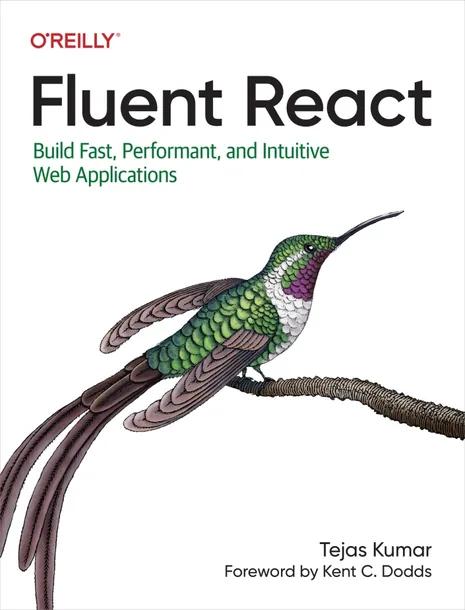
Fluent React
Build Fast, Performant, and Intuitive Web Applications
by Tejas Kumar
1st Edition
Publisher: O'Reilly Media
Book Details
| Print ISBN | 9781098138714 |
| eText ISBN | 9781098138677 |
| Publisher | O'Reilly Media |
| Publishing Year | 2024 |
| Edition | 1st Edition |
| Language | English |
In Fluent React (1st Edition), author Tejas Kumar and publisher O'Reilly Media deliver a structured guide aimed at web developers building performant web applications. Released in 2024, this volume clarifies how React operates under the hood while examining fundamental framework concepts.
The text traces the evolution of front-end development by discussing legacy tools such as jQuery, Backbone, KnockoutJS, and AngularJS, explaining how those libraries led to the adoption of Flux architecture. From that historical baseline, the coverage moves into core React mechanisms, analyzing how developers interact with state, reducers, and refs inside modern components.
The volume systematically addresses core framework topics, including JSX syntax, virtual DOM operations, React reconciliation, and performance optimization techniques. Web developers gain clear explanations of how component rendering and state updates function, creating a solid base for writing clean front-end code across complex web applications.
Table of Contents
Chapter 1: The Entry-Level Stuff
- • Why Is React a Thing?
- • The World Before React
- • jQuery
- • Backbone
- • KnockoutJS
- • AngularJS
- • Enter React
- • React’s Value Proposition
- • Releasing React
- • The Flux Architecture
- • Benefits of the Flux Architecture
- • Wrap-Up: So…Why Is React a Thing?
- • Chapter Review
- • Review Questions
- • Up Next
Chapter 2: JSX
- • JavaScript XML?
- • Benefits of JSX
- • Drawbacks of JSX
- • Under the Hood
- • How Does Code Work?
- • Extending JavaScript Syntax with JSX
- • The JSX Pragma
- • Expressions
- • Chapter Review
- • Review Questions
- • Up Next
Chapter 3: The Virtual DOM
- • An Intro to the Virtual DOM
- • The Real DOM
- • Pitfalls of the Real DOM
- • Document Fragments
- • How the Virtual DOM Works
- • React Elements
- • Virtual DOM Versus Real DOM
- • Efficient Updates
- • Chapter Review
- • Review Questions
- • Up Next
Chapter 4: Inside Reconciliation
- • Understanding Reconciliation
- • Batching
- • Prior Art
- • Stack Reconciler (Legacy)
- • The Fiber Reconciler
- • Fiber as a Data Structure
- • Double Buffering
- • Fiber Reconciliation
- • Chapter Review
- • Review Questions
- • Up Next
Chapter 5: Common Questions and Powerful Patterns
- • Memoization with React.memo
- • Getting Fluent in React.memo
- • Memoized Components That Still Rerender
- • It’s a Guideline, Not a Rule
- • Memoization with useMemo
- • useMemo Considered Harmful
- • Forget About All of This
- • Lazy Loading
- • Greater UI Control with Suspense
- • useState Versus useReducer
- • Immer and Ergonomics
- • Powerful Patterns
- • Presentational/Container Components
- • Higher-Order Component
- • Render Props
- • Control Props
- • Prop Collections
- • Compound Components
- • State Reducer
- • Chapter Review
- • Review Questions
- • Up Next
Chapter 6: Server-Side React
- • Limitations of Client-Side Rendering
- • SEO
- • Performance
- • Security
- • The Rise of Server Rendering
- • Benefits of Server Rendering
- • Hydration
- • Hydration Considered Harmful
- • Creating Server Rendering
- • Manually Adding Server Rendering to a Client-Only React App
- • Hydrating
- • Server Rendering APIs in React
- • renderToString
- • renderToPipeableStream
- • renderToReadableStream
- • When to Use What
- • Don’t Roll Your Own
- • Chapter Review
- • Review Questions
- • Up Next
Chapter 7: Concurrent React
- • The Problem with Synchronous Rendering
- • Revisiting Fiber
- • Scheduling and Deferring Updates
- • Diving Deeper
- • The Scheduler
- • Render Lanes
- • How Render Lanes Work
- • Processing Lanes
- • Commit Phase
- • useTransition
- • Simple Example
- • Advanced Example: Navigation
- • useDeferredValue
- • Purpose of useDeferredValue
- • When to Use useDeferredValue
- • When Not to Use useDeferredValue
- • Problems with Concurrent Rendering
- • Tearing
- • Chapter Review
- • Review Questions
- • Up Next
Chapter 8: Frameworks
- • Why We Need a Framework
- • Server Rendering
- • Routing
- • Data Fetching
- • Benefits of Using a Framework
- • Trade-Offs of Using a Framework
- • Popular React Frameworks
- • Remix
- • Next.js
- • Choosing a Framework
- • Understanding Your Project Needs
- • Trade-Offs
- • Developer Experience
- • Runtime Performance
- • Chapter Review
- • Review Questions
- • Up Next
Chapter 9: React Server Components
- • Benefits
- • Server Rendering
- • Under the Hood
- • Making Updates
- • Nuance
- • Rules of Server Components
- • Serializability Is King
- • No Effectful Hooks
- • State Is Not State
- • Client Components Cannot Import Server Components
- • Client Components Are Not Bad
- • Server Actions
- • Forms and Mutations
- • Outside of Forms
- • The Future of React Server Components
- • Chapter Review
- • Review Questions
- • Up Next
Chapter 10: React Alternatives
- • Vue.js
- • Signals
- • Simplicity
- • Angular
- • Change Detection
- • Svelte
- • Runes
- • Solid
- • Qwik
- • Common Patterns
- • Component-Based Architecture
- • Declarative Syntax
- • Updates
- • Lifecycle Methods
- • Ecosystem and Tooling
- • React Is Not Reactive
- • Example 2: Dependent Values
- • The Future of React
- • React Forget
- • Chapter Review
- • Review Questions
- • Up Next
Chapter 11: Conclusion
- • Takeaways
- • Our Timeline
- • The Mechanics Behind the Magic
- • Advanced Adventures
- • Staying Up-to-Date
Customer Reviews
0.0
0 reviews
No reviews yet. Be the first to review this book!
Write a Review
Reviewed by GradeFocus Editorial Team
▶Research Sources (15)
- Fluent React | Rent | 9781098138677
- FLUENT REACT (ebook) - tejas kumar
- Business & Professional Development - Fluent React - Defence ...
- https://lernerbooks.com/products/search_results?se...
- Fluent React | Rent | 9781098138714
- Fluent React: Build Fast, Performant, and Intuitive Web ...
- Sourcebooks, LLC.
- Fluent React: Build Fast, Performant, and Intuitive Web ...
- Please verify you are human - Captcha
- Fluent React: Build Fast, Performant, and Intuitive Web ...
- Fluent React: Build Fast, Performant, and Intuitive Web ...
- Fluent React 9781098138714
- Fluent React [Book]
- Fluent React 1st Edition by Tejas Kumar
- Fluent React - Paperback [9781098138714]