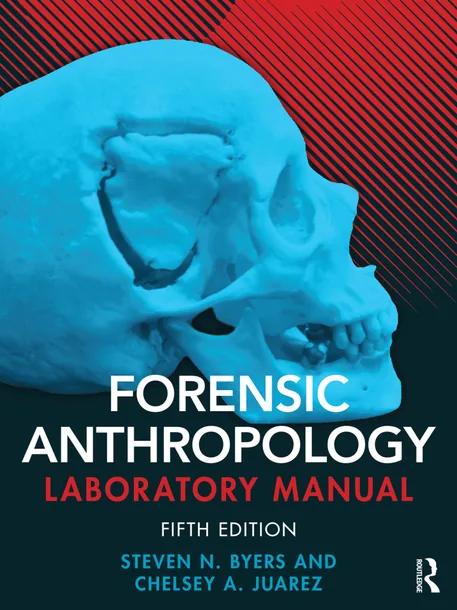
Forensic Anthropology Laboratory Manual
by Steven N. Byers, Chelsey A. Juarez
5th Edition
Publisher: Routledge
Book Details
| Print ISBN | 9781032627243 |
| eText ISBN | 9781040113066 |
| Publisher | Routledge |
| Publishing Year | 2025 |
| Edition | 5th Edition |
| Language | English |
| Pages | 132 |
The Forensic Anthropology Laboratory Manual, 5th Edition, provides university students with practical experience in core forensic anthropology techniques. Developed to accompany the sixth edition of the textbook Introduction to Forensic Anthropology, the manual explains essential protocols while reinforcing observational and analytical methods through structured exercise worksheets.
Practical activities center on determining medicolegal significance, inventorying recovered skeletal remains, and estimating biological profiles. Course exercises also guide students in calculating postmortem intervals and identifying distinct classes of skeletal trauma.
To support diverse classroom learning environments, most chapters provide online resources that can serve as practical alternatives to physical skeletons or traditional laboratory materials.
Table of Contents
Chapter 1: Introduction
- • Learning Objectives
- • Expected Outcomes
- • Minimum Materials
- • Optional Materials
Chapter 2: Bones, Teeth, Measurements and Methods
- • Learning Objectives
- • Expected Outcomes
- • Minimum Materials
- • Optional Materials
- • Basic Terms
- • Exercise 2.1: Cranial Skeleton
- • Exercise 2.2: Axial Skeleton
- • Exercise 2.3: Appendicular Skeleton: Upper Limbs
- • Exercise 2.4: Appendicular Skeleton: Lower Limbs
- • Exercise 2.5: Human Odontology
- • Note to Instructors
- • Exercise Worksheets
- • Exercise 2b.1 Basic Instruments and Their Use
- • Exercise 2b.2 Metric System and U.S. Measure
Chapter 3: Establishing Medicolegal Significance
- • Learning Objectives
- • Expected Outcomes
- • Bones and Teeth versus Other Materials Exercise
- • Minimum Materials
- • Optional Materials
- • Human Versus Nonhuman Exercise
- • Recent Versus Nonrecent Exercise
- • Exercise 3.1: Distinguishing Bone and Teeth from Other Material
- • Exercise 3.2: Distinguishing Human from Nonhuman Remains
- • Exercise 3.3: Distinguishing Recent from Nonrecent Remains
- • Note to Instructors
- • Exercise Worksheets
Chapter 4: Recovery Scene Methods
- • Learning Objectives
- • Expected Outcomes
- • Minimum Materials
- • Optional Materials
- • Exercise 4: Surface-Deposited Body (Outdoor or Indoor)
- • Note to Instructors
- • Exercise Worksheets
Chapter 5: Estimating Postmortem Interval
- • Learning Objectives
- • Expected Outcomes
- • Minimum Materials
- • Optional Materials
- • Exercise 5.1: Estimating PMI Using General Decomposition
- • Exercise 5.2: Estimating PMI Using TBS and ADD
- • Exercise 5.3: Estimating PMI Using TADS and ADD
- • Exercise 5.4: Estimating PMI Using Animal Scavenging
- • Exercise 5.5: Estimating PMI Using Deterioration of Clothing and Other Materials
- • Note to Instructors
- • Exercise Worksheets
Chapter 6: Initial Treatment and Examination
- • Learning Objectives
- • Expected Outcomes
- • Minimum Materials
- • Optional Materials
- • Exercise 6.1: Reconstruction
- • Exercise 6.2: Sorting
- • Exercise 6.3: Reassembly
- • Exercise 6.4: Inventorying Remains
- • Exercise 6.5: Highly Fragmented Remains
- • Note to Instructors
- • Exercise Worksheets
Chapter 7: Attribution of Population Affinity
- • Learning Objectives
- • Expected Outcomes
- • Minimum Materials
- • Optional Materials
- • Exercise 7.1: Estimating Population Affinity Using the Frequencies of Ordinally Scored Cranial Anthroposcopic Traits
- • Exercise 7.2: Estimating Population Affinity Using Dental Characteristics
- • Exercise 7.3: Estimating Population Affinity Using Discriminant Function Analysis of Dental Traits
- • Exercise 7.4: Estimating Population Affinity Using Osteometry
- • Note to Instructors
- • Exercise Worksheets
Chapter 8: Attribution of Sex
- • Learning Objectives
- • Expected Outcomes
- • Minimum Materials
- • Optional Materials
- • Exercise 8.1: Estimating Sex Using Pelvic Anthroposcopy
- • Exercise 8.2: Estimating Sex Using Cranial Anthroposcopy
- • Exercise 8.3: Estimating Sex Using MorphoPASSE
- • Exercise 8.3: Estimating Sex Using Cranial Metrics: Discriminant Functions
- • Exercise 8.4: Estimating Sex Using Postcranial Metrics
- • Note to Instructors
- • Exercise Worksheets
Chapter 9: Estimation of Age at Death
- • Learning Objectives
- • Expected Outcomes
- • Minimum Materials
- • Optional Materials
- • SUBADULTS
- • Exercise 9.1: Estimating Age at Death Using Long Limb Bone Measurements
- • Exercise 9.2: Estimating Age at Death Using Union of Primary Ossification Centers
- • Exercise 9.3: Estimating Age at Death Using Tooth Formation and Eruption
- • Exercise 9.4: Estimating Age at Death Using Epiphyseal Union
- • ADULTS
- • Exercise 9.5: Estimating Age at Death Using Symphyseal Surface
- • Exercise 9.6: Estimating Age at Death Using Auricular Surface of the Os Coxae
- • Exercise 9.7: Estimating Age at Death Using Sternal Rib Ends
- • Note to Instructors
- • Exercise Worksheets
Chapter 10: Calculation of Stature
- • Learning Objectives
- • Expected Outcomes
- • Minimum Materials
- • Optional Materials
- • Exercise 10.1: Calculating Stature Using Long Limb Bones
- • Exercise 10.2: Calculating Stature Using the Fully Method
- • Exercise 10.3: Calculating Stature From Fleshed Body Segments
- • Exercise 10.4: Adjustments to Stature Calculations
- • Note to Instructors
- • Exercise Worksheets
Chapter 11: Death, Trauma, and the Skeleton
- • Learning Objectives
- • Expected Outcomes
- • Minimum Materials
- • Optional Materials
- • Exercise 11.1: Basics of Bone Trauma
- • Exercise 11.2: Forces Causing Trauma
- • Exercise 11.3: Types of Trauma
- • Exercise 11.4: Timing of Bone Injury
- • Note to Instructors
- • Exercise Worksheets
Chapter 12: Projectile Trauma
- • Learning Objectives
- • Expected Outcomes
- • Minimum Materials
- • Optional Materials
- • Exercise 12: Analysis of Projectile Wounds
- • Note to Instructors
- • Exercise Worksheets
Chapter 13: Blunt Trauma
- • Learning Objectives
- • Expected Outcomes
- • Minimum Materials
- • Optional Materials
- • Exercise 13.1: Analyzing Blunt Trauma to the Skull
- • Exercises 13.2A and 13.2B: Analyzing Blunt Trauma to the Postcranial Bones
- • Note to Instructors
- • Exercise Worksheets
Chapter 14: Sharp and Miscellaneous Trauma
- • Learning Objectives
- • Expected Outcomes
- • Minimum Materials
- • Optional Materials
- • Exercise 14.1: Analyzing Sharp Trauma
- • Exercise 14.2: Analyzing Strangulation
- • Note to Instructors
- • Exercise Worksheets
Chapter 15: Antemortem Skeletal Conditions
- • Learning Objectives
- • Expected Outcomes
- • Minimum Materials
- • Optional Materials
- • Exercise 15.1: Analyzing Pathological Conditions
- • Exercise 15.2: Analyzing Skeletal Anomalies
- • Exercise 15.3: Analyzing Occupational Stress Markers
- • Note to Instructors
- • Exercise Worksheets
Chapter 16: Postmortem Changes to Bone
- • Learning Objectives
- • Expected Outcomes
- • Minimum Materials
- • Optional Materials
- • Exercise 16.1: Analyzing Saw Marks
- • Exercise 16.2: Analyzing Other Postmortem Damage
- • Note to Instructors
- • Exercise Worksheets
Chapter 17: Additional Aspects of Individualization
- • Learning Objectives
- • Expected Outcomes
- • Minimum Materials
- • Optional Materials
- • Exercise 17.1: Facial Approximation
- • Exercise 17.2: Computerized Facial Reconstruction
- • Note to Instructors
- • Exercise Worksheets
Chapter 18: Obtaining an Identification
- • Learning Objectives
- • Expected Outcomes
- • Minimum Materials
- • Optional Materials
- • Exercise 18.1: Identification From Radiographs
- • Exercise 18.2: Identification From Photographic Superimposition
- • Note to Instructors
- • Exercise Worksheets
Chapter 19: Conclusion
- • Learning Objectives
- • Expected Outcomes
- • Minimum Materials
- • Optional Materials
- • Exercise 19.1: Forensic Anthropology Report
- • Exercise 19.2: Expert Witness Testimony Evaluation
- • Note to Instructors
- • Exercise Worksheets
Customer Reviews
0.0
0 reviews
No reviews yet. Be the first to review this book!
Write a Review
Reviewed by GradeFocus Editorial Team
▶Research Sources (1)
Related Books
Forensic Serology
Shanan S. Tobe
Human Skeletal Remains
Teresa A. White
Investigative and Predictive DNA Testing
Hirak Ranjan Dash
Mathematical Methods for Accident Reconstruction
Harold Franck
Forensic Science and Quality Management
Roberto C. Parra

Criminalistics: Forensic Science, Crime, and Terrorism
James E. Girard