Book Details
| Print ISBN | 9780136845263 |
| eText ISBN | 9780136845348 |
| Publisher | Pearson |
| Publishing Year | 2022 |
| Edition | 3rd Edition |
| Language | English |
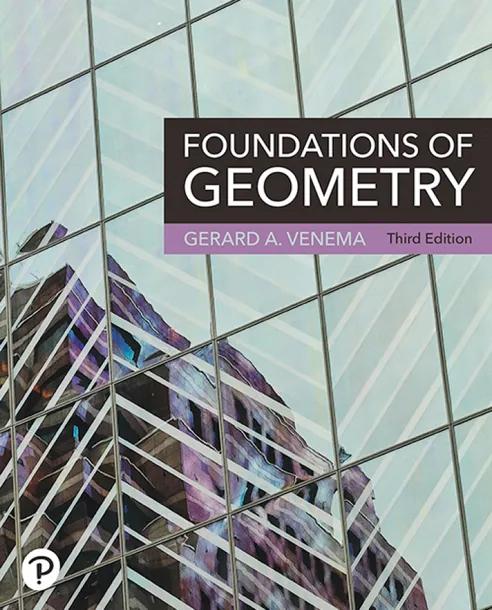
Foundations of Geometry, 3rd Edition, by Gerard A. Venema, is an undergraduate mathematics textbook planned to enrich the education of mathematics majors and encourage a smooth transition into advanced courses.
The volume provides comprehensive coverage of most of Euclid's Elements, including almost all the material across the first six books. Core areas of study include axiomatic systems, neutral geometry, Euclidean geometry, and non-Euclidean systems such as hyperbolic geometry, alongside non-traditional models and curved spaces.
For the 2022 edition, the textbook incorporates national standards and recommendations regarding geometry for the preparation of high school mathematics teachers. These additions encourage future educators to connect collegiate mathematics courses with the secondary classes they will later teach.
Table of Contents
Chapter 1: Prologue: Euclid's Elements
- • 1.1 Geometry before Euclid
- • 1.2 The Logical Structure of Euclid's Elements
- • 1.3 The Historical Significance of Euclid's Elements
- • 1.4 A Look at Book I of the Elements
- • 1.5 A Critique of Euclid's Elements
- • 1.6 A New View of the Foundations
- • 1.7 Some Final Observations about the Elements
Chapter 2: Axiomatic Systems and Incidence Geometry
- • 2.1 The Structure of an Axiomatic System
- • 2.2 An Example: Incidence Geometry
- • 2.3 The Parallel Postulates in Incidence Geometry
- • 2.4 Axiomatic Systems and the RealWorld
- • 2.5 Theorems, Proofs, and Logic
- • 2.6 Some Theorems from Incidence Geometry
Chapter 3: A System of Axioms for Plane Geometry
- • 3.1 The Undefined Terms and Two Fundamental Axioms
- • 3.2 Distance and the Ruler Postulate
- • 3.3 The Plane Separation Postulate
- • 3.4 Angle Measure and the Protractor Postulate
- • 3.5 The Crossbar Theorem and the Linear Pair Theorem
- • 3.6 The Side-Angle-Side Postulate
- • 3.7 The Parallel Postulates and Models for Neutral Geometry
Chapter 4: Neutral Geometry
- • 4.1 The Exterior Angle Theorem
- • 4.2 Triangle Congruence Conditions
- • 4.3 Three Inequalities for Triangles
- • 4.4 The Alternate Interior Angles Theorem
- • 4.5 The Saccheri-Legendre Theorem
- • 4.6 Quadrilaterals
- • 4.7 Statements Equivalent to the Euclidean Parallel Postulate
- • 4.8 Rectangles and Defect
- • 4.9 The Universal Hyperbolic Theorem
Chapter 5: Euclidean Geometry
- • 5.1 Basic Theorems of Euclidean Geometry
- • 5.2 The Parallel Projection Theorem
- • 5.3 Similar Triangles
- • 5.4 The Pythagorean Theorem
- • 5.5 Trigonometry
- • 5.6 Exploring the Geometry of Euclidean Triangles
Chapter 6: Hyperbolic Geometry
- • 6.1 Basic Theorems of Hyperbolic Geometry
- • 6.2 Common Perpendiculars
- • 6.3 The Angle of Parallelism
- • 6.4 Limiting Parallel Rays
- • 6.5 Asymptotic Triangles
- • 6.6 The Classification of Parallels
- • 6.7 The Critical Function
- • 6.8 The Defect of a Triangle
- • 6.9 Is the Real World Hyperbolic?
Chapter 7: Area
- • 7.1 The Neutral Area Postulate
- • 7.2 Area in Euclidean Geometry
- • 7.3 Dissection Theory
- • 7.4 Proof of the Dissection Theorem in Euclidean Geometry
- • 7.5 The Associated Saccheri Quadrilateral
- • 7.6 Area and Defect in Hyperbolic Geometry
- • 7.7 The Euclidean Area Postulate Reconsidered
Chapter 8: Circles
- • 8.1 Circles and Lines in Neutral Geometry
- • 8.2 Circles and Triangles in Neutral Geometry
- • 8.3 Circles in Euclidean Geometry
- • 8.4 Circular Continuity
- • 8.5 Circumference and Area of Euclidean Circles
- • 8.6 Exploring Euclidean Circles
Chapter 9: Constructions
- • 9.1 Compass and Straightedge Constructions in Geometry
- • 9.2 Neutral Constructions
- • 9.3 Euclidean Constructions
- • 9.4 Construction of Regular Polygons
- • 9.5 Area Constructions
- • 9.6 Three Impossible Constructions
Chapter 10: Transformations
- • 10.1 Isometries of the Plane
- • 10.2 Rotations, Translations, and Glide Reflections
- • 10.3 Classification of Euclidean Motions
- • 10.4 Classification of Hyperbolic Motions
- • 10.5 A Transformational Approach to the Foundations
- • 10.6 Similarity Transformations in Euclidean Geometry
- • 10.7 Euclidean Inversions in Circles
Chapter 11: Models
- • 11.1 The Cartesian Model for Euclidean Geometry
- • 11.2 The Poincaré Disk Model for Hyperbolic Geometry
- • 11.3 Other Models for Hyperbolic Geometry
- • 11.4 Models for Elliptic Geometry
Chapter 12: Polygonal Models and the Geometry of Space
- • 12.1 Curved Surfaces
- • 12.2 Approximate Models for the Hyperbolic Plane
- • 12.3 Geometric Surfaces
- • 12.4 The Geometry of the Universe
- • 12.5 Conclusion
- • 12.6 Further Study
- • 12.7 Templates
Chapter A: Euclid's Book I
- • A.1 Definitions
- • A.2 Postulates
- • A.3 Common Notions
- • A.4 Propositions
Chapter B: Systems of Axioms for Geometry
- • B.1 Hilbert's Axioms
- • B.2 Birkhoff's Axioms
- • B.3MacLane'sAxioms
- • B.4 SMSG Axioms
- • B.5 UCSMP Axioms
Chapter C: The Postulates Used in This Book
- • C.1 Criteria Used in Selecting the Postulates
- • C.2 Statements of the Postulates
- • C.3 Logical Relationships
Chapter D: The Van Hiele Model of the Development of Geometric Thought
Chapter E: Set Notation and the Real Numbers
- • E.1 Some Elementary Set Theory
- • E.2 Axioms for the Real Numbers
- • E.3 Properties of the Real Numbers
- • E.4 One-to-One and Onto Functions
- • E.5 Continuous Functions
Chapter F: Hints for Selected Exercises
Customer Reviews
0.0
0 reviews
No reviews yet. Be the first to review this book!
Write a Review
Reviewed by GradeFocus Editorial Team