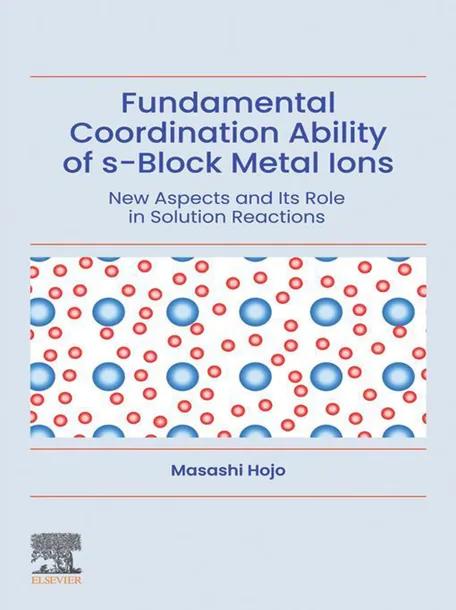
Fundamental Coordination Ability of s-Block Metal Ions
New Aspects and Its Role in Solution Reactions
by Masashi Hojo
1st Edition
Publisher: Elsevier
Book Details
| Print ISBN | 9780128219805 |
| eText ISBN | 9780128219812 |
| Publisher | Elsevier |
| Publishing Year | 2025 |
| Edition | 1st Edition |
| Language | English |
| Pages | 487 |
In Fundamental Coordination Ability of s-Block Metal Ions (1st Edition), Masashi Hojo presents a dedicated reference volume focused on the reaction processes and coordination characteristics of s-block metal compounds. The work analyzes crystallization and re-dissolution phenomena to clarify how light metal cations behave in liquid media. This text provides structured theoretical support for inorganic chemists, solution chemists, and main group metal specialists.
The thematic coverage evaluates host-guest structures involving s-block metal ions and crown ethers, building upon C. J. Pedersen's 1967 discovery. It details recent advancements in synthesizing light metal coordination polymers while examining primary ionic reaction pathways across organic and inorganic solvent systems.
As a defining verified feature, the volume explains salt effects and anomalous solution behavior through the coordination interactions of s-block metal ions in liquid environments. The publication provides targeted research material for specialists in supramolecular chemistry, analytical chemistry, and physical solution chemistry.
Table of Contents
Chapter 1: Host-Guest Chemistry of s-Block Metal Ions and the Development of Supramolecule Chemistry
Chapter 2: Light Metal Coordination Polymers
Chapter 3: Voltammetric Studies on Chemical Interactions of Alkali Metal Ions with Acetate and Benzoate Ions in Acetonitrile
Chapter 4: Salt Effects on Proton Transfer from Nitrophenols to Amine or Pyridine Bases in Acetonitrile
Chapter 5: Elucidation of Salt Effects on the Indicator Acidity in Acetonitrile
Chapter 6: Direct Chelate Formation between Alkaline Earth Metal Ions and 1-(2-Pyridylazo)-2-naphthol and Related Reactions in Acetonitrile
Chapter 7: Higher Ion–Aggregates in Low Permittivity Media
Chapter 8: Conductivity and Spectroscopic Studies of Ion Aggregates in Higher Permittivity Media
Chapter 9: UV–Visible and {sup|1}H or {sup|13}C NMR Spectroscopic Studies on the Specific Interaction between Lithium and Tropolonate Ions in Acetonitrile or Other Solvents
Chapter 10: Interaction between Protons or Alkaline Earth Metal Ions and the Benzoate Ion in Acetonitrile Studied by UV–visible, {sup|1}H and {sup|13}C NMR Spectroscopy
Chapter 11: Precipitation and Re-Dissolution of s-Block Metal Salts Based on Coordination and “Reverse Coordination” with Aromatic Dicarboxylate, Sulfonate, or Disulfonate ions in Acetonitrile
Chapter 12: Specific Coordination Phenomena of Alkaline Earth Metal Ions with Mono-, Di-, and Trisulfonates in Alcohols and Binary Solvents
Chapter 13: Strong Complexing Ability of Alkali Metal and Alkaline Earth Metal Ions with Organic Phosphinate and Phosphates
Chapter 14: Chemical Interaction between Alkaline Earth Metal Ions and the Benzoate or 2,6-Naphthalenedicarboxylate Ion in Acetonitrile and Alcohols
Chapter 15: Coordination and “Reverse Coordination” of Alkali Metal, Alkaline Earth Metal, and Indium Ions with 1,3,6-Naphthalenetrisulfonate Ion in Protic and Aprotic Solvents
Chapter 16: {sup|1}H and {sup|13}C NMR Detection of the Carbocations or Zwitterions from Fluoran Leuco Dyes or Trityl Chlorides on the Addition of s-Block Metal Ions
Chapter 17: Alternative Mechanism of S{sub|N}1 Solvolysis Based on the Direct Chemical Interaction between s-Block Metal Cations and Leaving–Group Anions
Chapter 18: Discovery of Enhanced Oxidation Mechanism of Dilute Nitric Acid (and Pure Gold Dissolution in Seawater)
Chapter 19: Pure Gold Dissolution by the Oxidation Ability of Dilute Nitric and Nitrous Acids in the Presence of Abundant Metal Salts
Chapter 20: Pure Gold and Stainless Steel Dissolution or Corrosion in Dilute Halic Acids (HXO{sub|3}, X = Cl, Br, I) Solution containing Abundant Halide Ions
Chapter 21: Elucidation of Specific Ion Association in Nonaqueous Solution Environments
Customer Reviews
0.0
0 reviews
No reviews yet. Be the first to review this book!
Write a Review
Reviewed by GradeFocus Editorial Team
▶Research Sources (15)
- [PDF] Fundamental Coordination Ability of s-Block Metal Ions by ...
- Fundamental Coordination Ability of s-Block Metal Ions | Angus ...
- Fundamental Coordination Ability of s-Block Metal Ions - Masashi ...
- Hornbook Treatises - Study Aids Collection | Search
- Sign In - MyLibrary | Hal Leonard Online
- Please verify you are human - Captcha
- Interaction between protons or alkaline earth metal ions and the ...
- Thompson Learn.
- Fundamental Coordination Ability of s-Block Metal Ions - Elsevier
- Fundamental Coordination Ability of s-Block Metal Ions | ScienceDirect
- Fundamental Coordination Ability of s-Block Metal Ions
- Fundamental coordination ability of s-block metal ions - Ryefield Books
- Fundamental Coordination Ability of s-Block Metal Ions - Shulph Ink
- Fundamental Coordination Ability of s-Block Metal Ions - 9780128219805
- Fundamental Coordination Ability of s-Block Metal Ions: New Aspects ...