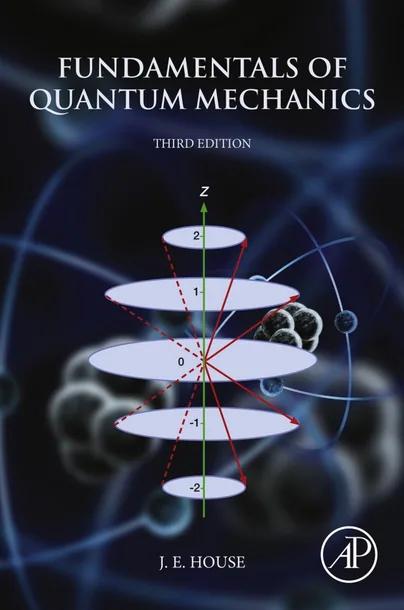
Fundamentals of Quantum Mechanics
by James E. House
3rd Edition
Publisher: Academic Press
Book Details
| Print ISBN | 9780128092422 |
| eText ISBN | 9780128092552 |
| Publisher | Academic Press |
| Publishing Year | 2018 |
| Edition | 3rd Edition |
| Language | English |
| Pages | 372 |
Fundamentals of Quantum Mechanics, 3rd Edition, introduces quantum principles and their applications across chemistry and physics. Author James E. House balances physical theory with practical examples to demonstrate how core concepts explain molecular behavior.
The textbook examines foundational quantum mechanical models, including particles in boxes, the rigid rotor, the harmonic oscillator, barrier penetration, and the hydrogen atom. It relates these principles to molecular structure, chemical bonding, and spectroscopy.
Designed for upper-level undergraduate and graduate students as well as practicing researchers, the text features colorful illustrations throughout. End-of-chapter problems offer opportunities to review and apply theoretical concepts.
Table of Contents
Chapter 1: Origins of Quantum Theory
- • Abstract
- • 1.1 Blackbody Radiation
- • 1.2 The Line Spectrum of Atomic Hydrogen
- • 1.3 Electrons and the Nucleus
- • 1.4 The Bohr Model for the Hydrogen Atom
- • 1.5 The Photoelectric Effect
- • 1.6 Particle-Wave Duality
- • 1.7 The Heisenberg Uncertainty Principle
- • Problems
Chapter 2: The Methods of Quantum Mechanics
- • Abstract
- • 2.1 The Postulates
- • 2.2 The Wave Equation
- • 2.3 Operators
- • 2.4 Eigenvalues
- • 2.5 Wave Functions
- • Problems
Chapter 3: Particles in Boxes
- • Abstract
- • 3.1 The Particle in a One-Dimensional Box
- • 3.2 Separation of Variables
- • 3.3 The Particle in a Three-Dimensional Box
- • 3.4 F-Centers in Crystals
- • 3.5 Solvated Electrons
- • Problems
Chapter 4: The Hydrogen Atom
- • Abstract
- • 4.1 Schrödinger′s Solution to the Hydrogen Atom Problem
- • 4.2 Interpreting the Solutions
- • 4.3 p and d Wave Functions and Orbitals
- • 4.4 Orthogonality
- • 4.5 Approximate Wave Functions and the Variation Method
- • Problems
Chapter 5: Structure and Properties of More Complex Atoms
- • Abstract
- • 5.1 The Helium Atom
- • 5.2 Perturbation Method
- • 5.3 Slater Wave Functions
- • 5.4 Electron Configurations
- • 5.5 Spectroscopic States
- • Problems
Chapter 6: Vibrations and the Harmonic Oscillator
- • Abstract
- • 6.1 The Vibrating Object
- • 6.2 Linear Differential Equations with Constant Coefficients
- • 6.3 Back to the Vibrating Object
- • 6.4 The Quantum Mechanical Harmonic Oscillator
- • 6.5 Series Solutions of Differential Equations
- • 6.6 Back to the Harmonic Oscillator
- • 6.7 Population of States
- • 6.8 Heat Capacity of Metals
- • Problems
Chapter 7: Molecular Rotation and Spectroscopy
- • Abstract
- • 7.1 Rotational Energies
- • 7.2 Quantum Mechanics of Rotation
- • 7.3 Heat Capacities of Gases
- • 7.4 Energy Levels in Gaseous Atoms and Molecules
- • 7.5 Rotational Spectra of Diatomic Molecules
- • Problems
Chapter 8: Bonding and Properties of Diatomic Molecules
- • Abstract
- • 8.1 An Elementary Look at Covalent Bonds
- • 8.2 Some Simple Relationships for Bonds
- • 8.3 The LCAO-MO Method
- • 8.4 Diatomic Molecules of the Second Period
- • 8.5 Overlap and Exchange Integrals
- • 8.6 Heteronuclear Diatomic Molecules
- • 8.7 Symmetry of Molecular Orbitals
- • 8.8 Orbital Symmetry and Reactivity
- • 8.9 Term Symbols
- • Problems
Chapter 9: The Hückel Molecular Orbital Method
- • Abstract
- • 9.1 The Hückel Method
- • 9.2 Determinants
- • 9.3 Solving Polynomial Equations
- • 9.4 Hückel Calculations for Larger Molecules
- • 9.5 Calculations Including Heteroatoms
- • 9.6 Some Triatomic Inorganic Molecules
- • 9.7 Kernels, Repulsion, and Stability
- • 9.8 Band Theory of Metals
- • Problems
Chapter 10: Molecular Structure and Symmetry
- • Abstract
- • 10.1 Valence Bond Description of Molecular Structure
- • 10.2 What Symmetry Means
- • 10.3 Symmetry Elements
- • 10.4 What Point Group Is It?
- • 10.5 Group Theory
- • 10.6 Symmetry of Molecular Orbitals
- • 10.7 Molecular Orbital Diagrams
- • 10.8 The Three-Center Bond
- • 10.9 Orbital Symmetry and Reactivity
- • Problems
Chapter 11: Molecular Spectroscopy
- • Abstract
- • 11.1 Visible and Ultraviolet Spectroscopy
- • 11.2 Electronic Transitions in Molecules
- • 11.3 Photoelectron Spectroscopy
- • 11.4 Determining Bond Lengths in Diatomic Molecules
- • 11.5 Structure Determination
- • 11.6 Types of Bonds Present
- • 11.7 Solvatochromism
- • 11.8 The Hydrogen Bond
- • 11.9 Effects of Hydrogen Bonding on Spectra
- • Problems
Chapter 12: Spectroscopy of Metal Complexes
- • Abstract
- • 12.1 The Effect of Ligands on d Orbitals
- • 12.2 Bands in Electronic Spectra of Complexes
- • 12.3 Interpreting Electronic Spectra of Complexes
- • 12.4 Charge Transfer Absorption
- • 12.5 Back Donation
- • Problems
Chapter 13: Barrier Penetration
- • Abstract
- • 13.1 The Phenomenon of Barrier Penetration
- • 13.2 The Wave Equations
- • 13.3 Alpha Decay
- • 13.4 Tunneling and Superconductivity
- • 13.5 The Scanning Tunneling Microscope
- • 13.6 Spin Tunneling
- • 13.7 Tunneling in Ammonia Inversion
- • Problems
Chapter 14: Comments on Computational Methods
- • Abstract
- • 14.1 The Fundamental Problem
- • 14.2 The Basis Set
- • 14.3 The Extended Hückel Method
- • 14.4 The Hartree-Fock Self-Consistent Field Approach
- • 14.5 Density Functional Theory
- • 14.6 Epilogue
- • Problem
Customer Reviews
0.0
0 reviews
No reviews yet. Be the first to review this book!
Write a Review
Reviewed by GradeFocus Editorial Team