Book Details
| Print ISBN | 9781032101590 |
| eText ISBN | 9781000644081 |
| Publisher | Chapman & Hall |
| Publishing Year | 2023 |
| Edition | 5th Edition |
| Language | English |
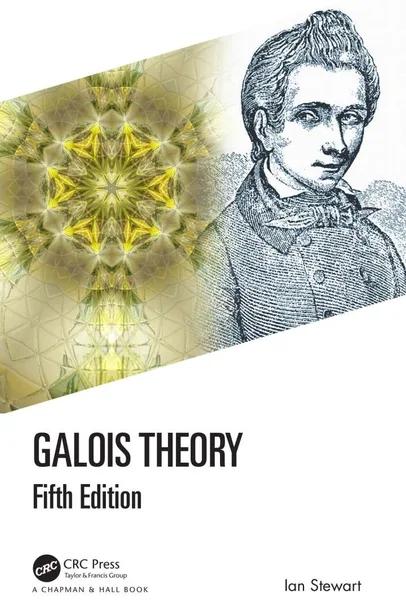
Galois Theory, 5th Edition, by Ian Stewart, is an undergraduate mathematics textbook that introduces classical Galois theory and Galois groups. The text guides modern algebra students through the relationships between polynomial equations and field extensions.
The work covers classical algebra, the factorisation of polynomials, field extensions, and the Galois correspondence. Stewart also examines classical geometric problems, exploring ruler-and-compass constructions in the complex plane alongside their impossibility proofs.
Designed for undergraduate study, the textbook provides pedagogical support with 38 black-and-white illustrations, detailed historical notes, and more than 200 exercises accompanying mathematical formulas, theorems, and proofs.
Table of Contents
Chapter 1: Classical Algebra
- • 1.1. Complex Numbers
- • 1.2. Subfields and Subrings of the Complex Numbers
- • 1.3. Solving Equations
- • 1.4. Solution by Radicals
Chapter 2: The Fundamental Theorem of Algebra
- • 2.1. Polynomials
- • 2.2. Fundamental Theorem of Algebra
- • 2.3. Implications
Chapter 3: Factorisation of Polynomials
- • 3.1. The Euclidean Algorithm
- • 3.2 Irreducibility
- • 3.3. Gauss’s Lemma
- • 3.4. Eisenstein’s Criterion
- • 3.5. Reduction Modulo p.
- • 3.6. Zeros of Polynomials
Chapter 4: Field Extensions
- • 4.1. Field Extensions
- • 4.2. Rational Expressions
- • 4.3. Simple Extensions
Chapter 5: Simple Extensions
- • 5.1. Algebraic and Transcendental Extensions
- • 5.2. The Minimal Polynomial
- • 5.3. Simple Algebraic Extensions
- • 5.4. Classifying Simple Extensions
Chapter 6: The Degree of an Extension
- • 6.1. Definition of the Degree
- • 6.2. The Tower Law
- • 6.3. Primitive Element Theorem
Chapter 7: Ruler-and-Compass Constructions
- • 7.1. Approximate Constructions and More General Instruments
- • 7.2. Constructions in C
- • 7.3. Specific Constructions
- • 7.4. Impossibility Proofs
- • 7.5. Construction From a Given Set of Points
Chapter 8: The Idea Behind Galois Theory
- • 8.1. A First Look at Galois Theory
- • 8.2. Galois Groups According to Galois
- • 8.3. How to Use the Galois Group
- • 8.4. The Abstract Setting
- • 8.5. Polynomials and Extensions
- • 8.6. The Galois Correspondence
- • 8.7. Diet Galois
- • 8.8. Natural Irrationalities
Chapter 9: Normality and Separability
- • 9.1. Splitting Fields
- • 9.2. Normality
- • 9.3. Separability
Chapter 10: Counting Principles
- • 10.1. Linear Independence of Monomorphisms
Chapter 11: Field Automorphisms
- • 11.1. K-Monomorphisms
- • 11.2. Normal Closures
Chapter 12: The Galois Correspondence
- • 12.1. The Fundamental Theorem of Galois Theory
Chapter 13: Worked Examples
- • 13.1. Examples of Galois Groups
- • 13.2. Discussion
Chapter 14: Solubility and Simplicity
- • 14.1. Soluble Groups
- • 14.2. Simple Groups
- • 14.3. Cauchy’s Theorem
Chapter 15: Solution by Radicals
- • 15.1. Radical Extensions
- • 15.2. An Insoluble Quintic
- • 15.3. Other Methods
Chapter 16: Abstract Rings and Fields
- • 16.1. Rings and Fields
- • 16.2. General Properties of Rings and Fields
- • 16.3. Polynomials Over General Rings
- • 16.4. The Characteristic of a Field
- • 16.5. Integral Domains
Chapter 17: Abstract Field Extensions and Galois Groups
- • 17.1. Minimal Polynomials
- • 17.2. Simple Algebraic Extensions
- • 17.3. Splitting Fields
- • 17.4. Normality
- • 17.5. Separability
- • 17.6. Galois Theory for Abstract Fields
- • 17.7. Conjugates and Minimal Polynomials
- • 17.8. The Primitive Element Theorem
- • 17.9. Algebraic Closure of a Field
Chapter 18: The General Polynomial Equation
- • 18.1. Transcendence Degree
- • 18.2. Elementary Symmetric Polynomials
- • 18.3. The General Polynomial
- • 18.5. Solving Equations of Degree Four or Less
- • 18.6. Explicit Formulas
Chapter 19: Finite Fields
- • 19.1. Structure of Finite Fields
- • 19.2. The Multiplicative Group
- • 19.3. Counterexample to the Primitive Element Theorem
- • 19.4. Application to Solitaire
Chapter 20: Regular Polygons
- • 20.1. What Euclid Knew
- • 20.2. Which Constructions are Possible?
- • 20.3. Regular Polygons
- • 20.4. Fermat Numbers
- • 20.5. How to Construct a Regular 17-gon
Chapter 21: Circle Division
- • 21.1. Genuine Radicals
- • 21.2. Fifth Roots Revisited
- • 21.3. Vandermonde Revisited
- • 21.4. The General Case
- • 21.5. Cyclotomic Polynomials
- • 21.6. Galois Group of Q(ζ)= Q
- • 21.7. Constructions Using a Trisector
Chapter 22: Calculating Galois Groups
- • 22.1. Transitive Subgroups
- • 22.2. Bare Hands on the Cubic
- • 22.3. The Discriminant
- • 22.4. General Algorithm for the Galois Group
Chapter 23: Algebraically Closed Fields
- • 23.1. Ordered Fields and Their Extensions
- • 23.2. Sylow’s Theorem
- • 23.3. The Algebraic Proof
Chapter 24: Transcendental Numbers
- • 24.1. Irrationality
- • 24.2. Transcendence of e
- • 24.3. Transcendence of π
Chapter 25: What Did Galois Do or Know?
- • 25.1. List of the Relevant Material
- • 25.2. The First Memoir
- • 25.3. What Galois Proved
- • 25.4. What is Galois Up To?
- • 25.5. Alternating Groups, Especially A5
- • 25.6. Simple Groups Known to Galois
- • 25.7. Speculations about Proofs
- • 25.8. A5 is Unique
Chapter 26: Further Directions
- • 26.1. Inverse Galois Problem
- • 26.2. Differential Galois Theory
- • 26.3. p-adic Numbers
Customer Reviews
0.0
0 reviews
No reviews yet. Be the first to review this book!
Write a Review
Reviewed by GradeFocus Editorial Team