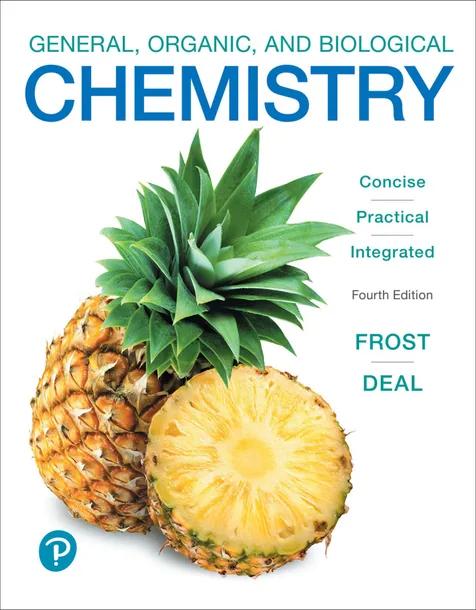
General, Organic, and Biological Chemistry
by Laura D. Frost, S. Todd Deal
4th Edition
Publisher: Pearson
Book Details
| Print ISBN | 9780134988696 |
| eText ISBN | 9780135169681 |
| Publisher | Pearson |
| Publishing Year | 2019 |
| Edition | 4th Edition |
| Language | English |
| Pages | 560 |
General, Organic, and Biological Chemistry, 4th Edition, is a textbook written by Laura D. Frost and S. Todd Deal and published by Pearson in 2019. Developed for introductory one-semester courses, this volume delivers subject coverage spanning general chemistry, organic chemistry, and biological chemistry.
Initial chapters present physical science topics, including atomic structure, isotopes, and medical applications of radioisotopes. Instruction advances to examine ionic and covalent compound formation, electron arrangements, the mole, and molecular polarity. Content then transitions into organic structures, addressing alkanes, functional groups, systematic nomenclature, and isomerism. Further coverage details chemical reactions and energetic principles, including thermodynamics, chemical kinetics, oxidation and reduction, and organic reactions.
Throughout the text, practical applications are integrated to support students in introductory chemistry learning environments. These application features are designed to assist learners pursuing health-focused academic tracks or general science curricula as they build subject knowledge.
Table of Contents
Chapter 1: Chemistry Basics - Matter and Measurement
- • 1.1 Classifying Matter: Pure Substance or Mixture
- • 1.2 Elements, Compounds, and Periodic Table
- • 1.3 How matter Changes
- • 1.4 Math Counts
- • 1.5 Matter: The "Stuff" of Chemistry
- • 1.6 Measuring Matter
Chapter 2: Atoms and Radioactivity
- • 2.1 Atoms and Their Components
- • 2.2 Atomic Number and Mass Number
- • 2.3 Isotopes and Atomic Mass
- • 2.4 Radioactivity and Radioisotopes
- • 2.5 Nuclear Equations and Radioactive Decay
- • 2.6 Radiation Units and Half-Lives
- • 2.7 Medical Applications for Radioisotopes
Chapter 3: Compounds - How Elements Combine
- • 3.1 Electron Arrangements and the Octet Rule
- • 3.2 In Search of an Octet, Part 1: Ion Formation
- • 3.3 Ionic Compounds- Electron Give and Take
- • 3.4 In Search of an Octet, Part 2: Covalent Bond Formation
- • 3.5 The Mole: Counting Atoms and Compounds
- • 3.6 Getting Covalent Compounds into Shape
- • 3.7 Electronegativity and Molecular Polarity
Chapter 4: Introduction to Organic Compounds
- • 4.1 Representing the Structures of Organic Compounds
- • 4.2 Alkanes: The Simplest Organic Compounds
- • 4.3 Families of Organic Compounds- Functional Groups
- • 4.4 Nomenclature of Simple Alkanes
- • 4.5 Isomerism in Organic Compounds
Chapter 5: Chemical Reactions
- • 5.1 Thermodynamics
- • 5.2 Chemical Reactions: Kinetics
- • 5.3 Overview of Chemical Reactions
- • 5.4 Oxidation and Reduction
- • 5.5 Organic Reactions: Condensation and Hydrolysis
- • 5.6 Organic Addition Reactions to Alkenes
Chapter 6: Carbohydrates - Life's Sweet Molecules
- • 6.1 Classes of Carbohydrates
- • 6.2 Function Groups in Monosaccharides
- • 6.3 Stereochemistry in Monosaccharides
- • 6.4 Reactions of Monosaccharides
- • 6.5 Disaccharides
- • 6.6 Polysaccharides
- • 6.7 Carbohydrates and Blood
Chapter 7: States of Matter and Their Attractive Forces: Gas Laws, Solubility, and Applications to the Cell Membrane
- • 7.1 Gases and Gas Laws
- • 7.2 Liquids and Solids: Predicting Properties Through Attractive Forces
- • 7.3 Attractive Forces and Solubility
- • 7.4 Dietary Lipids
- • 7.5 Attractive Forces and the Cell Membrane
Chapter 8: Solution Chemistry - Sugar and Water Do Mix
- • 8.1 Solutions Are Mixtures
- • 8.2 Formation of Solutions
- • 8.3 Chemical Equations for Solution Formation
- • 8.4 Concentration
- • 8.5 Dilution
- • 8.6 Osmosis and Diffusion
- • 8.7 Transport Across
Chapter 9: Acids, Bases, and Buffers in the Body
- • 9.1 Acids and Bases- Definitions
- • 9.2 Strong Acids and Bases
- • 9.3 Chemical Equilibrium
- • 9.4 Weak Acids and Bases
- • 9.5 pH and the pH Scale
- • 9.6 pKa
- • 9.7 The Relationship Between pH, pKa, Drug Solubility, and Diffusion
- • 9.8 Buffers and Blood- The Bicarbonate Buffer System
Chapter 10: Proteins - Workers of the Cell
- • 10.1 Amino Acids- The Building Blocks
- • 10.2 Protein Formation
- • 10.3 The Three-Dimensional Structure of Proteins
- • 10.4 Denaturation of Proteins
- • 10.5 Protein Functions
- • 10.6 Enzymes - Life's Catalysts
- • 10.7 Factors That Affect Enzyme Activity
Chapter 11: Nucleic Acids - Big Molecules with a Big Role
- • 11.1 Components of Nucleic Acids
- • 11.2 Nucleic Acid Formation
- • 11.3 DNA
- • 11.4 RNA and Protein Synthesis
- • 11.5 Putting It Together: The Genetic Code and Protein Synthesis
- • 11.6 Genetic Mutations
- • 11.7 Viruses
- • 11.8 Recombinant DNA Technology
Chapter 12: Food as Fuel - An Overview of Metabolism
- • 12.1 How Metabolism Works
- • 12.2 Metabolically Relevant Nucleotides
- • 12.3 Digestion - From Food Molecules to Hydrolysis Products
- • 12.4 Glycolysis - From Hydrolysis Production to Common Metabolites
- • 12.5 The Citric Acid Cycle - Central Processing
- • 12.6 Electron Transport and Oxidative Phosphorylation
- • 12.7 ATP Production
- • 12.8 Other Fuel Choices
Customer Reviews
0.0
0 reviews
No reviews yet. Be the first to review this book!
Write a Review
Reviewed by GradeFocus Editorial Team
▶Research Sources (10)
- General, Organic, and Biological Chemistry, 4e-9780135169681
- General, Organic, and Biological Chemistry - ISBN 9780135169681
- General, Organic, and Biological Chemistry - BooksRun
- General, Organic, and Biological Chemistry 4th Edition
- General, Organic, and Biological Chemistry | CampusBooks
- General, Organic, and Biological Chemistry - eCampus.com
- General, Organic, and Biological Chemistry | Rent
- General, Organic, and Biological Chemistry
- The Basics of General, Organic, and Biological Chemistry
- General, Organic, and Biological Chemistry (4th Edition)