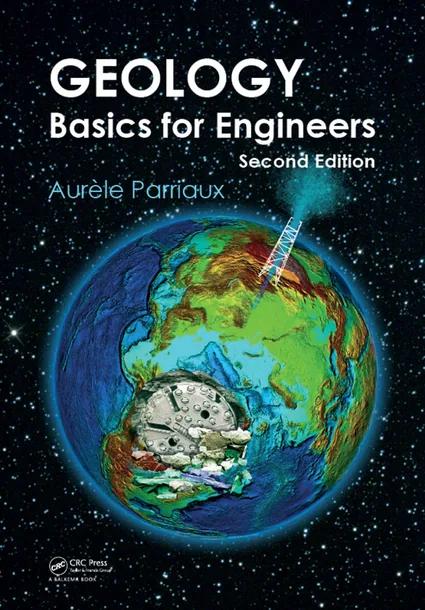
Geology
Basics for Engineers, Second Edition
by Aurèle Parriaux
2nd Edition
Publisher: CRC Press
Book Details
| Print ISBN | 9781138096622 |
| eText ISBN | 9780429854897 |
| Publisher | CRC Press |
| Publishing Year | 2019 |
| Edition | 2nd Edition |
| Language | English |
| Pages | 596 |
Geology: Basics for Engineers, Second Edition, 2nd Edition, is a textbook that instructs engineers on incorporating geological conditions into their planning and construction projects.
The volume covers the physical and chemical characteristics of the Earth, the behavior of water, and the properties of rocks and sediments. It examines planetary transformations across diverse scales of space and time, demonstrating how these processes affect natural resource development, geological hazards, and subsurface pollution management.
Employing a problem-based learning approach, the text assists undergraduate and graduate engineering students as well as professionals in civil engineering, environmental engineering, architecture, and urban planning.
Table of Contents
Chapter 1: The Geology-Engineering Partnership
- • 1.1 Areas of engineering geology
- • 1.2 The history of geology
Chapter 2: The Earth in Space
- • 2.1 The solar system
- • 2.2 The telluric planets
- • 2.3 Giant planets
- • 2.4 Comets
- • 2.5 Meteorites
Chapter 3: The Earth Through Time
- • 3.1 Measurement of geologic time
- • 3.2 Origin of the Universe and matter
- • 3.3 Voyage through time: From the Precambrian to the Quaternary
Chapter 4: Physics of the Globe
- • 4.1 Seismology
- • 4.2 Gravimetry
- • 4.3 Magnetism
- • 4.4 Geothermics
Chapter 5: Rock Forming Minerals
- • 5.1 Crystallography
- • 5.2 Geochemistry
- • 5.3 Practical mineral identification
Chapter 6: Magmatism and Magmatic Rocks
- • 6.1 Composition of the Earth’s layers
- • 6.2 Magmatism and plate tectonics
- • 6.3 From magma to magmatic rocks
- • 6.4 Magmatic events
- • 6.5 Major magmatic rocks
Chapter 7: The Water Cycle
- • 7.1 Water reserves and their exchanges
- • 7.2 The atmosphere
- • 7.3 Surface water
- • 7.4 Groundwater
- • 7.5 Water in the seas and oceans
Chapter 8: The Continental Sedimentary Environment
- • 8.1 Generalities
- • 8.2 Hillslope environments
- • 8.3 The alluvial environment
- • 8.4 The lacustrine environment
- • 8.5 The palustrine environment
- • 8.6 Boreal and polar environments
- • 8.7 The desert environment
Chapter 9: The Oceanic Sedimentary Environment
- • 9.1 Continental margin
- • 9.2 The continental rise and the abyssal plains
Chapter 10: Diagenesis and Properties of Sedimentary Rocks
- • 10.1 Diagenetic processes
- • 10.2 Detrital rocks
- • 10.3 Biogenic rocks
- • 10.4 Evaporite rocks
Chapter 11: Metamorphism
- • 11.1 Transformation processes
- • 11.2 Types of metamorphism
- • 11.3 Principal metamorphic rocks and their properties
- • 11.4 Identification of magmatic, sedimentary and metamorphic rocks
Chapter 12: Tectonics
- • 12.1 Mechanical stresses in the subsurface
- • 12.2 Stress-deformation relationships
- • 12.3 Brittle deformation
- • 12.4 Ductile deformation
- • 12.5 Geometric representation and treatment of structural elements
- • 12.6 The Alps: a tectonic model
Chapter 13: Weathering
- • 13.1 Weathering processes
- • 13.2 Catalog of weathering-prone materials
- • 13.3 Extent of weathering at depth
- • 13.4 Engineering concerns
- • 13.5 Screening for weathering
Chapter 14: Geology’s Role in the Major Issues Facing Society
- • 14.1 Land development and natural resources
- • 14.2 Environmental protection
- • 14.3 Conclusion
Customer Reviews
0.0
0 reviews
No reviews yet. Be the first to review this book!
Write a Review
Reviewed by GradeFocus Editorial Team