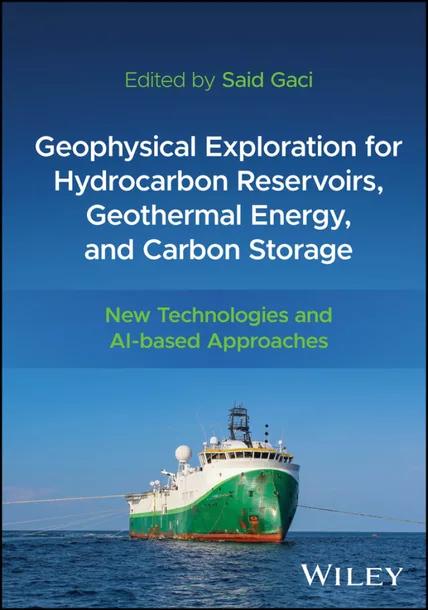
Geophysical Exploration for Hydrocarbon Reservoirs, Geothermal Energy, and Carbon Storage
New Technologies and AI-based Approaches
by Said Gaci
1st Edition
Publisher: Wiley-Blackwell
Book Details
| Print ISBN | 9781394261536 |
| eText ISBN | 9781394261543 |
| Publisher | Wiley-Blackwell |
| Publishing Year | 2025 |
| Edition | 1st Edition |
| Language | English |
| Pages | 528 |
Geophysical Exploration for Hydrocarbon Reservoirs, Geothermal Energy, and Carbon Storage, 1st Edition provides a practice-oriented overview comparing concepts and workflows for geophysical reservoir characterization. Edited by Said Gaci, Director of Scientific and Technical Support to Research at Sonatrach's Central Research and Development Directorate, this 528-page volume addresses subsurface energy exploration across hydrocarbon reservoirs, geothermal energy sites, and large-scale carbon sequestration projects.
The material moves across four main parts. Part I summarizes novel petroleum technologies and global case studies, including gas seepage indicators in continental margins, petrophysical thermobaric modeling in Transcarpathia, and resource potential in the Mid-Continent Rift. Part II combines seismic and non-invasive surveying methods to achieve multiscale characterization. Part III details artificial intelligence applications for remote exploration, rock typing, and fluid prediction.
Part IV demonstrates adapting established hydrocarbon exploration methodologies to geothermal energy and underground carbon dioxide storage. The text supports the professional needs of geologists, geoengineers, geophysicists, and fossil fuel specialists managing energy transition tasks.
Table of Contents
Chapter 1: Gas Seepage in Marginal Structures as Additional Shallow and Deep Hydrocarbon Systems Indicator (Some of Recent FR Scanning Results)
- • 1.1 Introduction
- • 1.2 General Principles and Methods
- • 1.3 Gas Fluids as Additional Hydrocarbon Processes Indicator in Some Continental Margin Structures
- • 1.4 Conclusions
Chapter 2: The Role of the LVZ and of Increased Seismicity in the Localization of Abiogenic HC in the Crystalline Crust of Transcarpathia
- • 2.1 Introduction
- • 2.2 Basic Principles of Petrophysical Thermobaric Modeling
- • 2.3 Influence of ÐÒ-Regimes on the Elastic Characteristics and Density of Rocks
- • 2.4 The LVZs in the Crystalline Crust as Zones of Increased Porosity of Mineral Matter
- • 2.5 A Comparison of Experimental Data and Geophysical Observations
- • 2.6 Geological Interpretation of the PTBM Results
- • 2.7 The Nature of LVZ along the DSS Profile (RP-17) Using the PTBM Methodology
- • 2.8 Elastic Characteristics of the Mineral Substance along the DSS Profile (RP-17)
- • 2.9 Conclusions
Chapter 3: Precambrian Mid-Continent Rift Potential for Hosting Numerous Helium and Hydrogen Accumulations, Central USA
- • 3.1 Introduction
- • 3.2 The Formation of the Mid-Continent Rift System
- • 3.3 Geology
- • 3.4 Wells of Interest
- • 3.5 Trap and Seal
- • 3.6 Gravity/Magnetics
- • 3.7 Seismic
- • 3.8 Oil and Gas Exploration and Production
- • 3.9 Iron and Base Metals
- • 3.10 Impact Craters
- • 3.11 Helium
- • 3.12 Hydrogen
- • 3.13 Summary
Chapter 4: Production from Desmoinesian and Atokan Age Coalbed Methane and Carbonaceous Mudstone and Their Relationship to Structure and Geologic History of the Cherokee Basin, Kansas and Oklahoma, USA
- • 4.1 Introduction
- • 4.2 Geology
- • 4.3 Production
- • 4.4 Drilling and Completion Methods
- • 4.5 Jefferson-Sycamore Area
- • 4.6 Discussion
Chapter 5: Geophysical Research and Monitoring Within the Framework of a Block-Layered Model with Inclusions of a Hierarchical Structure
- • 5.1 Review
- • 5.2 Conclusions
Chapter 6: A Review on Shear Wave Velocity Estimation Methods
- • 6.1 Introduction
- • 6.2 Empirical Relationships for Estimating S-Wave Velocity
- • 6.3 Intelligent Systems for Estimating S-Wave Velocity
- • 6.4 Rock Physics Models for Estimating S-Wave Velocity
- • 6.5 Example
- • 6.6 Conclusions
Chapter 7: Geomechanics in Petroleum Exploration, Development, and Energy Transition
- • 7.1 Introduction
- • 7.2 Role of Geomechanics in Exploration and Development
- • 7.3 Enhancing Reservoir Performance Through Geomechanics
- • 7.4 Predictive Analyses and Production Optimization
- • 7.5 Unconventional Hydrocarbon Reservoirs and Geomechanics
- • 7.6 Geomechanics in Geological Carbon Storage
- • 7.7 Geomechanics of Hydrogen Storage and Production
- • 7.8 Conclusions
Chapter 8: Size Scaling and Spatial Clustering of Natural Fracture Networks Using Fractal Analysis
- • 8.1 Introduction
- • 8.2 Geological Settings
- • 8.3 Methods and Approaches
- • 8.4 Fractal Analysis
- • 8.5 Conclusions
Chapter 9: Application of Seismic Attributes on Digital Elevation Model: Fractures Detection and Reservoir Implication
- • 9.1 Introduction
- • 9.2 Problematic
- • 9.3 Workflow and Methodology
- • 9.4 Fault Detection Techniques
- • 9.5 Fault Analysis
- • 9.6 Fracture Intensity and Density Analysis
- • 9.7 Fracture Connectivity, Permeability, and Wavelet Analysis
- • 9.8 Discussion
- • 9.9 Conclusions
Chapter 10: Structural Analysis and Fracture Kinematics Using Seismic 2D and Geological Maps
- • 10.1 Introduction
- • 10.2 Material and Methods
- • 10.3 Geological Settings
- • 10.4 Gravity Data
- • 10.5 Structural Analysis
- • 10.6 Seismic Data Analysis
- • 10.7 Fault Analysis
- • 10.8 Conclusions
Chapter 11: A New Method for Reservoir Fracture Characterization and Modeling Using Surface Analog
- • 11.1 Introduction
- • 11.2 Methodology
- • 11.3 Geological Background
- • 11.4 Material and Methods
- • 11.5 Data Analysis
- • 11.6 3D Fracture Models
- • 11.7 Discussion and Conclusions
Chapter 12: An Integrated Workflow for Multiscale Fracture Analysis in Reservoir Analog
- • 12.1 Introduction
- • 12.2 Geological Background
- • 12.3 Material and Method
- • 12.4 Fracture Characterization
- • 12.5 Fracture Analysis
- • 12.6 Fractal Analysis
- • 12.7 3D Fault Models
- • 12.8 Discussion
- • 12.9 Conclusions
Chapter 13: Exploring the Depths: Satellite Image Processing and Artificial Intelligence in the Oil and Gas Industry
- • 13.1 Introduction
- • 13.2 Overview of Satellite Technology
- • 13.3 Evolution of Satellite Technology in the Oil and Gas Industry
- • 13.4 Satellite Image Processing Techniques
- • 13.5 Artificial Intelligence in Satellite Imagery Processing
- • 13.6 Practical Applications and AI in the Oil and Gas Industry
- • 13.7 Conclusions
Chapter 14: Modern AI Usage in the Oil and Gas Industry for Reservoir Characterization and Lithofacies Forecasting (Rock Typing)
- • 14.1 Introduction
- • 14.2 Workflow of Rock Typing Using Machine Learning
- • 14.3 Application
- • 14.4 Conclusions
Chapter 15: Logging-Data-Driven Fluid Prediction in Clastic Reservoir Based on Fractal Attributes and Machine Learning Methods
- • 15.1 Introduction
- • 15.2 Studied Dataset
- • 15.3 Overview of Fractal Analysis Steps Employed in Geophysical Well Logs Study
- • 15.4 Overview of Employed Machine Learning Methods
- • 15.5 Model Evaluation
- • 15.6 Results and Discussion
- • 15.7 Conclusions
Chapter 16: Unlocking Deeper Insights: Using Machine Learning to Predict Dynamic Shear Wave Slowness from Well Logs
- • 16.1 Introduction
- • 16.2 Studied Wells and Dataset
- • 16.3 Overview of Employed Machine Learning Methods
- • 16.4 Model Evaluation
- • 16.5 Results and Discussion
- • 16.6 Conclusions
Chapter 17: Energy Transition and the Role of AI: Statistics, Trends, and Implications
- • 17.1 Introduction
- • 17.2 Objectives for the Energy Transition
- • 17.3 Emerging Trends of Energy Transition and AI
- • 17.4 Implications of Leveraging AI in Energy Transition
- • 17.5 Challenges to Apply AI in Renewable Energy Sector
- • 17.6 Conclusions
Chapter 18: On the Importance of Integrating Geomodeling in Geothermal Studies
- • 18.1 Introduction
- • 18.2 Geology of Geothermal Provinces
- • 18.3 Exploration of Geothermal Reservoirs
- • 18.4 Modeling the Subsurface of Geothermal Reservoirs
- • 18.5 Concepts of 3D Geocellular Modeling
- • 18.6 Geophysical Modeling with the 3D Geocellular Grid
- • 18.7 Faults and Fracture Network Modeling with the 3D Geocellular Grid
- • 18.8 Updating the Property Models with Integrated Workflows
- • 18.9 Conclusions
Chapter 19: Advancements, Challenges, and Outlook of Geothermal Reservoir Operations
- • 19.1 Introduction
- • 19.2 Geomechanical Considerations of Geothermal Reservoirs
- • 19.3 Drilling and Well Completion Technologies
- • 19.4 Production and Injection Optimization
- • 19.5 Future Directions and Research Needs
- • 19.6 Environmental and Social Considerations for Geothermal Energy Development
Chapter 20: Multiscale Reservoir Characterization of a CO 2 Storage Aquifer: Mineralogical, Geomechanical, and Petrophysical Analyses for a CCS Project in North Dakota?
- • 20.1 Introduction
- • 20.2 CCS Overview
- • 20.3 Case Study: Carbon Storage in the Broom Creek Saline Aquifer, Williston Basin, North Dakota
- • 20.4 Conclusions
Chapter 21: Anthropogenic Carbon Sequestration into the Subsurface: Caveats and Pitfalls
- • 21.1 Introduction
- • 21.2 CO 2 Incentives
- • 21.3 Chemistry
- • 21.4 Carbon Dioxide
- • 21.5 Potential Sequestration Locations
- • 21.6 Sequestration in Hydrocarbon and Carbon Dioxide Reservoirs
- • 21.7 Risk Assessment Analysis and Characterization of a Reservoir for CO 2 Sequestration
- • 21.8 Sequestration in Saline Aquifers
- • 21.9 Sequestration in Coal Seams
- • 21.10 Sequestration in Carbonaceous Mudstones
- • 21.11 Mineral Sequestration
- • 21.12 Sequestration in Oceans
Customer Reviews
0.0
0 reviews
No reviews yet. Be the first to review this book!
Write a Review
Reviewed by GradeFocus Editorial Team
▶Research Sources (15)
- Geophysical Exploration for Hydrocarbon Reservoirs ...
- Geophysical Exploration for Hydrocarbon Reservoirs ...
- Self-Help
- Study Aids Collection | Search
- Sign In - MyLibrary | Hal Leonard Online
- primepublishingbooks
- Said GACI - Head of Scientific & Technical Support for R&D
- AI-Based Modeling: Techniques, Applications and Research ...
- (PDF) Agent-Based Hybrid AI Models and Technologies
- Hybrid AI Integrating GenAI and 'Traditional' AI Approaches
- Top 11 AI Technologies & Trends in 2025
- New Trends in Artificial Intelligence and Technology
- Five AI technologies
- Top 11 New Technologies In AI: Exploring The Latest Trends
- 11 New Technologies in AI: All Trends of 2025-2026